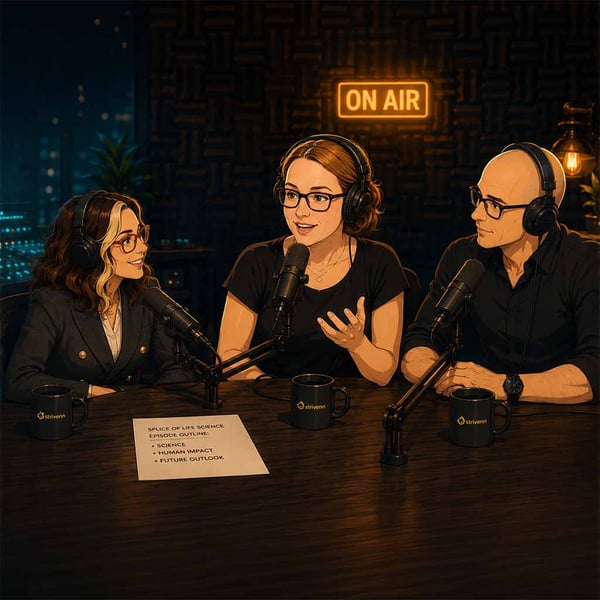
If you are a scientist-turned-marketer trying to stop scattergun outreach and start generating real revenue, this episode is for you. In 30 minutes we unpack segmentation, ideal customer profiles and why ICPs are not the same thing as personas. Practical, evidence led and ready to use.
Shownotes
Most life science marketers confuse ideal customer profiles with personas, costing them 37% of their marketing budget according to Gartner. These are fundamentally different tools that serve different purposes.
This episode is for biotech startup marketers who want to stop wasting budget on the wrong audiences and start targeting with precision. Matt Wilkinson and Jasmine Gruia-Gray break down the critical difference between ICPs and personas, then share a practical five-step process for crafting both effectively. The key insight: how to craft ICPs and personas that work - and that they ARE NOT the same thing.
What you will learn:
- Why ICPs are about companies and personas are about people within those companies
- Philip Kotler's five requirements for effective market segmentation
- How to use AI tools for deep persona research in 15-20 minutes
- The iterative process between segmentation, ICPs, and persona development
- Why this must be a cross-functional team effort involving sales, marketing, and field applications
- How to create "persona AI" for ongoing message validation and strategy
Keywords: ideal customer profile, customer personas, market segmentation, biotech marketing, life science marketing, customer research, account based marketing, buying groups, firmographic data, persona development, customer targeting, marketing segmentation
Stop targeting the wrong customers and start maximising your marketing ROI. Watch this episode, subscribe for more life science marketing strategies, and visit our website for additional segmentation resources.
Shownotes
Most life science marketers confuse ideal customer profiles with personas, costing them 37% of their marketing budget according to Gartner. These are fundamentally different tools that serve different purposes.
This episode is for biotech startup marketers who want to stop wasting budget on the wrong audiences and start targeting with precision. Matt Wilkinson and Jasmine Gruia-Gray break down the critical difference between ICPs and personas, then share a practical five-step process for crafting both effectively. The key insight: how to craft ICPs and personas that work - and that they ARE NOT the same thing.
What you will learn:
- Why ICPs are about companies and personas are about people within those companies
- Philip Kotler's five requirements for effective market segmentation
- How to use AI tools for deep persona research in 15-20 minutes
- The iterative process between segmentation, ICPs, and persona development
- Why this must be a cross-functional team effort involving sales, marketing, and field applications
- How to create "persona AI" for ongoing message validation and strategy
Keywords: ideal customer profile, customer personas, market segmentation, biotech marketing, life science marketing, customer research, account based marketing, buying groups, firmographic data, persona development, customer targeting, marketing segmentation
Stop targeting the wrong customers and start maximising your marketing ROI. Watch this episode, subscribe for more life science marketing strategies, and visit our website for additional segmentation resources.
ICPs vs Personas: The Critical Difference Every Life Science Marketer Must Know
In this episode of 'a splice of Life Science marketing', hosts Matt Wilkinson and Jasmine Gruia-Gray tackle one of the most misunderstood concepts in B2B marketing: the difference between ideal customer profiles and personas. They explore Philip Kotler's segmentation requirements, share a practical five-step process for crafting effective personas, and demonstrate how AI tools can revolutionise customer research in minutes rather than hours.
Philip Kotler on Market Segmentation
Jasmine Gruia-Gray
Welcome everybody. I'm Jasmine Gruia-Gray,
Matt Wilkinson
and I'm Matt Wilkinson, and today we're going to be talking about segmentation, ideal customer profiles, and how these are not personas,
Jasmine Gruia-Gray
right? So I'd like to kick off with Matt is a quote from Philip Kotler, the esteemed marketer. He said, All customers are important, but some are more important than others, which sort of comes to the fine point of segmentation, and even further from that to ideal customer profile. And he said, If markets are to be segmented and cultivated, they must meet certain requirements. Segments must be measurable, sustainable, accessible, differentiable and actionable.
Matt Wilkinson
I'd fully agree. And I think you can take that even further to looking at actually down to how do you, once you've got an idea of your markets, actually even down to key accounts, and how you treat accounts and therefore how you market to them as well. So I think it's a fantastic quote from Kotler, as per always, one of my heroes. It's a really interesting challenge. And so often we see segmentation reading on a very high level based on the end market uses. But I'm curious, Jasmine, what have you seen that sort of best practices in terms of segmentation that goes beyond the end market
Beyond Product Market Fit to Company Market Fit
Jasmine Gruia-Gray
so it's really interesting. A lot of companies focus on product market fit, which don't get me wrong, I think is super important, but I think there also needs to be an equal amount of time and a continuous amount of time on looking at what company is the best fit for your company's products or services and goals, and so some of the Best Practices I've seen for established companies is actually go to your data, look at your own data, and look at where you're getting lifetime value with certain customers. And what makes those customers a coherent group? Is it the size of the company and their behaviours on your website? Is it the types of applications that they're involved in and the unmet needs that your products and services solve? So it's a combination of looking at the data from, certainly from a firmographic perspective, but absolutely layering on top of that, the attributes around environmental and behavioural,
Matt Wilkinson
fantastic. And so I guess it also comes up to, could be a little bit down to the structure of the organisations internally as well. So it could be to do with the nature of the teams, who's involved, who's doing the work as well.
Jasmine Gruia-Gray
This is a team sport. This is not an independent department exercise and thought process. It involves sales. It involves marketing. It involves the field applications team. In some cases, it may even involve R&D as well.
The Iterative Process Between Segmentation and ICPs
Matt Wilkinson
And so when we then move to ideal customer profiles, do we need to? Do we go backwards and forwards between our ideal customer profiles and segmentation. Or do we start with segmentation and then look at our ICPs? Or do we, how do we, what's the best practice you've seen doing that? Because, obviously there's a nice process where we say, let's get this, let's identify our segments and then look at the ideal customers within those segments. But actually, is that a sort of a two way conversation, a bit of a cyclical, iterative process?
Jasmine Gruia-Gray
Yeah, I think that's a great question, and a great pitfall that many companies and commercial teams fall into, that they think it's a linear process. You start with the segments you're either given the segment where you start with identifying the segment, and then you pulled on that thread and go to the ICP. And then, typically, when they think of the ICP, the only think about the firmographic side, the company size, number of employees, the geography kind of thing, but your point is really well made and super important that it's an iterative thing. You may start with the segment and go to your ICP, then you've defined your ICP, go back to the segment and constantly think of it as a cyclical process. And then, depending on your business, this may be an annual process, or it may be an every six month process.
Matt Wilkinson
So it's a bit like the scientific process. Then really, where you start off with a hypothesis on your segment, move into a hypothesis on your ICPs, and then you revisit once you've and you get closer and closer to a model that hopefully fits and delivers value.
Jasmine Gruia-Gray
Yeah, I love that analogy. It is very much like that. In the case of larger companies, your hypothesis can be borne out by the data that you have, the data from finance, the data from your website, the data from your conferences, in terms of smaller companies you may not have access to as much data, and so in that case, your hypothesis can be tested by going out into the world and actually talking to folks to really hone in on that ideal customer profile. And you know, we should go back for a second, and maybe this is a good transition into personas. Ideal customer profile is the brick and mortar. It is not the person.
ICPs Are Not Personas
Matt Wilkinson
I think that's an incredibly important point. I've definitely had heated discussions when people have started describing their ideal customer profile as a person. And I think particularly, I guess, the origin of that starts off a little bit in the B to C world, where actually your ideal customer is your ideal customer and it is a person, whereas in the B to B world, I think that distinction is incredibly important. And then you can, as you say, you can then go into looking at who's involved in your buying group. Who do you need to influence within those ideal customer profiles? I think a really nice way to almost segment your ICPs is actually making is, by, once you've been through that process, is to then look at what characteristics of our ICPs actually contain similar buying groups and have similar questions that they're going to be asking? So if we can identify kind of the consistencies between ICP buying groups that helps us set in sort of segment our ICPs in a different way, maybe, or create micro segments that allows us to then maybe target them in a different way, in a more customised way, to really make sure that we can have the impact that we want on both generating new customers into maximising customer lifetime value.
Jasmine Gruia-Gray
That word personalised is thrown around so much these days, especially with AI. And I think the really, the only way that you can get to the true meaning of personalisation is to really understand those ICPs very deeply, and that means getting down to the level of the buying groups.
Using AI for Account Intelligence
Matt Wilkinson
Absolutely, I mean, I know you can get a lot from account intelligence and looking at what's going on. I think that's really important to understand the pressures that our individual organisations were selling to are under. But then it's really about getting beyond the firmographics, what, where are they headed to? What are they doing? And, of course, I was excited this week with the launch of MIA from humantic AI, that with just putting two names in the amount of data that you can get from an agentic accounts intelligence, sort of the research approach is just staggering. I mean, what you can pull out now compared with two years ago, it's almost criminal if we're not using these tools when we're going through these processes, to be able to find out information that might be buried in investor relations reports, or what the investors are talking about, or then the other side of things that sort of looking at what's going on within the business. Are they having trouble recruiting? So all of these things, I think, can be such an incredibly powerful way to understand the pressures that our ICPs are under.
Jasmine Gruia-Gray
I think what these tools enable us to do is give more meaning to the question of what keeps you up at night. And it enables marketers to arm their sales partners with that kind of information, not that you're going to know everything that keeps that company in that R&D group up at night, but at least you have a foundation of what's important to them and what's unsolvable by them, and how that then relates to your offering.
Matt Wilkinson
Anybody that's ever been involved in sales will say you don't tell the customer about them, but you ask them good questions I think it gives you a fantastic wealth of starting points for asking questions and being learning more about your customer and what bothers them. And I think that's the really interesting thing, because you can then guide the questions to really understand what if A, B and C are really bothering the customer, then we're able to start figuring out, how can we create something that's really going to answer not just their technical problem, but maybe build an offer that actually answers maybe a challenge with getting capex or OPEX, or whatever it is, build an offer that actually makes sense for them in that moment,
Five Steps to Craft Meaningful Personas
Jasmine Gruia-Gray
if we sort of become super focused on being practical here for a second, Matt, Could you outline five steps of what you would recommend somebody in marketing who's listening to this podcast should do to really craft meaningful personas,
Matt Wilkinson
as I said on a recent Sam's webinar, there's sort of five key steps, and that was focused around Account Based Marketing. But I think it's the same sort of approach. First of all, try and understand the accounts you're going after, as I mentioned earlier, sort of account intelligence. But you can also use deep research tools now to search across the web, to understand the context of your individual ICPs. And it's worth probably doing it on a at an ICP level, individually, and then looking for the trends across those so you can get to that sort of micro segmentation within your ICPs.
Then I would look at using those same sort of approaches to try to understand what does procurement look like in those organisations, there's quite often, certainly for big companies, sort of procurement policies are quite well articulated on the web, surprisingly enough, and you'll find a lot of information about what people maybe have purchased. So you can find out an awful lot about what their buying habits may or may not be, and also get some insight into who's likely to be in those roles in the buying group. And of course, once, whenever you're doing any of that research, the insights that you can then build on from the sales teams and that in the field get at the coal face, as it were, really getting that insight, and marrying those two together can be an incredibly powerful combination.
Once we understand who's in the buying group, I think it's really important to understand, well, who is it that we end up having conversations within these organisations? Who should we be having conversations with? Who do we know that is influencing the buying decision? But never we don't get to see very often, and who are the key blockers? I think those bits are really important, because very often it's very easy to build messaging that appeals to our the champions as part of a sale, or internal champions that are really want, that have a problem, that want us to solve that for them. But where I think it's really interesting is, what can we do to help influence and support the decision making of the people that we're not in front of. So that might be procurement. What is it the procurement wants to see from a company? Yes, they're going to want to make sure that the product or service meets the specifications, but they're going to have other needs, and so being able to get under those needs is really important.
So if we've got an understanding of who we need to influence and why we can then go away. And, very often the persona creation process involves sitting people down, and they're sort of making guesswork as to who they are. And so approach that I've been advocating for is to absolutely take that approach, agree. It's critical to get the teams aligned. But once we've got alignment, find real life examples of the types of people that fill those persona and agree on those and then go away and use deep research sort of capabilities within openAI or Gemini to go off and search those LinkedIn profiles and build really detailed persona based on the insights that we can glean off of the web based on the profiles themselves and the job descriptions, because job descriptions give an awful lot of way about how people are measured.
So by building all of that together, we can build really detailed pictures of persona based on publicly available information, which we can then take back to the sales team to validate or to edit an update. And then, with that information in hand, we can then take those persona and create persona AI, as I like to call them, essentially in silico, versions of our ideal members of our buying group. And that can then allow us to do a whole range of things, from rather than just having to read and try and find the right information, being able to ask some questions all the way through, to being able to brainstorm with them, to strategise with them, to get them to help craft messaging for them, or even to validate messaging that we've created and check that actually it does hit the right buttons. So there's a whole range of things there that we can really use to better understand our persona. But I think it's really crucial that we're they're not just a one and done. And we don't just create persona, use them for a campaign and then leave them to rust away on the hard drive somewhere. I think we really need to be able to turn these into essentially, in silico versions of reality that we can actually really use and extract maximum value for.
The other thing I'll say is that the deep research approach, in about 15-20 minutes, you can get so much detail from those searches that you wouldn't be able to get if you were doing that yourself. So in 15-20 minutes, you can do a better job of getting real insight into from across a range of different profiles that you would never have got from doing it yourself behind a desk and maybe several hours of work. So I think that's a really powerful thing. The other thing, of course, is that, if you've got more time, can you then go away and interview those persona themselves, and enrich the data that you've collected with real life interview data? And it's really interesting that you can add the quotes themselves, or even just upload them separately and have them as two knowledge bases within the same custom GPT or AI assistant, and be allow the AI to create the vision of what's important.
Personas as Part of Your Marketing Plan
Jasmine Gruia-Gray
There's so much there to unpack. Maybe if we start with your point about not letting this information just rust on a hard drive somewhere. I actually believe that today, persona and using AI to develop personas and use that as a resource becomes part of your marketing plan. Think about price promotion, product, place, processes, proof points and people is the sort of seven PS, that seventh P on people, I think, has been underutilised and under thought about when you build marketing plans for the quarter or for the year, and now AI has given has enabled us as marketers to really hone in on that people part of the seven Ps.
Matt Wilkinson
I'd agree. I think it does add a layer of complexity in the thinking and planning of campaigns, to some extent, but it gives but it also unlocks incredible ability to want to try to resonate and connect better and more effectively. I think the other side of it as well, as if these tools give us the fantastic ability to create faster as well. And so I think that while there's maybe some extra complexity about trying to not just create a segment led campaign, but maybe micro segment based on the ICPs and then the persona in question, it's just then creating forks in the campaigns themselves, and trying to figure out how and when you make sure that you've got content to support their role in the buying decision. It's quite a complicated thing, but it does. It absolutely necessitates deeper alignment between sales and marketing, more communication, and I think that's one of the things that has always surprised me, is that sales and marketing so often only meet up at quarterly or yearly events, and other than maybe regional marketers speaking to the regional sales teams. Now, as across a group, we're not necessarily solving problems together, and I think that's a big miss.
Jasmine Gruia-Gray
I completely agree. I think a lot of these tools are now an enabler to bring the team together as a single commercial team and discuss how to make campaigns better, how to make the sales tools and brochures and other marketing materials more useful, more resonant with the buyer persona you're targeting and ultimately make the brand unforgettable.
The Future of Customer Intelligence
Matt Wilkinson
Absolutely, I think it's critical, and I think that we're actually only at the start of this journey as well, because, as you mentioned, so we're getting the data and being able to understand that, but it won't be that far in the future before the data that we get from what people interact with, the stuff that we can at least see when they're on the channels that we own, and how they interact with us, being able to then leverage that back into update those models. Whether you want to do that live, or do that on a fairly frequent basis. But being able to update those the models that we create of our customers based on not just the hypothesis and research that happens sporadically, but being able to do that on a really frequent basis, I think is a really exciting prospect for me.
The Cost of Getting It Wrong
Jasmine Gruia-Gray
I recently learned of this study that Gartner did in 2023 where they were looking across a lot of different industries. So it's not specific to life science, but they found that marketing teams waste 37% of their budget targeting the wrong audience, 37% wild.
Matt Wilkinson
I'm lost for words. Really. I mean, it's kind of unforgivable in many ways, and I guess it goes to show that maybe life science marketers are set up to do this. Well, particularly those that have come out and would come out of the lab, because we're trained to experiment, we're trying to come up with a hypothesis and then prove what we're thinking. And I think that's also the basic foundations of an agile marketing approach as well. But I do think the traditional desire to have a yearly marketing plan, if you will, with everything buttoned down, it kind of forces you into not being able to experiment and test and be agile as you go within each of those. So it's really about, yeah, we know there's some fixed points in time, but what can we do to be really agile and maximise every single thing. And how can we figure out how to test and learn before we waste nearly 40% of our budget, do it on the wrong things?
Jasmine Gruia-Gray
Yeah, I think you bring up a good point in my experience. I think there's a balance you do need to have your annual marketing plan, just so everybody is aligned and everybody understands the big picture. In addition to the fact that within that annual plan, you have to have experiments. You have to do, what would people who are embedded in Lean called tri storming, go out and experiment and look at different situations, whether it's your ICP, and better understanding what your ICP is for that quarter or for that year, having a scoring criteria for your ICP that applies for this point in time, or whether it's experimenting with different personas and different messages for those personas to dial in the understanding of the pain points and the motivators.
Testing and Learning
Matt Wilkinson
Absolutely. I mean, I think with the tools we now have available through some of the pay per click style advertising, whether that's on Google or on LinkedIn, or wherever it is, we actually have the ability to run very small experiments and get some pretty interesting data quite quickly. I'm always taken, I think this was Tim Ferriss that came up with the idea of, when he was coming up with a book launch, he test the names of the books that he was thinking of using pay per click advertising, and set a small budget for each one and see what got, did the best, and then whatever was the best that had the best click throughs, that essentially spent his money the fastest, I guess, was the one that people wanted the most. And if that was the case, that was the title that you go with. And I think by saying, Well, how can we test if we, if we can approach marketing and list out the assumptions that we're basing our approach on and look at, how can we test those and then, therefore test the market, the messaging and everything else, knowing that we've also got these assumptions, if we can look at testing those things, I think we can make some really big gains just by making sure that we test and learn.
Jasmine Gruia-Gray
I think that's a fantastic take home message to end this podcast on it is all about testing. It is making no assumptions, going into every aspect of marketing with an open mind and learning from other people around you and learning from the data that come out of the experiments that you run.
Matt Wilkinson
Absolutely. Thank you very much for today, Jasmine, it's been great speaking with you as always.
Jasmine Gruia-Gray
Thank you, Matt. I love the discussions we have. And thank all of you for attending another episode of splice of life, science marketing, see you again soon.
Matt Wilkinson
See you soon.
Q&A:
What's the actual difference between an ICP and a persona?
An ICP (Ideal Customer Profile) describes the company or organisation - the "brick and mortar" as Jasmine calls it. It includes firmographics like company size, industry, and behaviours. A persona describes the individual people within that ICP - their roles, motivations, pain points, and how they make decisions. You need both: ICPs tell you which companies to target, personas tell you how to talk to the people inside those companies.
How do I start if I don't have enough customer data for segmentation?
Start with hypotheses about your ideal segments and ICPs, then test them by talking directly to customers and prospects. Use the scientific method: form a hypothesis about who your best customers might be, then validate through interviews and small experiments. Even with limited data, you can run small pay-per-click tests on LinkedIn or Google to see which segments respond best to your messaging.
What AI tools can help me research personas in 15-20 minutes?
Use OpenAI or Gemini to research LinkedIn profiles of people who match your persona criteria. Feed the AI job descriptions and LinkedIn profiles to build detailed persona profiles based on publicly available information. You can then create "persona AI" - custom GPTs trained on this data to help validate messaging, brainstorm campaigns, and answer questions about how these personas would respond to different approaches.
How often should I update my ICPs and personas?
Treat this as an iterative, cyclical process rather than a one-time exercise. For most biotech companies, review and update every 6-12 months, but also run continuous small experiments to test assumptions. Set up regular touchpoints between sales and marketing to share insights from customer interactions. As you gather more data from campaigns and sales conversations, feed this back into refining your ICPs and personas.
How do I avoid wasting 37% of my budget like the Gartner study showed?
Build experimentation into your annual marketing plan from the start. List all the assumptions underlying your targeting and messaging, then design small tests to validate each assumption before committing large budgets. Use pay-per-click platforms to test different audience segments and messages with small budgets first. Maintain close alignment between sales and marketing teams to quickly identify when targeting is missing the mark.