63% of exhibitors at ACS Fall ’25 weren’t even piloting AI, here’s what that means for life science marketers!
Shownotes
Catalysts for conversion don’t happen by accident. In this episode, Matt Wilkinson and Jasmine Gruia-Gray share what they learned surveying exhibitors live on the ACS Fall ’25 floor—and why so many booths still lead with specs instead of standout experiences.
This is for life science marketing leaders and do-it-all marketers who want trade shows to drive pipeline, not just badge scans. We cover what exhibitors actually measured, how sales/marketing handoffs break, where ABM falls down, and practical ways tiny teams can use AI to create memorable, repeatable outcomes. KEY IDEA: 63% of exhibitors we surveyed are not even piloting AI yet.
What you will learn:
- Why “memorable booth experiences” beat “spec speak” (and how to create one next week)
- The metrics teams track at shows—and the ones they miss that drive word-of-mouth
- A simple play for cleaner marketing → sales handoffs using your CRM
- Where ABM targeting breaks and how to realign on focus accounts
- Fast, safe ways a 1-person team can pilot AI beyond content drafting
- How to build checklists into reusable “units of work” for webinars and events
Transcript
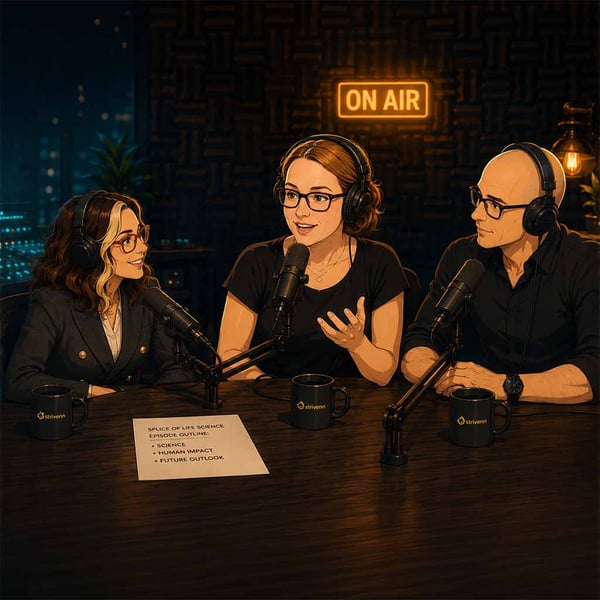
In this episode of “A Splice of Life Science Marketing,” Matt Wilkinson and Jasmine Gruia-Gray share findings from a live exhibitor survey at ACS Fall ’25 in Washington, DC—covering what made booths memorable (or not), the metrics that mattered, sales–marketing friction, and a surprising gap in AI adoption.
Opening & Sponsor
Speaker: Matt Wilkinson
Matt, hello and welcome to a splice of Life Science marketing. This episode is brought to you by Humantic AI. Imagine if you could close 22 and a half percent more deals overnight using a buyer intelligence platform. Imagine slashing prep time by 70% boosting close one deals by 37% and accelerating deal velocity by 336 and a half per cent across your team. That's what customers the world over are achieving using Humantic AI's account and buyer intelligence system. The platform arms you with firmographic and psychographic insights at scale so every outreach hits the mark, deals move faster and revenue grows. Scan the QR code or click the link in your show notes to claim your 10% discount. Now, without further ado, let's get on with the show.
Hi and welcome to a splice of Life Science marketing, the podcast where scientists turn marketers, compare notes, running run small campaigns and turn signal into revenue. I'm Matt Wilkinson and
Why We Ran a Live Exhibitor Survey
Speaker: Jasmine Gruia-Gray
I'm Jasmine Gruia-Gray, welcome again, and today, what we're going to talk about is something a little bit different. It's an experiment that Matt and I ran a couple of weeks ago at the American Chemical Society conference that was held in Washington, DC, and we ran a survey with the exhibitors to understand why they were attending ACS, what some of the sales and marketing challenges they were facing today and then the next six months, and what their AI adoption was like. So Matt, maybe I'll throw it over to you. How did you feel that experience running the survey in this way
Speaker: Matt Wilkinson
was so it was really, really interesting to see the difference you got from walking up to a booth and being interested in asking them questions and surveying exhibitors. You got to have, you had a lot more in depth conversations and and much more in depth conversations than either when I was walking booths as a journalist, where people might be a little bit nervous about speaking to you, in case they felt they'd be misquoted. But then also very different from walking around as a marketing consultant, walking up where people instantly go, oh, you know, you're not a prospect. You're not interested in me. You're just trying to sell me something. And so even though I was interested in what they were doing, the barriers would go straight up. And so this was, I felt was the best way of disarming people. And we learned so much. And by going through the survey and asking a series, you know, series of 10 questions or so, I felt we really got a really good sense of the pulse of what was going on on the exhibitor floor, where things were, and you know, why not maybe statistically significant across the entire population of all science companies. I thought it was a really good snapshot of what people felt was happening in their worlds.
Memorable Experiences vs “Spec Speak”
Speaker: Jasmine Gruia-Gray
Yeah, same. What I found surprising was that people had difficulty answering two questions. The first question was, what intentionally do at your booth to create a memorable, valuable experience for attendees? Yeah, people had to process the question they didn't really think about in their planning phase. They didn't think about making the experience memorable. And I think a lot of that comes from people not really thinking about brand marketing enough and only focused on performance marketing. You know, my goal is to meet existing customers and to get leads. I'm going to count out how many priority leads I get at the end of every day.
Speaker: Matt Wilkinson
I found that really interesting, and when I reflect back on the brands that we did engage with. It's sad how many I actually have to go back to the list to look at who was actually on the exhibition floor. There were a few that stood out to me, Frontier specialty chemicals, in particular, because they had some really cool swag. Thank you so much, Haley for the Talk Nerdy to Me mug, which is, which is great. I think that. Then also there was a great big 100 liter reactor booth at the ACE chemicals on the ACE glass booth. And that was really quite memorable. And then one of the other, you know, there were some really memorable conversations I had. And. And one of which was, of course, at the Bricker booth where, you know, looking at some of the new things that they're doing in NMR, I had a crash course in exactly how much I forgotten about NMR over the past couple of decades, which was a little bit embarrassing, but good to see. Or, you know, get to see that what I used to be have to do in a room that had a magnet that was the size of a room can now be done on the bench top. So some really interesting, exciting stuff. There not too many new brands that I really remember, which I think is really, really sad.
Speaker: Jasmine Gruia-Gray
Yeah, I am in the same boat. I certainly remember Brooker. I remember waters. But what strikes me as being common among all of the exhibitors is they all led with spec speak. They all tried to differentiate themselves with with specifications, rather than really thinking deeply about the value that they add to a potential customer,
Speaker: Matt Wilkinson
and a lot of the answers that we saw from that question did come down to the conversation that they wanted to have with people. And people did a really good job of having great conversations. I mean, great conversations at the rigku booth, at, you know, the ika booth, and a number of places where people were really, really engaging and very, very memorable, but it was more the people that you remembered, rather than the brand, and actually, necessarily some of the things that they would have been maybe trying to sell. So I thought that was a that was a bit surprising. What did you feel the big challenges that companies had? What did you hear that the companies were saying the big challenges in terms of sales and marketing
Leads, Metrics & Word-of-Mouth
Speaker: Jasmine Gruia-Gray
came down to sort of the typical things you hear. It's about leads, it's about generating leads. It's about the extended sales time to closing leads.
Speaker: Matt Wilkinson
And that's that's always really interesting. I mean, I had exactly the same thing, and that shows in the results we saw. One of the other things that I thought was really quite sad was that those are the same things that people are being measured on, and so we're not necessarily, I mean, I know measuring brand is hard, and it's maybe at a level that is not done on a trade show to trade show level, and maybe it's done once or twice every year, every now and again. But there's a huge opportunity at these, you know, on the exhibition floor to generate word of mouth marketing, and some work I've done recently as a bit of an experiment, you know, using the research tools and some fairly complicated prompting, actually being able to look across time at Share of Voice sentiment and come up with, sort of your own word of mouth marketing scores, and doing something that goes back to, you know, the first question you said about, what do people do to make this memorable brands take a bit of a risk and do something that, as Mark Schaefer would say, is truly audacious, that would generate so much buzz, so much brand awareness, and I think that then leads through to the trust, the recollection of the brand, and and can really, then help make generating leads far more, you know, far, far easier, and actually shorten that that time to sale. So I kind of felt that was a that was still became a really
Speaker: Jasmine Gruia-Gray
big message, I think capturing that share of mind, everybody's focused on share of wallet, but balancing the a way to capture the share of mind so that you can get the share of wallet was probably a big Miss across all of the exhibitors. I don't I think it's in the planning, right the in the planning, asking the the team, what, how are we going to answer the question, what's different about us, and we are the fill in the blank company, and how you fill in the blank is part of that being memorable. I don't think enough companies think about that and how to really differentiate yourself in a meaningful, memorable way, so that you can get to lead generation and shortening the sales cycle and building that word of mouth marketing and building that relationship.
Sales–Marketing Alignment & Handoffs
Speaker: Matt Wilkinson
One of the other things that we asked was about key performance indicators. How were they measured? And some of that, two things that struck me were, one was down to the sort of shortening the cycle time and the number, you know, the pipeline bill and and the close rate of sales, which, again, speaks exactly to that sort of performance marketing conversation that we just, we just touched on, how did you feel? The big challenges between sales and marketing teams were sort of discussed as well in those results,
Speaker: Jasmine Gruia-Gray
I thought they were all focused on sales, which is fine. I think part of that has to do with the time of the year. We've passed h1 we're now into the second half of the. Year, there are all kinds of pressures now to close the third quarter, and it's great that that sales and marketing are aligned in that way, but I don't think that there was enough focus, at least from from those who answered the survey on what that journey looks like, and what part of that journey marketing owns and will provide a handoff to sales?
Speaker: Matt Wilkinson
Yeah, that really came up to one of the questions we asked was, What can marketing do better? And there were two key things there. One was, as you say, exactly, making sure that handover from marketing to sales is as smooth as possible, work that I've been doing with for years now, sort of using CRM systems and the likes of HubSpot, where, you know, it's so you can make such a difference by really accelerating that that handover, which is which can make a huge, huge difference. But the one that I thought was really interesting, and, you know, speaks a lot to, you know, some of my big passions in Account Based Marketing is really where marketing wasn't necessarily doing enough to target the accounts that sales are going after. And so that's sort of that that really targeted outreach was, was one, was the biggest thing that you know, particularly the sales teams thought that marketing could do better with. And so I really do feel that the webinar I did with Sam's back in June really does speak to, how can we target those key accounts, you know, those those focus accounts, so much better. And that really makes me, you know, lean into some of the the interesting things about well, if we're going to try and target we've got small teams in marketing, which we heard consistently. How are we going to do that? And that then shocked me in terms of when we started asking about AI, because 63% of the companies that we spoke with are not even piloting AI, yet, not even for content creation. A few of them are just exploring. They're doing a few experiments within that 63 but very, very few are doing anything other than, you know, or even piloting. I think it was only 15% of piloting. So that means that really we got a very small number that are actually using AI. And some of the the outliers in that were companies that actually are AI companies, or software companies where they're naturally going to be using AI in the software development and then the AI side of things. Where did you Where did you see that that people were using AI,
AI Adoption: Where It Is (and Isn’t)
Speaker: Jasmine Gruia-Gray
yeah, the few that were using it were using it in content creation, kind of these days, standard stuff of content creation, and it was hard to get to get them to broaden their thinking and understand what's possible. The other thing that I more recently learned after the survey is that Forbes had done a study where they found that within a company, the highest adoption was at the executive team level. So it's interesting that if that's true with these life science companies, that the executive team is using AI, somehow that inertia is not making it down to the mid level of the company.
Speaker: Matt Wilkinson
I know that we didn't dig into this enough. This is something that I'd love to explore. I wonder how much of that is a bit of a fear of replacing yourself with AI, because we've heard all this hype of how AI is going to it's going to replace jobs. Or I wonder how much of it actually is, perhaps just people not necessarily having the frameworks to know what they can and can't do with AI. Then there's this. There's statistics in the UK that show that across, you know, across many SMEs, small, medium sized enterprises, actually, AI, literacy is, is incredibly low levels. And so I think that there's a real challenge about actually, how do we train teams? How do we make space for teams to try things, to experiment and to and to learn? And I think that's a that's something that really seems to speak, you know, strike a call to me that not enough companies in the life sciences are really about giving people space.
Training, Checklists & Repeatable Work
Speaker: Jasmine Gruia-Gray
I think that's true. At the same time, I hearken back to a conversation you and I had earlier this week with a marketer who's a marketer team of one, and while she definitely wasn't steeped in all the nuances of AI. She was excited about the opportunity that AI provided to her to be able to get more done with less, and to be able to think outside the box differently, whether we were talking about ideal customer profiles, whether we talk we talked about Account Based Marketing or whatever the topic was, she really got very excited about that opportunity. And I think it behooves people like you and I to really. We broadcast what is possible with AI and have folks in life sciences reach out to us to help them, whether it's on the education side, whether it's to create custom AIS for a certain problem set to be solved, or whether it's something else that they're thinking outside of the box on.
Speaker: Matt Wilkinson
Yeah, that training piece is really interesting because there's, there's a lot of people out there talking about learning how to prompt, and there's some, you know, there's some great, great guides out there. Andy Cresta Dean has got a fantastic of orbit media has got some fantastic guides out there on how to prompt. And I've learned a lot from him, but I also learned a lot from sort of doing the British Standards Institute training about using AI ethically, sort of the ISO 42,001 sort of practitioner training, which really dug, dug, really in deep to sort of understanding how to put in place the right guardrails. And that then struck me and some work I've been doing with clients to try to start a better persona, and putting those in this sort of, shall we say, Persona councils, but actually get them to the point where you can get them to create sort of repeatable units of work. And so Jasmine, when you were sort of leading marketing teams, how frequent was it that you'd have those sort of repeatable units of work, or the teams would have to do repeatable units of work. You've got a webinar, you got a trade show. These are all the things that we need to deliver.
Speaker: Jasmine Gruia-Gray
Right? Checklists were our friend, right, that we would do something once we put a checklist together, and that was our Bible for the repeatable units of work, and that that was a consistent situation, whether, as you said, whether you're talking about webinars, whether you're talking about conferences, or whether you're talking about writing up specific content for an application note, For example.
Speaker: Matt Wilkinson
And so that was something that we recently put into practice with a product that we've just introduced called Atlas, which contains a whole range of things in essentially enabling marketing teams to create those repeatable units of work focusing on the relevant persona. So I know we're going to talk more about that in the future. But if anybody does want to go to the striven website and visit the and meet Atlas, there's a there's a nice new web page there that can tell you all about it, kind of before we wrap up. I just wanted to say thank you so much to humantic Ai, who kindly are sponsoring this podcast now. Humantic AI are a personality and account intelligence AI, company that enable buyers to better understand the accounts they're selling to and the people within those accounts. Last week, we had a really, really interesting interview with RO, the Chief of Staff of humantic AI. And I really do urge anybody listening to this, and that's got this far to dive into that podcast
Close & Survey Access
Speaker: Jasmine Gruia-Gray
as well. Yeah, completely agree. And also, thank you from my side to humantic AI for sponsoring this episode. This was a fantastic conversation. Thank you so much, Matt. And by the way, if anybody is interested in the survey that we ran at ACS, please don't hesitate to reach out to us on the striven.com website. Thank you
Speaker: Matt Wilkinson
so much. See you on the next episode. You.
Q&A
How can a tiny team start an AI pilot next week without risk?
Pick one repeatable task with clear inputs/outputs—e.g., first-draft booth follow-up emails. Write a short checklist, include tone, length, and CTA. Use an AI tool to generate versions, then A/B test on 20 prospects. Track reply rate and time saved. Meet weekly to review outputs and update the checklist. Document learnings in your CRM so sales sees what changed.
What’s one low-cost way to make our booth more memorable?
Create a 60-second “micro-demo” anchored to a single customer outcome. Script it, rehearse it, and run it every 15 minutes. Hand a small takeaway that reinforces the outcome (card with QR to a 2-minute video, or a sticker with the promise line). Train staff to open with a problem question, then invite to the next micro-demo slot.
How do we fix the sales handoff from the show?
Before the event, agree on three lead classes (A/B/C) and mandatory fields (problem, use case, next step). Build a HubSpot form or mobile note template for booth staff. Within 24 hours, marketing enrolls A leads into a 3-step sequence and assigns an owner; sales commits to first touch in 48 hours. Hold a 15-minute daily stand-up the week after to clear blockers.
Where should ABM focus if we only have capacity for 10 accounts?
Align with sales on one ICP and three buying signals (technology in use, hiring patterns, recent funding). Choose 10 accounts showing ≥2 signals. For each, map 5 contacts (economic, technical, end user). Build a one-page “reason to care” brief and one personalized asset (email or LinkedIn post) per role. Review progress biweekly and swap out laggards.
How do we measure beyond badge scans without new tools?
Add three simple metrics: (1) Qualified conversations (met ICP + problem identified), (2) Memorable moments created (micro-demos attended or photos taken), and (3) Next steps scheduled (demos, samples, trials). Track these in a shared spreadsheet during the show. Afterward, compare conversion rates from each to meetings and pipeline to learn what actually moved deals.