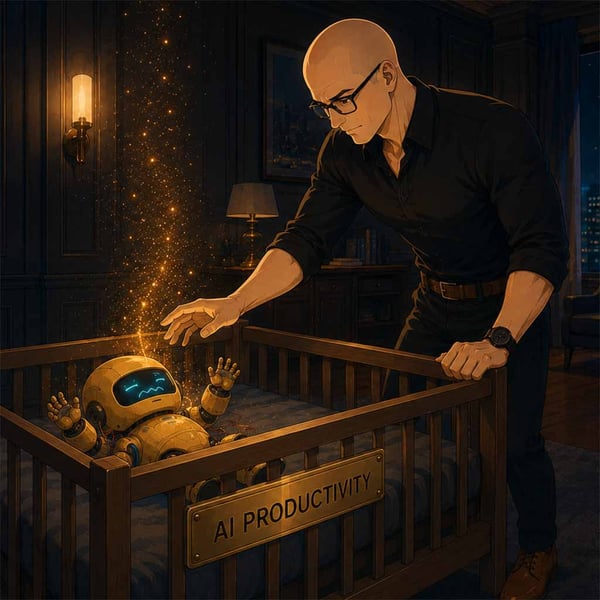

Trade shows aren't information channels anymore - they're trust tests. Your booth and your team's judgment are all that's left to differentiate.
Shownotes
Your competitor already won the spec-sheet war before the exhibit opened. Every scientist benchmarked your product online. The conversation at the booth isn't about features anymore - it's about whether your team deserves the risk.
For life science marketers, commercial leaders, and product managers rethinking trade shows and AI adoption.
At SLAS 2026 in Boston, Matt Wilkinson and Jasmine Gruia-Gray unpacked two arguments that reshape how to approach conferences and AI in commercial teams. First: the conference booth has shifted from information delivery to human conviction channel. Second: AI adoption in commercial teams is no longer a tool question - it is a structural one. The challenge isn't whether to adopt AI. It's whether your organisation can deliberately protect the judgment that makes AI useful in the first place.
Key idea: AI owns the information war. Your booth and your team's judgment are all that's left - and both need deliberate protection.
What you will learn
- Why information parity is now table stakes and what booths should actually do instead
- How booth authenticity (admitting knowledge limits) is your strongest credibility signal
- The hidden cost of AI adoption - skill debt and eroded critical thinking in junior teams
- Why deliberate adoption requires mapping which tasks stay human and why
- How leadership measurement discipline makes or breaks AI integration in commercial functions
Transcript
Matt Wilkinson and Jasmine Gruia-Gray explore the shifting purpose of trade show booths and the structural nature of AI adoption in commercial teams. Recorded at SLAS 2026, this conversation challenges conventional trade show strategy and examines the hidden risks of rapid AI integration without protecting core commercial judgment.
Information Parity and the Purpose of the Booth
Matt Wilkinson
Hello and welcome to a splice of life science marketing. Today we're talking about two blog posts that were inspired by a recent trip to SLAS 2026 in Boston. While it was bitterly cold outside with temperatures getting down to minus 20 degrees Celsius or about minus three or four degrees Fahrenheit, the stories we're talking to you about today are on fire. And the first is one that's been written by Jasmine and it's about your booth being a live audition. I found this really interesting, really resonated with me and the central argument was really simple but really uncomfortable I think for most conference budget holders. It's the information parity is now a baseline condition in life sciences. So a scientist can benchmark your instrument against your competitors before the exhibit hall opens.
Now AI search has made it so easy to create their people's own buyer's guides that basically the rational case for your products, no longer is the differentiator. It's table stakes. Now that shift doesn't make conferences obsolete, it just changes what conferences are actually put for. Digital content handles the logical case for considering your product, but the conference booth now really needs to be about human conviction and connection and demonstrating through observable behaviour whether your team can be trusted post-sale. Every hesitation at your booth perimeter, every field application specialist who admits the edge of their knowledge, every question your team asks before listing a feature is a data point the prospect uses to predict what being your customer will feel like.
Sharpest angle targets product managers directly. Structured voice of customer interviews are filtered by design. Conference booths strip that filter. Spontaneous frustrated customer language like gripper alignment drift or surfaces blind spots that can joint analysis will never be out of catch. The product manager's job at the booth is pattern recognition across conversations, not providing demos.
The uncomfortable subtext is this, most booth strategies are still optimised for a world where digital does not exist yet. Badge scan targets, product theater and spec sheet distribution are the legacy behaviours of a pre-Google conference playbook. The companies still running that playbook are generating 180 leads with 8% qualification rates and yet still calling it a success. So, Jasmine, what is the booth actually for now?
Jasmine Gruia-Gray
It's what I've started calling disrupting the digital. What I mean by that is digital has won the information war and that's not a threat. It's a gift, it's a fact. It means the booth no longer has to do that informational heavy lifting and distributing brochures and spec sheets. The remaining feature and benefit of the booth is to demonstrate what working with that company actually feels like. Every behaviour that the team exhibits on that floor is data that prospects use to answer one question. Is this company worth the risk? That is a narrower and more powerful mandate than lead generation has ever been. And it's a very, very human mandate. And so that's what I mean by disrupting the digital and getting in front of people and helping them understand what that experience of being that company's customer is like.
From Information Theatre to Authentic Trust Signals
Matt Wilkinson
Yeah, I agree. and I really love thinking about the booth now being the human conviction channel, or at least a big part of that play. The problem that I see is that so many organisations still measure trade shows as lead generation events. And people that I walk past even wanted to just scan my badge so that they could hit a number of badge scan targets. I was never going to be the right person for that list, but they needed to hit a certain number of badge scans. And as they went through on the last day, they were desperate to make sure that they'd had, the interactions that led to a badge scan, even if they were completely meaningless in terms of lead generation. Speaking about sort of an example that I think repeated itself time and time again, if we're looking at that as being the wrong behaviour. So what does good look like the trade show floor?
Jasmine Gruia-Gray
I think a lot of people get caught up with needing to be perfect on the trade show floor. And to me, it's not about perfection. The specific moment that closes a deal is not that perfect demo. It's when your field application specialist or your salesperson hits the end edge of their knowledge and says, that's a bit outside of my range. Let me grab somebody else who will have the answer for you. So they're not bluffing through an answer. They're being upfront, they're being very human, but they're also finding a way to get that answer for you. And I think that scientists customers in the life sciences are trained to detect an oversell that honestly is not a weakness. It's the most credible signal your booth can send about what post-sales support looks like. It's not about the perfect white paper. It's not about the perfect discussion. It's really about listening very intently and making sure that you can accurately answer that question or find somebody else who can answer that question.
Capturing Customer Voice on the Floor
Matt Wilkinson
I agree. I think that the big challenge that I saw was if the right person wasn't at the booth or the right person was in, the middle of a 45 minute discussion about, the deep technicalities of the compound library or, how the automation worked. And so when those people are unavailable, I think that the big challenge really becomes is how do you handle that? Obviously first come first served. not trying to get rid of people. You're not trying to move people on like a conveyor belt. But how do you create that tent? how do you solve that tension? I think that's a, that's a really, really interesting challenge that does show what's it like to be a customer because we're not always available and how we handle that and how we follow up is so critically important. Another thing that you about in the blog is the importance about what people do with what they hear. think that sort of partly comes to that follow up question, but it also partly comes to, what are they actually saying? How are we capturing that information and how are we using it? So Jasmine, what should people be doing with what they hear and learn?
Jasmine Gruia-Gray
It's all about stop trying to impress and really, really listen. Actively listening by asking open-ended questions so you really get to the heart of the matter. And then you collect the most defensible post-show assets in the building. The exact words your prospects used, that language is so important to describe their example, the gripper alignment drift after 200 plates. That phrase is gold for follow-up emails and for voice of customer in future projects. that also shows that you're really paying attention to what the customer or future customer is saying. That specificity is what separates a cold follow-up from a conversation that continues. So conversation of snippets should be going into your post-show follow-up, should be going into whatever app you're using on the show floor so that when the follow-up happens, it can be much more personalised. And similarly, going back to your earlier point of a lot of times, the show floor gets quite crazy and the resources that you need to answer questions is busy, I think you can always say, look, do I have your permission to have somebody call you back with the answer? Or do I have your permission to email you tomorrow with your answer? I think people appreciate that kind of response. It's a very human response. And obviously, you have to honour that timeline that you committed to.
Trade Shows as Strategic Customer Engagement Channels
Matt Wilkinson
Yeah, absolutely. It really does feel that the booth has shifted from having that dual purpose of information to being sort of human connection and really trying to value and honour the value of the connections made at the show. I think that's really, really apparent in what you've been sharing. And I think it's one of those things where the more companies can do to focus on the human connection side of things at the show. Maybe they can start to look at being able to use them as kind of customer advisory boards, focused user groups, those sort of other places where you might struggle to get people together, on a regular basis, but using those opportunities at trade shows to at least enhance to to add to those sorts of processes. I think it's a really, really valuable way of reframing what a trade show should be about.
Jasmine Gruia-Gray
definitely. I think there's also value in at the end of every day, the team who has been in the booth gets together for 15, 20 minutes and just shares what they've learned and somebody documents those learnings because there's a lot of value in connecting the dots among many conversations.
Matt Wilkinson
Absolutely. Thank you so much. I think it was a fascinating new perspective and I hope many people get to think differently about their trade show appearances because of it.
The Structural Nature of AI Adoption in Commercial Teams
Jasmine Gruia-Gray
here's what we can agree on. The conference booth has been doing double duty for years, serving as both the information delivery channel on the one hand and a human connection channel on the other the power of digital and digital marketing these days, that first job has been taken over and it's being done very well. And that now enables conferences to focus more intently on the human connection side. And the question is not whether to invest in human connection at conferences, it's whether your organisation has the measurement discipline and leadership alignment to actually change what it optimises for. or whether it's still going to 120 leads just because they're being judged on the scanning wondering why pipeline quality never improves. If you're a product manager listening to this, the most important conversation you can have before your next conference is not about booth design or demo scripts. It's about whether your leadership is willing to change that use to decide whether the show was worth it or not.
Okay, so with that, Matt, I found your blog super, super interesting, a little sort of different angle from what I had written. And the central argument is simple and uncomfortable for most commercial teams to sit with. And that's that AI adoption gap in life sciences is no longer a tool question, it's a structural one. I think that your argument moved from a first on AI are not just moving faster, they're compounding. Better ICP or ideal customer profiles, refinement, sharper pre-call intelligence, content cycles, leaner cost per opportunity. Late movers on the other hand are not starting from zero. They're starting from behind a target that keeps moving. That compounding is an advantage thesis, contains a hidden assumption, the article does not examine. And that the judgment being amplified was worth amplifying in the first place. Pre-call research trains pattern recognition. Content drafting sharpens positioning instinct. Account mapping builds strategic intuition. These aren't just inefficient tasks AI can replace. They're the practice that builds the commercial judgment AI is supposed to amplify. When the repetition disappears into a machine, the short-term output improves. The long-term skill development, however, can quietly stall. And nobody notices until the AI gets it wrong. and nobody can course correct. So with that, Matt, is the gap structural or are we dramatising this?
Matt Wilkinson
So it's probably a little bit of both, but I really do think it's structural and certainly me be clear though, I'm absolutely advocating that the humans still need to understand what good looks that means that we need to be augmenting humans rather than replacing them. But as we go through this process, it's clear that you can iterate so much faster using AI than without it. You can get so much closer with your ICP refinement, your account research, your content cycles. You can reduce the cost per opportunity based on what you do using AI. It's just staggering. And I think that's the real tricky. It's a real productivity upgrade, but it also can help you change your economic model of operating in your market. And I think that's the really exciting part for me. Some of the organisations I spoke with that were early adopters, they're not just already shifting first AI models to their second. They're looking at reinventing how they go to market. And that's really, really exciting. And I think that that's the structural and cultural change that you're starting to see is that you've got organisations playing by rules that worked fine, back in 2020, 2015. those models aren't going to be around for that much longer. People will get out competed soon.
Evidence, Bias, and the Risk of Overstatement
Jasmine Gruia-Gray
Yeah, so I think the challenge I'm having is maybe I'm wearing too strong of a science hat And what I mean by that is that we're based on conference conversations and not data. Someone used AI and now their pipeline velocity is higher. It's a directional and not part of, controlled comparison, so to speak. So before we call this a structural shift, I'm curious how much of the observed advantage is really AI and how much is a combination of talent and timing and so on and survivorship bias from only hearing the success stories at the booth. The urgency framing is also doing commercial work here. If you're selling AI training programmes, for example, a dramatised structural threat shortens your sales cycle. That doesn't make the threat wrong, but it means that we should pressure test the evidence before we tell a life science commercial team that they're already losing.
Matt Wilkinson
Yeah, I agree. And I mean, as you know, do provide those AI training I think it's one of those challenges where on the one hand, the number of organisations that we're seeing right now in the life sciences that are really embedding AI across the organisations, they're still few and far between. We're still looking at maybe 7%. So the numbers of organisations that are still, going down that AI maturity learning curve are still in the majority. So we're not going to see that out competing yet. But what we can see is what's happened in software development, we can see what's happening in organisations and in segments where AI is perhaps being adopted far more Last summer, I gave at a big construction materials company. this is company selling glass and concrete and, sorts of things where you would say, hang on a second, they shouldn't be at the cutting edge of AI and yet they are. The people in that segment are really pushing the boundaries about what is possible. And that's really it's really interesting to me to see that we're able to see that shifts and there are segments where we're already seeing the segment trends where these shifts are happening and there's documented evidence for that. Maybe there isn't the body of evidence within life sciences yet, but there will be and we can see where that maps to against those other adoption charts.
Judgment Amplification in Practice
Jasmine Gruia-Gray
So what does judgment amplification actually look like in practice?
Matt Wilkinson
I it's one of the things where it's not about just speed, it's about cognitive load. If we can start offloading some of the busy work and start spending time on the stuff that really moves the needle, we'll be so much better. And so the trick. It's about looking at need the human insight? Where can we augment the human? And where can we make sure that we're saving time and mental energy for those tasks where it's really, really crucial? And that's what I'm really, really convinced that we need to be doing when we're architecting processes for organisations. It's not just about what can we do to increase efficiency, it's what can we do to make sure that we're preserving what's most important about keeping the human in the loop.
Skill Debt and the Experience Gap
Jasmine Gruia-Gray
for me, the amplification argument assumes that the judgment being amplified already exists and is sharp. So it's maintaining that critical thinking and the output being of high quality. That's a safe assumption for a senior commercial leader who has the lived experience, right? Who has built their instincts over many, years of difficult interactions before AI existed. think it's a challenging assumption for a marketer, a salesperson, a field application specialist who's at the beginning of their career and doesn't have that foundation of lived experience. To me, there is a meaningful difference between a senior professional using AI to offload practice repetition and a junior professional who's never or hasn't done a lot of that repetition. One is amplified, sure. And there is a risk even with the senior person that there's a reduction in critical thinking, but I think that's less of a risk. But the other for the less experienced one feels very propped up. and most organisations can't tell which they have until the moment the AI produces a misread account and nobody has the instinct to catch it before it goes to the customer.
Deliberate Adoption vs. Stagnation
Matt Wilkinson
think that's fair. And I think that really you're looking at sort of does does sort of AI and speed compound advantage or compound error. And I think that skill debt argument is real. But I don't think it's an argument against adoption. I believe it's an argument for deliberate adoption. stagnation of doing things the way we've always done it, it's not a safe harbour. the skills, the teams that calculators or Excel sheets or any of the tools that we now take for granted no longer exist. And the same will be for those that avoid AI adoption. We have to adopt and we have to adapt, but we have to do so deliberately. Organisations aren't just competing on cost structure speed their market will no longer support. companies that can iterate faster will be able to get ahead. You the answer isn't to slow down AI integration until you've solved the judgment preservation problem. It's to deliver a practice back into the workflow so that you can identify which tasks AI should absorb and which tasks the team need to still be involved with precisely because they build something irreplaceable. That's exactly why humans still need to be on the booth. It's exactly why they still need to be involved in customer service. business model design challenge, not a reason to delay adoption.
Jasmine Gruia-Gray
Yeah, I very much like those words of deliberate adoption. I'd also add to that in terms of maintaining critical thinking. What I believe it requires is organisational discipline that most teams haven't yet built. And part of that discipline is to have clearly mandated AI guidelines. if you can't name which tasks you're keeping that's going to be manual and why, you're not doing deliberate adoption. You're just moving fast and hoping the judgment is still there when you need it. So I think one of the areas I'd advocate our listeners really thinking about is what is deliberate adoption mean for your organisation? So who owns this mat and what does the first real move looks like?
From Tools to Commercial Identity Redesign
Matt Wilkinson
owns this? I think we all do. I don't believe that disrupting yourself is really just about the tools. I believe it's about fundamentally rethinking commercial identity. You know, we're no longer just running campaigns. We're no longer shuttling content from place to place and through approvals. We need to be thinking about redesigning the commercial system. That's a different self-concept, a different set of decisions. And it's a different conversation with the leadership team. And the practical first move isn't picking at all. It's the audit. It's understanding where teams spends cognitive energy on tasks that do not require judgment. The times when we spend sitting in meetings that don't go anywhere. We need to map those workflows, identify the genuine decision points. that really do need human input in the places where the human experience is vital, then we need to deliberately decide which tasks we need to keep doing as humans because they build the pattern recognition that makes any AI output better than anybody else's. That's where the competitive advantage will sit in the future.
Jasmine Gruia-Gray
So I agreed that the identity reframe is compelling. However, it doesn't solve the measurement problem. good intentions isn't quite enough. And I think an organisation's leadership is still approving AI investment based on headcount impact, cost savings, and pipeline metrics. Until the conversation at that level changes, Until someone agrees to measure commercial judgment, skill development and sustainable advantage and maintaining critical thinking, rather than just velocity and volume, individual teams redesigning their identity and isolation are just generating fewer badge scans and getting questioned at the quarterly review. And we've all been there and that's a very uncomfortable position to be in. The uncomfortable question that the article doesn't ask, and here I go back to my science background, is compared to what? Does AI augmented commercial execution actually beat the same investment in customer advisory boards, structured field visits, or senior FAS time? Those are also human judgment channels. They're also unfiltered. And some of them don't require rebuilding your entire commercial identity to use them.
Layering AI with Customer Engagement Channels
Matt Wilkinson
I think that's fair. I would also, though, argue that with AI, we've got the ability to do more with the insights we gain from those interactions. So whether that's at the trade show floor, whether that's in a field visit or an advisory board, the more we can do to capture and analyse that data, the better. time and time again qualitative for people and the outputs in the past would often be series of quotes. you're not looking at the thematic analysis, you're not going through how we really hit data saturation. And I think that's where with AI, able to do things at a level that we would never have been able to do before because of time and capability constraints. But here's what I think we can agree on. AI adoption in life science commercial teams is no longer optional. and the teams moving first are building real advantages. And I saw that time and time again on the trade show floor. The harder question is not whether they are building compounding advantage or compounding are they compounding institutional knowledge about how to adapt and how to grow. Adopting AI, we really need to do it in a way that amplifies best judgment and quietly replaces the practice that builds it. Now, if you're a commercial leader listening to this, the most important conversation you can have this week is not about which AI tool to use. It's about which task your team is going to keep doing and why.
Jasmine Gruia-Gray
And maintaining that judgment and critical thinking, I think those are really important aspects of what wrote about and what we both found, not only in going to SLAS, but in all the research we've been doing until now. This has been a spectacular conversation as always. Thanks again, Matt.