

Strivenn Thinking
Pull up a seat at our
digital campfire
where story, strategy,
and AI spark
new possibilities
for sharper brands
and smarter teams.
Sales Wants One More Quarter, R&D Quit Six Months Ago
By Jasmine Gruia-Gray
How to Execute Product EOL When Nobody Agrees
Vesta, goddess of the hearth, asked every Roman household the same question: what flame are you tending, and why?
Her sacred flame burned in the Temple of Vesta, tended by priestesses who devoted their lives to its preservation. The flame could never be allowed to die completely or as the myth says, Rome itself would fall. Yet preservation did not mean mindless fuel consumption. Vesta's priestesses understood the difference between a flame that needed wood and a flame that needed renewal. They knew when to add fuel, when to let the fire dim to coals, and when to perform the ritual rekindling that transformed old flame into new.
What made them wise was not their devotion to the flame. It was their understanding that eternal did not mean unchanging. The sacred flame survived through strategic stewardship, not stubborn preservation of dying embers.
Product Managers (PMs) face Vesta's question every quarter: what flame are you tending in your portfolio, and why? Some products are the sacred flame, the core intellectual property and customer relationships that must be preserved and renewed. Others are just wood burning, consuming resources without generating the heat that powers your business forward. The challenge is knowing which is which before you run out of fuel entirely.
The Cost of Indecision
The "zombie" product phenomenon drains life science companies more than any competitor ever could. Engineering teams maintain legacy codebases instead of building next-generation platforms. Support staff field questions about discontinued reagents instead of onboarding new customers. Sales carries SKUs that generate $200K annually but consume $400K in overhead. R&D roadmaps get hijacked by requests to extend products that should have sunset two years ago.
Poor cross-functional alignment makes this worse. R&D wants to kill the product. Sales wants one more quarter. Marketing stopped promoting it eighteen months ago. Support is handling escalations with no development team backing them up. The product exists in organizational purgatory, neither alive enough to invest in nor dead enough to stop draining resources.
The Six-Step Product Exit Framework
Strategic product End of Life (product EOL) is not about killing products. It is about managing what you carry forward. Here is the framework for making those decisions with clarity and speed.
1. Run the Triage Assessment
You cannot preserve every aspect of a declining product portfolio. The first step is brutal honesty about what has strategic value versus what is dead weight.
Build a two-axis matrix: profitability (gross margin after fully loaded costs) versus strategic value (customer relationships worth preserving, IP that transfers to next generation, market position that defends against competition). Products in the high-profit, high-strategy quadrant get investment. Products in the low-profit, low-strategy quadrant get immediate product EOL. The tension lives in the other two quadrants.
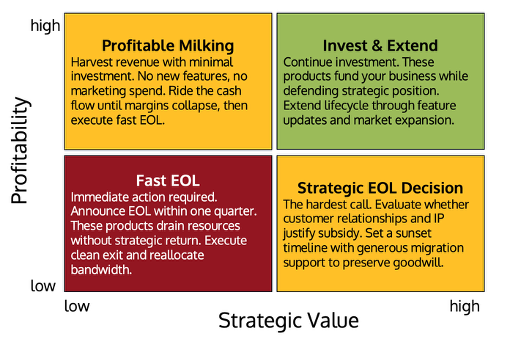
For example, a qPCR reagent kit generating 60% gross margin but serving a shrinking application might be profitable today but strategically dead. Conversely, a cell culture media line with 20% margins might be worth extending if it keeps pharma customers engaged with your platform while they transition to your next-generation product. The triage assessment forces explicit trade-offs instead of allowing zombie products to persist through organizational inertia.
2. Quantify the Inheritance
What does your product carry forward?
Make an explicit list: core intellectual property (antibody clones, assay protocols, bioinformatics algorithms), customer relationships (pharma partners who bought this product but remain strategic accounts), institutional knowledge (failure modes, edge cases, application expertise that informs next-generation design), and brand equity (if the product name or technology platform has recognition worth preserving through rebranding).
A genomic sequencing panel might have minimal resale value in hardware, but if the bioinformatics pipeline can accelerate your next platform launch by nine months, that acceleration is the quantifiable inheritance. This inheritance inventory becomes the business case for how you execute product EOL with investment rather than pure cost-cutting.
3. Establish Cross-Functional Hard Dates
Product exit execution requires temporal discipline.
Get Sales, R&D, Support/Field Applications, Operations, and Finance in a room. Establish four dates with no ambiguity: Last Order Date (final day customers can purchase), Last Ship Date (final day you fulfill orders), End of Support Date (final day you answer technical questions), and Product Removal Date (final day it appears in any customer-facing materials). These dates must align with inventory depletion, manufacturing capacity transition, and competitive announcement timing.
Sales will push for extending Last Order Date. R&D will want to accelerate End of Support to free up bandwidth. Operations will flag supply chain constraints that might force earlier Last Ship Date. Finance will quantify the carrying cost of excess inventory. The PM's job is to force explicit trade-offs with numbers attached. If Sales wants six more months of orders, they must commit to a minimum revenue threshold that justifies the extension. If R&D wants to cut support immediately, they must accept the customer churn risk and quantify its impact on adjacent products.
4. Map Customer Migration Paths
PMs who announce product EOL without mapping migration paths lose customers permanently.
Before any internal product EOL discussions begin, answer these questions: Where do loyal customers go if we sunset this product? Do we have a replacement that serves 80% of their use cases? If not, which competitor will they adopt, and how do we maintain the relationship through that transition?
For each customer segment, assign a migration difficulty score: Green (replacement serves their workflow), Yellow (needs protocol optimization), Red (likely competitor migration). Build detailed transition plans for Green and Yellow segments before announcing anything. The Red segment will leave, but documenting where they go and why helps you understand what your replacement product is missing.
5. Design the Dignified Exit
Your customers may have an emotional attachment to products that have served them for years.
Build a communication plan that honors what the product achieved: announcement letter that acknowledges the product's impact and thanks customers for their partnership, transition support resources (protocol conversion guides, application notes for alternative products, direct access to technical specialists during migration), customer-specific outreach for high-value accounts, transition pricing programmes (discounted migration offers, extended support windows, capital equipment trade-in allowances that bridge economic gaps), and public documentation of the product's scientific contributions (citations enabled, protocols archived, data analysis tools made open-source if possible).
Timing the announcement requires understanding your customer base's budget cycles. Academic labs and pharma quality groups need lead time to submit replacement products for budget approval. This window varies by geography and institution type.
However, announcing too early creates stockpiling surges or immediate customer abandonment. Consider a phased approach: confidential notification to strategic accounts first, broader announcement timed to budget planning windows, and transition pricing that extends beyond Last Order Date.
The dignified exit acknowledges their investment in your product and provides the tools to preserve continuity. This is not sentimentality. It is risk management. Customers who feel abandoned will not buy your next product. Customers who feel supported through a difficult transition become advocates for your portfolio strategy.
6. Execute the Leap
Set clear metrics that trigger product EOL execution: revenue decline below $X quarterly for three consecutive quarters, gross margin below Y% after fully loaded cost allocation, competitive obsolescence (three competitors launch superior alternatives within 18 months), or customer concentration risk (more than 60% of revenue from fewer than 10 accounts who signal migration intent).
When those triggers hit, execute the product EOL plan without reopening the debate. The decision has been made. The cross-functional alignment exists. The communication strategy is ready. Delaying execution to reconsider the decision burns the very resources you are trying to preserve through strategic product EOL. Make the call, announce the timeline, and focus organisational energy on supporting customer transitions rather than defending a product that is already dead.
Tend the Sacred Flame
The priestesses understood that their duty was not to hoard wood or prevent all consumption. Their duty was to preserve the flame that mattered. They let some fires die. They rekindled others. They added fuel only where it would generate heat that served Rome's future.
Strategic product EOL demands the same wisdom. Know what to preserve. Execute without guilt.
The products you sunset today create the organisational capacity to build what matters tomorrow. Tend the flames worth preserving. Let the others die without guilt. Vesta does not judge you for the fires you extinguish. She judges you for the flame you fail to renew.