
Strivenn Thinking
Pull up a seat at our
digital campfire
where story, strategy,
and AI spark
new possibilities
for sharper brands
and smarter teams.
Walking in the Customer's Shoes
By Matt Wilkinson
Alison has been in life science marketing for eleven years. She is good at her job. Patient with stakeholders, sharp with a brief, the kind of person who still reads the primary literature so she understands what her buyers actually do in the lab.
She is not someone who makes obvious mistakes.
Which is why what happened last spring still bothers her.
Alison did everything right
The campaign had taken four months. It started, as most campaigns do, with the right intentions.
Alison had conducted fifteen buyer interviews the previous year. Recorded, transcribed, coded. She had built personas from the outputs - solid ones, grounded in real conversation, the kind that make you feel genuinely prepared. She wrote the brief herself, stayed close to the language her buyers used, pushed back twice when early copy drifted toward vendor-speak.
She knew her buyers. Or at least, she had known them once.
Then the process got hold of it
The product team added two features that had not been in the original brief, because the product had evolved since the interviews. Legal softened the headline claim. Regulatory changed "removing the guesswork" to "designed to support more informed decision-making." The VP asked for a reference to the company's fifteen-year heritage. A well-meaning colleague suggested leading with the platform rather than the problem.
Alison pushed back where she could. She lost most of the arguments, because she was arguing from instinct and everyone else was arguing from process. By the time the final version was approved, the message that went to market was a consensus document. Not a customer document.
This is not a failure of process. It is organisational gravity. And it pulls every piece of content away from the buyer and toward the organisation, every single time.
She told herself it would still land. She had been close enough to the insight at the start. Some of it would survive.
7% open rate. A handful of white paper downloads. The word "interesting."
The campaign launched on a Tuesday.
By Friday, Alison was staring at an open rate of just 7%. Her campaigns usually hit 35%. The sales team reported back at the end of week two. Conversations opened but did not progress. One prospect replied to say the content was "interesting" - the word buyers use when they are being polite about something that did not speak to them.
Alison pulled up the original interview transcripts. She read back through what her buyers had actually said. And she could see it, not dramatically, just clearly: the distance between what the buyer had described and what the campaign had said.
The buyer had talked about the anxiety of not knowing whether a result was a real finding or an artefact of the assay. The campaign had talked about platform confidence and validated workflows.
Both sentences were about the same thing. But one was written from inside the buyer's experience and one was written from inside the corporation.
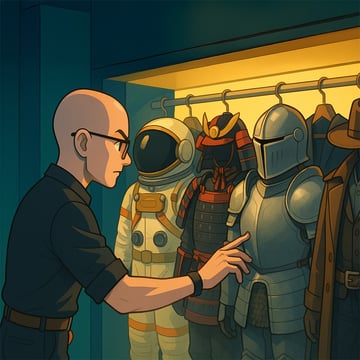
She had tried to put herself in the shoes. But they never fitted.
This is the part nobody says out loud in a campaign kickoff.
Alison had tried. She had pulled up the interviews, thought through what she knew, forced herself into her buyer's perspective as hard as she could. But that exercise feels like squeezing your feet into shoes two sizes too small.
You can force your way in - and experienced marketers do, through sheer professional effort - but you cannot move naturally. You cannot stay in character. You are spending most of your cognitive energy managing the squeeze, the discomfort of the fit, the effort of holding the position, rather than actually seeing the world from where your buyer stands.
You get glimpses. Moments of real clarity, usually in the first few minutes before the pressure reasserts itself, before the Slack messages arrive asking where the first draft is. Because nobody can sustain that level of forced perspective under a campaign deadline, a stakeholder review, and an approval process that has its own priorities.
The insight was real. The attempt was genuine. But the shoes never fitted, and by the time the campaign went to market, it carried the faint imprint of that discomfort - written from proximity to the buyer rather than from inside their world.
The problem was never the research. It was that the buyer left the room.
Alison did not need someone to tell her buyer empathy mattered. She had known that for eleven years, and she had done the work to earn it. Fifteen interviews. Proper coding. Real personas built from real conversations.
The problem was that all of that lived in a document. A document consulted at the start of the process, when the brief was fresh and the instinct was sharp, and then slowly overwritten by every review, every revision, every well-intentioned stakeholder edit between the insight and the market.
What she needed was not more research. It was a way to keep the buyer present throughout the process. Not available once a year when the budget aligned. Present. In the room where the product team suggested the additional features, where legal softened the claim, where the VP asked for the heritage reference.
The buyer disappears after the research phase. The system replaces empathy with consensus. And Alison - like every marketer who cares about this - is left defending instinct against process. And losing.
The buyer that never goes home
What changed for Alison wasn't more research. It wasn't a better process. It wasn't another round of interviews, though those still matter.
It was that her buyer never left the room again.
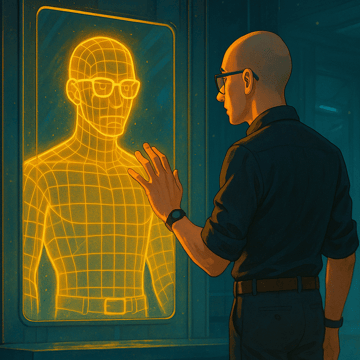
PersonaAI is that. Not a tool. Not a template. A synthetic customer that can actually stay present - through every brief, every draft, every approval, every stakeholder who means well and dilutes anyway.
Built from her fifteen interview transcripts, the VOC survey data her team had collected, and the LinkedIn profiles of the specific buyer types she was targeting. Not a PDF in a folder. Not a static persona that captured who the buyer was eighteen months ago and had sat untouched since. A living, queryable representation of her buyer, grounded in real data, available at every stage of the process.
Before the brief. Inside the brief. After the first draft. After legal had finished with it. On the Friday afternoon when someone senior suggested a headline change and she needed evidence, not instinct, to make the case.
The synthetic customer did not flatter her. It did not approve every message the way an eager intern might. It pushed back in the specific language her real buyers used - flagging where the copy had drifted back into vendor-speak, where the framing had stopped feeling like a problem the buyer owned and started feeling like a feature the company wanted to sell.
In work with life science tools companies, grounded synthetic personas surface on average three to five category-specific objections that generic LLM personas miss entirely - the ones that live in the gap between what a buyer writes on LinkedIn and what they actually say when they think no one is pitching them.
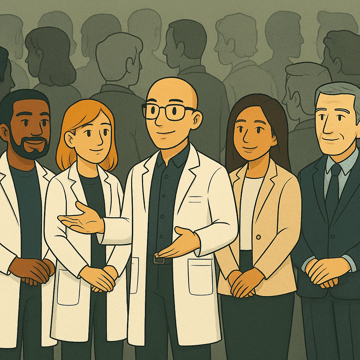
And it is not just marketing that benefits. Sales teams use the same synthetic customer to prepare for discovery calls, anticipate procurement objections, and pressure-test their pitch before it meets a real buying committee.
And when the next campaign went through the same process - the same additions, the same legal softening, the same stakeholder edits - Alison could take each revised version back to her synthetic customer and ask the question she had never previously been able to ask mid-process: does this still sound like it was written for you?
Sometimes the answer was yes. Sometimes it was no, and here is specifically why. Either way, she had something more than instinct to argue with in a review meeting. She had evidence. And evidence changes the conversation in a way that instinct alone does not.
The shoes still fit the same. The difference is she can stay in them.
Alison still can't squeeze her feet into her buyer's shoes, but she no longer has to. The synthetic customer stays present throughout the process. From when the brief becomes a draft, when it goes into review, when it gets approval and becomes a campaign.
The fit, imperfect as it always was, holds for as long as the work requires.
The message that reaches her buyer is closer to the insight that inspired it. The gap between what she intended and what they received is smaller. The content that comes out the other end of the approval process sounds less like every other vendor in the category and more like something written specifically for one person.
Because in the end, that is the only content that was ever worth writing.
The question is not whether your buyer empathy is good enough. It's whether your buyer is still in the room when it matters.
Not more research. Not better personas. A buyer who never leaves the room.
That is the shift.
Meet PersonaAI at strivenn.com/personaai
*Alison is a composite character. This is a stylised story based on aggregated and averaged experiences from Strivenn's work with life science marketing teams.