ELRIG survey exposes the conference paradox: companies invest heavily to acquire customers but fail to prepare for impact.
Shownotes
You're spending tens of thousands on conference booths to acquire new customers. But are you actually ready to win them?
Matt Wilkinson and Jasmine Gruia-Gray surveyed 107 exhibitors at ELRIG Drug Discovery 2025 and discovered a disturbing pattern: companies are acquisition-focused yet preparation-poor. While 61% struggle with lead quality, only 14% have competitive battle cards ready. Worse still, most exhibitors couldn't articulate what makes them memorable, had no strategic conversation frameworks, and were improvising competitor responses on the fly.
This isn't about budget constraints—it's about strategic negligence. Companies are treating conferences as lead-scanning exercises rather than architecting experiences that convert prospects into pipeline. The "rinse and repeat" approach is failing, and hope is not a commercial plan.
What you will learn:
- Why acquisition focus without preparation creates a dangerous disconnect
- The preparation trifecta missing from most booths: battle cards, memorable messaging, strategic follow-up
- How to use the STAR model to handle competitor questions with confidence instead of improvisation
- Why marketers must be at conferences to capture intelligence that drives future positioning
- Pre-show targeting tactics that book meetings with your exact ICP before the show floor opens
- How Atlas and persona AI transform conference prep from guesswork to strategic role-playing
Keywords: life science marketing, conference strategy, ELRIG Drug Discovery, competitive preparation, battle cards, memorable differentiation, strategic booth conversations, acquisition strategy, life science tools, trade show ROI, conference planning, customer acquisition
Ready to stop wasting your conference investment? Preparation determines whether you're memorable or invisible among 200 booths. Subscribe for more unvarnished life science marketing insights, and visit strivenn.com to access our AI Readiness Diagnostic.
TRANSCRIPT
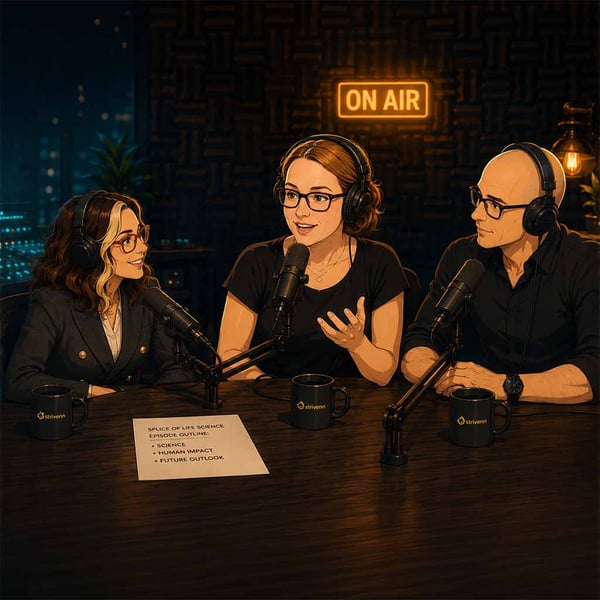
Matt Wilkinson and Jasmine Gruia-Gray expose the conference preparation gap that's costing life science companies millions in wasted booth investment. From the absence of battle cards to the inability to articulate memorable differentiation, this conversation challenges exhibitors pinning acquisition hopes on conferences without doing the strategic work required to convert prospects into pipeline.
The Survey Exposing Strategic Negligence
Speaker: Jasmine Gruia-Gray [0:00]
Matt, hello everybody, and welcome to a splice of Life Science marketing. We're glad that you joined us again. Hi Matt, hi Jasmine. How you doing good? Thanks. I thought that today we could talk about an event that we attended on October 21 and 22nd in Liverpool, which was the L rig Drug Discovery conference. Do you want to share with everybody what we did there?
Speaker: Matt Wilkinson [0:34]
Yeah, absolutely. So on the on the Monday, actually, on the on the 20th, there was a little training session for exhibitors. And so we were there training some exhibitors on AI and how to, you know how to make more out of their out of their budgets in 2025 and going into 2026 but the real reason that Jasmine flew over from the US to Liverpool and then myself, Charlotte and Lynn, traveled up from, you know, the south of the country, all the way up to Liverpool, was that we wanted to run a survey of exhibitors. And the reason for doing this was, it was a couple of reasons. One, you know, from a selfish reason, it's great to have great conversations with exhibitors and understand the challenges that they're currently facing. But when you're going around as a marketing consultant, those conversations can be a little bit salesy, or people assume you're trying to sell something, and so these this was a real way of just trying to get a real pulse on the industry. And of course, there's been such a so many shocks across the sector, from funding cuts to people shifting where sites are being built, that it really makes sense to try and understand what is going on in the industry. I think that probably the one of the most profound parts of that survey was that the survey revealed that 61% of exhibitors struggle with lead quality, while only 14% actually have any kind of competitive battle cards ready to hand. So Jasmine, I know you've been in charge of organizations where you've made sure that those are ready. So why do you think there's such a massive preparation gap, and what should a good battle card actually contain for Life Science exhibitors?
Acquisition-Focused but Preparation-Poor
Speaker: Jasmine Gruia-Gray [2:08]
Yeah, so by the way, I really, really enjoyed the discussions that we had with the exhibitors. It was everything from startups to large, well established life science tools and reagents companies, a couple of automation companies and some SAS companies, software as a service companies, learned tons from each one of these conversations that we couldn't have learned by Doing an website search or an AI search. I think part of the problem is that while companies agree that trade shows are worthwhile attending, and companies spend 1000s of dollars on booth space, on travel, on staffing and so on. There's a little bit of rinse and repeat syndrome going on where people have been to these conferences, whether it's L rig, whether it's medica, you name your favorite conference, so many times that they're not stopping to think about. Well, hold on a second. What's our strategy here? What do we want to achieve at this conference? And if they do stop to think about it, more often than not, it's number of leads. And we can go down the rabbit hole of, is it truly lead generation, or is it more buyer intent? And there's a nuance there that I don't think a lot of companies are having that discussion over I think the the other part of it is that that there's no focus on what's differentiated, what what's unique to us as a brand. What's unique to us about how we're solving pain, customer, pain points and that kind of leads into competitors. There's, there's a little bit of, you know, if it's, if it's laziness, or assuming we know all the competitors out there, and there's no thinking towards how can we be more quote, unquote, battle ready to talk about competition and again, come back to how we're differentiated based on what the customer is doing and what what their current challenges are, how do you see it? Matt, yeah, well,
Speaker: Matt Wilkinson [4:43]
I think one of the things that the data showed was that exhibitors are really acquisition focused, you know, they really want to get new customers. They're really focused on that. But at the same time they're differentiation poor. That, to me, is a real disconnect. You know, we started asking exhibitors, what, what do you do to me? Memorable, and they really struggle to answer that question. There's really not a focus of standing out on a crowded show floor. How do you feel that commercial teams can move from just sort of collecting those leads through to actually standing out? Yeah,
Badge-Scanning Is Not a Strategy
Speaker: Jasmine Gruia-Gray [5:12]
I think it's really a discussion with the person who's coming up to your booth. It's not about just capturing or scanning their badge and making sure you understand whether they want a brochure or an application. A bit note, it's about the quality of that conversation and really digging into you know, what are they doing today to solve a current pain point? What are they happy with in how they're doing that today? What do they think that they could improve on and why, you know, what are they using today? What you know, if they could dream in a budget, unlimited world, what would they dream of having and a way of solving the problem that they have, and typically, conversations don't go like that. It was astounding how many times people didn't even ask me so, so what do you do? I mean, they didn't even ask whether I was in their market, which I clearly wasn't. It's, it's this rush to just sort of capture that lead and be able to tick the box that I've fulfilled the goal. And by the way, where were all the marketers at this conference? I'd say the vast majority of people I spoke with were either field application scientists or sales people, the product marketers, the marketing managers. I didn't speak to a one. What about yourself?
Speaker: Matt Wilkinson [6:46]
Yeah, I think between us, we spoke to more than 100 exhibitors, and the number of marketers were few and far between. I think it was something similar we saw when we ran a similar survey at the American Chemical Society back in the summer, where there were very, very few marketing folks on the booth itself. And that really speaks to me, sort of as a disconnect. It feels like marketing has been sort of pushed aside, in some ways, into sort of more of a coloring in department and delivery department, and a lot of that, sort of the strategic stuff, has moved into product and then to sort of sales and field application specialists. And I think there's been a real, real Miss there, because the field application scientists are really there to be helpful and to know their subject, which is fantastic sales are obviously selling, but there's not necessarily this, anybody on the booth that's really tasked to kind of understand and get a sense of what's happening in the market. How do we make sure that we're positioning our brand and our plans for, you know, the next 369, 1236, months in context with what they're seeing out there? And I think that's something that's a real a real shame.
The Intelligence You Can't Replace
Speaker: Jasmine Gruia-Gray [7:54]
I completely agree. I mean, back in the day, as a young marketer, that's how I cut my teeth. I went to the human genome organization conference and the human proteome organization conference, and while I could get decently technical if I found that I was out of my depth, there was always an FAS there that that I could call in to expand on the conversation, but there was huge value in understanding in specific, as well as in aggregate, what those conversations were like, what kind of questions we were being asked, and then reporting back in a debrief after The conversation, after the conference and and sharing that information with the next group of people who are going to the Next Conference. Word of mouth market intelligence is so, so critical and and can't be replaced with website searches and just sitting in your office.
Speaker: Matt Wilkinson [8:58]
That's really important to note, I think, in that when you have those conversations, you really get to understand and feel the questions that customers and prospects are asking, both of, you know, the company itself, but also what, what the sales team are getting asked, and that can then provide such useful seed material for content, for, you know, for how you market, for campaign ideas. And I feel that that's maybe something that that is being lost right now in the way that some of these companies are being structured and the way they're sending people to shows.
Competitor Intelligence: Unprepared and Improvising
Speaker: Jasmine Gruia-Gray [9:28]
I agree. I think the other thing is being lost is conferences are a superb place for competitor intelligence. This is a great place where you can Yes, of course, look at the features and benefits of different products, especially if there's been a new launch, but, you know, taking a beat and looking at the graphics of the booth and what is the messaging? What are the conversations like in Booth x versus booth y? Versus your own booth and and collating that competitor intelligence and enriching battle cards. I mean, I think we talked at the very beginning of this show a little bit about battle cards, but maybe we should take a moment and describe what a battle card is. Do you want to kick that off? Yeah, sure. At
Speaker: Matt Wilkinson [10:21]
its core battle card is really an ability to provide sales or a customer facing member of the team with some key points about how your offer differentiates from others. Now that may include technical spec comparisons. It may involve differences around the positioning, differences around the sort of offers that you provide software as a service. Companies do this really, really well. You will find on most SaaS companies web pages, they'll house websites. They'll have at least one page where they show how they compare with each other. I recently had a look at comparing some different AI powered note takers and transcription power software, and on all of them, there are direct head to head comparisons between the offer from company A and company B, and that means that then you can, as a customer, you can take a look, and you can try and try and understand a little bit about, well, what makes more sense? For me, we're not saying that you should necessarily have brochures that do that direct head to head. But I do think it's really important for the sales teams, and you know, customer facing members of the team, to be able to understand, how do we stack up? Where somebody asks about x? Yeah, we can give them some answers. But actually, really where we want to do is this. We want to guide them to the places where our value proposition is strongest. And if the match between our value proposition and their need, me, that's really where you hit the sweet spot, right?
The STAR Framework: Stop Improvising
Speaker: Jasmine Gruia-Gray [11:46]
The other elements that I used to add in a battle card are, what's the pain point this that this product addresses? How do how does the product as well of the as the company position itself relative to the competitors. And also, there was a little section on what questions should I ask, not that the salesperson should be locked into those questions, but just to sort of remind them of a starting point that they can then personalize depending on the scenario. They're meant as sort of prep cards in the 10 or 15 minutes before you get to a particular client, and just a reminder of how you want the conversation to go and how you might want to react depending on what questions you get from that potential client. The other thing I was very surprised at is when we asked these exhibitors, if a client comes or a prospect comes up to you and asks, How do you compare to competitor, ABC, more often than not, they kind of improvised on the fly. They didn't have anything in the booth, whether overtly or subtly, showed a comparison to a competitor. What do you make of that?
Speaker: Matt Wilkinson [13:13]
I think that there's a couple of things there. One may be the people that we're speaking to. They're sending, often field application specialists there, so they're not necessarily trained in sort of that competitive selling piece, but I just get the sense that competitor Intel isn't centralized. It's probably held by product marketing as part of as part of the product development and the and the briefs into marketing campaigns, and then it gets lost. And so I think that that's the big mess. I really wasn't expecting that generic talking points was going to be the biggest answer there. And I get the sense that there's a, maybe there's a UK bias thing here, that we're not we, you know, we don't necessarily have the same advertising head to head campaigns that happen in the US. But I get the sense that there's a, there's a fear of saying the wrong thing. And so what people are trying to do is just to talk about their value and sort of almost ignore the rest of the competition. And in some ways, sometimes, you know, life science offers do have elements of uniqueness. But even though the technical uniqueness is one thing, they may solve the same need as something else that does it in a different way. And I think that's where, very often we we miss out as marketers, in the fact that we're looking at, well, what's the what makes this special versus actually, what makes it special in use, in my customers hands, and that's the that's the bit I think we really need to focus on. I think
Speaker: Jasmine Gruia-Gray [14:27]
there's also the wrapper of the customer experience, uniqueness. What is it like to work with you? Company A, never mind about companies B and C, but that's your opportunity to show your pride at working at this company. The other thing that I've often found is helpful in training booth staff, which, by the way, I think that has stopped happening long ago, which is quite a shame. But when asked, how do you compare. To competitor, X. I used to think about the star model, star being situation assessment, asking the person who you're in front of, what are they currently using, what's working well for them, what's not working well, what's driving them to look for alternatives, and so on. So that's the s, the T is targeted differentiation. So pick one or two things. It doesn't have to be a plethora of things. So no worries about forgetting stuff. One or two things that matter to the person in front of you's situation. A is acknowledge the competitor's strengths. You don't have to do competitor bashing. And R is reframe around your value, which is what you were talking about. Just now. Bring it back to what outcomes that particular client is trying to achieve, and how your product and your company experience can help them. Have you used a similar model or something different, I
Speaker: Matt Wilkinson [16:08]
think I've used, I've used sort of similar models. I think that the big thing here is the fact that whatever model people are using, I don't think that they were really using that many models in their booth strategies. I think it was one of the things that was really sad to me, was that it kind of felt that these organizations are pinning a lot of hope on it. And I think it's probably worth sort of just sort of talking a little bit about the economic side of things and the perspectives there, but people are pinning a lot of hope on, you know, and a lot of the marketing budget on going to these trade shows, meeting new customers and prospects, and then they're there. And they haven't necessarily optimized the way that they want to show up, the way they want to be memorable to customers and prospects, the whole processes that they go through, and they haven't necessarily even thought about their follow up. And I think that's the real challenge. I don't necessarily know that the commercial team is necessarily conference ready. I don't think that they ask the question, What's memorable about your presence? Most of the time, the questions come back to it's either something about the product or it's about the people that they have on the booth. And both of those things are valid. But there nobody said the one simple thing that nobody had a clear articulation of a value proposition or something that would just make me go this. And there was maybe one or two that's maybe a bit harsh, but it was a real rarity to even see a really coherent answer around
Hope Is Not a Commercial Plan
Speaker: Jasmine Gruia-Gray [17:31]
Yeah. So what do you think you know if we could be in a position of giving some of these commercial teams some advice. What do you think they should change to weather through this sort of stuck in neutral economic sentiment?
Speaker: Matt Wilkinson [17:51]
Yeah, so I think it's worth saying, when we asked about that, there was a lot of people that probably said that they were, you know, we asked people to rate the economic environment on a scale of one to five, and most people ended up putting it in a three. And most people gave us very, very similar kind of prediction for the next 12 months as well. But both of those were based on hope. So I think that actually people were saying this isn't great, but I suppose you know, somewhere between a two and a three, and they'd opt for a three. So I think that there was a level of not wanting to make things sound too difficult, you know, challenging for the company. And then there was also that side of where people just really didn't feel that things can't get much worse. I think was something that came up a few times. So I think that's a real shocker, that then, when we're spending money to go out and get in front of our desired audiences, we're not optimizing for it. So that's, that's that, to me, is a real disconnect there. But I think one of the things that really strikes me is that if we've got these challenges, we've got economic headwinds due to, you know, changes in geopolitics and changes in what's happening in AI, and a whole range of things around that, I think we have to really guard against the pothole if we don't have a perfect answer to how to address these challenges, we have to start with experiments. But I think we first of all have to focus on, you know, with all of those things, and if it's a trade show, fantastic, but we have to focus on, out of all of the attendees, which companies do we want to target, and from those companies, what are ideal customer personas that we're going to be talking to? So if we're getting ICPs and personas right, how do we then make sure that we're doing something that will be memorable for them, that attracts them? You know, to remember that we're a booth. No matter how big or small it is, we're situated amongst hundreds of others. And so we really need to do something that's memorable. We need to be able to take a bit of a risk to become memorable. And then we've got to look at, how do we architect our our offer to make sure that we're we're dragging people, you know, into the booth, that we're having great conversations with them, and that we're really answering their needs. And one of the ways that that I know that we've talked about a lot, is being, you know, really focusing on building out really value, you know, reliable ICPs and personas, and then being able to use AI to. Take that in and start being able to build synthetic customers, where we can trial some ideas with but also then being able to use that along with our brand guidelines and maybe some of the claims matrices that we want to look at and building out something that we've named Atlas, to be able to then become a content creation tool and a way of engaging with synthetic customer, so that we can actually go and say we're going to our drug discovery, we're going to be targeting our pharmaceutical researchers in, you know, an early drug discovery. Build out my email campaigns. Test my messaging on the booth. Build up, you know, build up my follow up that the sales team should be able to go, and you're then able to be able to build out those, those pieces of content in really, really defined ways. Of course, we still want to make sure that we're testing and editing and doing that stuff right, but in terms of doing that sort of stuff, we can get to really, really focus communications that pick on personas specific pain points in a really, really quick and easy way that then allows us to then go and provide those tools to sales teams so that we can follow up quickly and effectively with each of them. And if we then know, hey, I've got some great data about this, this person that came to the booth, this was the conversation we had, I can then use that to tailor those conversations really, really easily. And rather than just using a one size fits all template that they just blast to everybody, I can actually talk to individual but understand a little bit more about the pain points that as a persona they're talking about in general, as well as the specific conversation we had.
Role-Playing Your Way to Conference Readiness
Speaker: Jasmine Gruia-Gray [21:28]
There's so much to talk about there. What really, really excites me about applying AI to persona work and to ICPs is this is the first time that marketers have an opportunity to engage in role playing. Usually, role playing was left for sales, but this is the opportunity for marketers to role play with that persona, AI that we call Atlas, and say, Okay, if you are this persona from this lab. How would you react to this message on the booth if you wanted to see something bolder or more provocative? What would you suggest I say if you're in the UK? What would you suggest I say if you're in the US? What would you suggest I say to your point of, sort of different mindsets and different cultures. As you can tell, I get very animated when I think about Atlas and the use of AI and Persona work, because this is, this is the first time that marketers have had a companion. I don't think many are using it. And I'd really, really like to encourage our audience to help us with word of mouth marketing and get the word out there about Atlas and Persona AI and how it can be super helpful to your day to day and to leveling up that memorable experience at these conferences, I think the other area where people can do prep work before they get to the conference is really look at the attendee list, match the companies that are being represented by these attendees with your ICP and reach out personally to those attendees that match your ICP to make an appointment ahead of time. Certainly look at the agenda when you know when things are in session. You don't want to interfere with that. But really be proactive and don't just sort of spray and pray and send out a generic email two weeks before the conference, hey, we're going to be there. People want personalized messages and do your homework again. AI can be a huge help
Speaker: Matt Wilkinson [23:51]
there. And I just call back to some of the, you know, the conversation we had with Valentina some weeks ago where, you know, go on to LinkedIn, look at those ICPs. Make sure you're following the companies. Make sure you're looking at the companies that will be going will be saying things about their attendance as well. And so many of the exhibitors will be and the visitors will be, certainly, those that are presenting posters, more maybe talking or speaking, will be promoting the fact that they're giving talks, and then reach out to them, make sure you're following their posts. And so you can really look at trying to be very targeted, and use sort of that multi channel discipline to really make sure you're trying to cast a bit of a net around the people that are going to make sure that you're booking meetings with exactly the right people that you can find, and to make sure that you're not missing out those on those opportunities. So
The Preparation Trifecta for Conference Success
Speaker: Jasmine Gruia-Gray [24:40]
maybe we can wrap it up with this question, looking at the data holistically. If you were advising a life science company who had a conference budget of $50,000 or 50,000 pounds, what would be your top three priorities to address? The gaps that we've been talking about for their next major show.
Speaker: Matt Wilkinson [25:04]
So I think that there's definitely the first thing is, you know, in amongst all of these other booths, there's a lot of noise, so you have to do something that really helps you stand out. And so I'd really want to lead with well tested, simple, clear messaging. I'd want to make sure that we focus on the one single thing that we want people to remember us for after the show. And that's not necessarily having the best pick and mix, but it is. What does that then relate to? So it needs to be something that's simple, clear message that doesn't want to be specs or instrument picks. It has to be something that both attracts people to the booth, draws them in, but it's also something that's really memorable. So I think if the survey concludes with the best, most memorable execution, is going to win. So I think that's the first thing. We need to make sure that we have something in the booth to really attract people. We have to attract people to come in and engage with us, something that, you know, that can be meaningful as well. And I, you know, I think that the first the third thing is really making sure that we have both marketing and sales in the booth. Sure get field application specialists in there as well, but make sure that we've got marketing in there to really learn and understand, because they're going to then be able to help evolve the booth presence for the next shows. And so it's really important to make sure that we've got the whole commercial team represented, and that we've really got a good sense of understanding the customers that we want to attract, and really focusing in on making sure that we do something that's really, really memorable. After all, if you're exhibiting, you're one of what was it? 160 200 different exhibition booths. You know, we got around most of them. And, you know, it was sad to see how many weren't necessarily that memorable. And so making sure that your booth is really, really memorable and you do something that is bold, brave, or, as Mark Schaefer would say, audacious, let's make sure that we're doing that.
Speaker: Jasmine Gruia-Gray [26:59]
Yeah, what I would add to that is please stop this rinse and repeat. Really take the time and do pre show planning. Really think about how this conference matches your corporate strategy or your department strategy, and pick two things that you're going to do differently at that conference. The other aspect is post show debriefing. What did we all learn? What can we share with the rest of our our colleagues that will help them when, when they attend their next conference? You know, shamelessly pick something that you saw at another booth that you thought was really clever. How can we do something similar? So pre and post show planning is sort of on the top of my list of what I would recommend. Now
Speaker: Matt Wilkinson [27:52]
I'd agree, let's let's make sure that we really focus on the customer experience from pre to the end, and make sure that everything we do wraps up and focuses on our desire for customers in that we give them the best possible experience we can and an experience that is really, really memorable.
Speaker: Jasmine Gruia-Gray [28:08]
This was a fun conversation. Thank you so much. Matt. On our next episode, we're going to talk about the second half of the survey, which is about AI adoption and AI insights that we gleaned from from some of these exhibitors. So looking forward to seeing everybody again at a splice of Life Science marketing. Thanks, Jasmine, thank you, Matt. You.
Q&A
We're spending £50,000 per conference but struggling with lead quality. How do we shift from badge-scanning to strategic conversations?
Start by defining exactly which 20-30 companies you're targeting before the show opens. Research their attendees on LinkedIn, understand their pain points, and book meetings in advance. Train booth staff on the STAR framework—Situation assessment first, then Targeted differentiation based on what you learn. Build battle cards with competitor positioning and 2-3 strategic questions to guide conversations. The goal isn't volume—it's having 15 deep conversations that generate actual pipeline rather than 150 badge scans that go nowhere.
Our exhibitors keep saying they want new customers but can't articulate what makes them memorable. Where should we start?
This is the acquisition-focus-without-preparation trap. Force a pre-show workshop where you answer one question: "What's the one thing prospects should remember about us 48 hours after leaving our booth?" Not your product specs—the outcome you deliver. Then test that message with Atlas representing your target persona. Ask: would this make you stop? What would make you walk past? Role-play booth scenarios until your team can confidently pivot from product features to customer outcomes in under 30 seconds.
Why does it matter if we're improvising competitor responses? Our FAS team knows the technical differences.
Because technical knowledge without competitive positioning loses deals. When a prospect asks "How do you compare to Company X?" and your team improvises, you're signalling unpreparedness. Worse, you're letting the prospect's assumptions about your competitor guide the conversation instead of reframing around where your value proposition is strongest. Battle cards aren't about memorising specs—they're about strategic redirects that acknowledge competitor strengths while guiding prospects to problems you solve better. Improvisation costs you pipeline.
We've been doing the "rinse and repeat" conference approach for years. What are the two things we should change immediately?
First, implement pre-show targeting: identify 20 named accounts from the attendee list, research their current challenges, and reach out personally with meeting requests two weeks before the show. No generic "we'll be there" emails—personalised outreach showing you understand their specific pain points. Second, mandate post-show debriefs within 48 hours. Capture what questions prospects asked, what competitor intelligence you gathered, and what messaging resonated. This intelligence informs your next conference and feeds your content strategy for six months.
How can we use persona AI like Atlas to prepare for conferences differently than we're doing now?
Atlas transforms preparation from guesswork to strategic rehearsal. Before the conference, role-play booth scenarios with Atlas representing your target persona—a pharmaceutical R&D manager, for instance. Test provocative messaging: "Would this headline make you stop at our booth or keep walking?" Ask Atlas to challenge your differentiation claims as a skeptical prospect would. Use Atlas to generate personalised follow-up email sequences for different conversation scenarios you'll encounter. This preparation means your booth team arrives conference-ready with tested messaging and tailored follow-up rather than hoping improvisation works.