
I'd done my research. I knew the account's strategic priorities, their funding pressures, their regulatory headaches. I'd mapped the buying group, profiled their personalities, and rehearsed the talk in my head more times than I care to admit. It was one of those moments where you tell yourself, you've got this.
And then I tested myself on an AI role-play that I had created, and I scored 50%
I did all of this while preparing for a talk at the SAMPS North American Conference in Boston, I'd built a scenario using real account intelligence tools. I'd researched everything I could about the company. I still failed the first attempt.
The problem wasn't information. It was synthesis.
I was the weakest link.
Your buyers already use AI
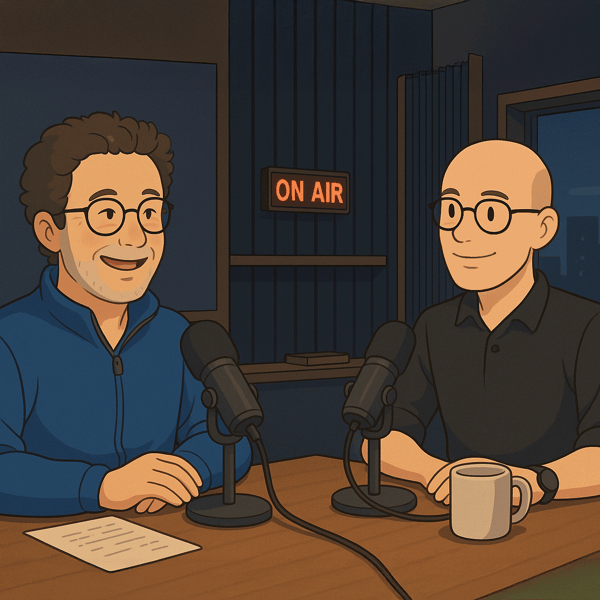
Standing in front of 70 sales and marketing professionals in Boston, MA I couldn't resist a historical reference. "The bots are coming, The bots are coming" I announced, channelling my best Paul Revere as a Brit in Boston.
The room laughed. The data behind the joke isn't funny.
90% of B2B buyers now use generative AI to research and shortlist vendors before speaking to a salesperson. That's Forrester's current data. Meanwhile, 73% of executives ignore messages that aren't personalised. And 38% of all B2B purchase attempts end not with a competitor win, but with a "no decision to proceed."
The status quo is your biggest competitor.
Buying groups have ballooned. Gartner tracked them growing from 7-12 people in 2016 to as many as 20 today. More stakeholders means more competing priorities, more internal politics, more friction. The complexity isn't in finding information anymore. It's making sense of it fast enough to bring a point of view.
Your customers are using AI to prepare for conversations with you.
If you're not doing the same, you're turning up to a gunfight with a spreadsheet.
Choosing the hard mode
Here's where I made things interesting for myself. When building the demo scenario for my talk, I decided to use a real company as the selling account. Not just any company - one that would have people in the room. New England Biolabs.
For those who don't know NEB, they're a 50-year-old reagent company with a stellar reputation for quality and scientific rigour. They're also the kind of organisation whose team members attend SAMPS conferences. Which meant that as I walked through my AI-powered account analysis, buying-group mapping, and personality profiling, the actual team I was pretending to be a part of were sitting right there in the audience.
No pressure.
I used Humantic AI's account intelligence tool to generate a full report: executive summary, top challenges, industry context, talk tracks, discovery questions, next best actions. I mapped a fictitious buying group: CEO, Director of Strategic Research, Director of Regulatory Affairs, Head of Plant Science Innovation, Chief Strategy Officer.
Then I profiled each person using Humantic's personality analysis tool. I knew who was a Dominant driver who wanted speed and outcomes, and who was a Conscientious critic needing data and structure. I even had a "magic quadrant" showing who might be a Crusader, who would be a Skeptic, and who would stay Neutral.
I had everything. And I still couldn't hold it all in my head when the pressure was on.
The 50 percent wake-up call
When I first ran through the scenario using Yoodli - an AI role-play tool that simulates buyer conversations - I scored 50 percent. Half marks. A failing grade by any reasonable standard.
The NEB folks in the audience found this hilarious. I told them I'd failed the job interview. At 50 percent, they weren't arguing.
The issue wasn't that I'd gathered the wrong information. It was that I'd gathered so much information I couldn't deploy it fluidly. Salespeople spend only two hours per day actually selling, according to HubSpot. The rest is admin, research, meetings, CRM updates.
When you finally get in front of the buyer, you don't have time to re-read a 15-page account brief.
Gathering isn't learning.
The missing layer
So I turned to NotebookLM.
I uploaded everything: the account intelligence report, the personality profiles, the buying-group analysis. Then I used NotebookLM to generate different learning modalities. Quiz cards to test my recall. A podcast-style audio overview I could listen to while walking. Video summaries for the visual concepts.
The shift was immediate. Instead of passively reading information, I was actively learning it. The material moved from my screen into my memory.
With the knowledge internalised, I went back to Yoodli. Second attempt: 70 percent. Third attempt: 85 percent.
The difference wasn't more information. It was confidence built through repetition. I'd heard myself say the wrong thing, adjusted, and tried again. No risk. No lost deal. Just deliberate practice.
Some sales leaders insist these tools are crutches - that real selling skill comes from live reps, not simulations. There's something to that. No AI scenario fully replicates a CFO going off-script or a champion suddenly going cold.
But even elite athletes have coaches. Surgeons practice on simulators. Pilots drill emergencies they'll hopefully never see.
The goal isn't to replace live experience. It's to compress the learning curve so that when you're in the room, you've already made your mistakes somewhere safe.
The stack in practice
Here's the workflow I now use before any complex sales conversation:
Layer 1 - Account intelligence: Use tools like Humantic MIIA or deep research prompts to surface strategic priorities, financial pressures, and industry context. Output: a customised value proposition aligned to what matters.
Layer 2 - Buying-group mapping: Identify who's in the room. Use SciLeads, LinkedIn, or your CRM. Don't stop at job titles - understand responsibilities and success measures.
Layer 3 - Personality profiling: Apply DISC or similar frameworks to understand how each person prefers to engage. A Dominant buyer wants speed. A Steady buyer wants reassurance. The message doesn't change - the delivery does.
Layer 4 - Synthesis and learning: Upload everything into NotebookLM. Generate quiz cards, audio summaries, conversation guides. Move the information from documents into memory.
Layer 5 - Practice and feedback: Use Yoodli or similar tools to rehearse. Record yourself. Review the coaching. Iterate until the talking points feel natural, not scripted.
The output isn't a script. It's readiness.
The human at the end
Despite all the AI in the buying process, customers still want a human at the end. Someone accountable. Someone who will fix things when they go wrong. Someone they trust to make stuff happen.
AI doesn't have that agency.
You do.
These tools exist to help you show up better prepared, more confident, and more attuned to what each stakeholder needs to hear. They compress the preparation time so you can focus on building more meaningful and valuable connections.
I may not have closed the deal. But at least I know I did my homework.
Q: How long does this prep process actually take? ▼
A: The first time through, expect an hour or two per account. You're learning the tools, figuring out what works, building muscle memory. But here's the thing - most of that time replaces work you're already doing less efficiently.
The real question isn't how long it takes. It's how much pipeline you're losing by showing up underprepared.
Q: Do I need all five layers, or can I start smaller? ▼
A: Start with layers four and five - synthesis and practice. Most salespeople already gather information. The gap is turning that information into recall under pressure. Upload whatever research you already have into NotebookLM, generate some quiz cards, and run one role-play in Yoodli. You'll see immediately where your gaps are. Then work backwards to improve your inputs. The stack is modular. Use what you need, add layers as complexity demands.
Q: What if my company won't pay for these tools? ▼
A: Most of this stack has free tiers. NotebookLM is free. Yoodli has a free version. LinkedIn is already in your toolkit. The paid tools like Humantic accelerate the process, but they're not mandatory. You can build buying-group maps manually and use publicly available information for personality signals. The methodology matters more than the specific tools. Start scrappy, prove the value, then make the business case for investment.