

When to Fight Leadership on Testing
Vulcan, the Roman god of fire and the forge, crafted Mars' battle sword using techniques perfected over centuries. The weapon performed flawlessly in traditional Roman warfare. When Mars returned requesting the same sword for the Gallic campaign, other gods expected immediate delivery. The design was proven. The metallurgy was identical. Why waste time on additional testing?
Vulcan refused. Gallic warriors fought differently. They used irregular cavalry charges through forests rather than organized phalanx formations. They wielded longer blades creating different parrying dynamics. Combat conditions introduced variables his forge testing never encountered. He insisted Mars test the sword in training that simulated Gallic fighting styles before the campaign. The other gods called it excessive. Vulcan called it validation of field conditions.
When the sword failed in the first engagement (the blade's weight distribution proved wrong for mounted combat), Mars survived only because Vulcan had prepared a backup design informed by those training sessions. As Product Managers (PMs) in life science tools, we face identical pressure when leadership labels products as line extensions to avoid New Product Development (NPD) timelines and alpha/beta testing requirements.
The Real Cost of Mislabeling
In conversations with several life science PMs over the past eight months, over half reported leadership pressure to classify products as line extensions to reduce NPD timelines. The pattern is remarkably consistent: the same customers, in the same workflow, for the same applications, and the product specs are identical or nearly identical to a parent product. Internal verification and validation (V&V) confirm everything works. Leadership sees no technical differences and classifies it as a line extension to compress launch timelines.
Then field conditions expose the gaps. Post-launch validation work is needed, delaying revenue by up to 12 months. The failures were not technical. The products performed exactly as designed. The failures were contextual. Pharma QC groups rejected products because validation documentation did not meet their regulatory filing requirements. Academic customers in new geographies could not get institutional approval because the product lacked regional compliance certifications. Sales teams could not close deals because the product missed segment-specific proof requirements that beta testing would have surfaced.
The pattern is consistent: leadership mislabels to compress timelines, the deployment context contradicts the label, and PMs absorb the damage. Field teams spend 4-8 months troubleshooting issues that were not product failures but deployment gaps. Engineering burns $60K-$120K generating validation data or documentation that should have been scoped during development. Revenue delays by two or three quarters. And the PM's VP questions their judgment on launch readiness.
True line extensions serve the same customers, in the same workflows, for the same applications. You already validated what 'good' looks like through the parent product. Internal V&V might suffice because you are not guessing about segment-specific requirements. But when leadership “mislabels” products to get to market more quickly, post-launch reality becomes your problem to solve.
The Three-Dimension Customer Reality Framework
The strongest version of this conversation happens before leadership locks in the classification, not after. Run this assessment at the stage gate, not in a post-launch debrief. Clayton Christensen's Jobs-to-be-Done framework applies perfectly here: if customers are hiring your line extension to do a different job than your parent product, you have not validated the job-specific success criteria yet. Like Vulcan refusing to assume Roman warfare validated Gallic combat performance, PMs must assess whether parent product testing actually validated the deployment context this variant will face.
Assess your line extension across three dimensions before the NPD classification decision is made. If any dimension differs from your parent product, the line extension label is wrong and customer testing becomes essential.
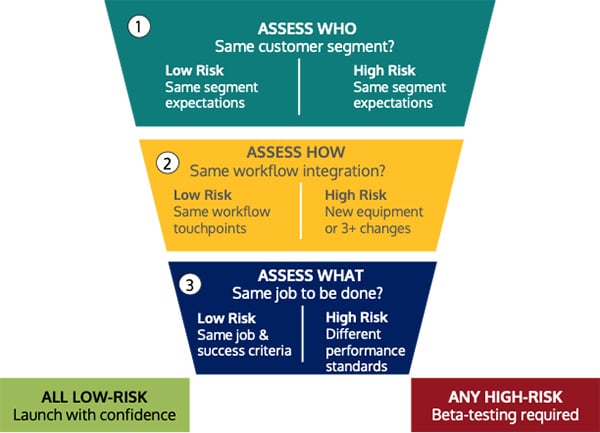
Dimension 1: WHO Is Using It (Customer Segment)
Are you targeting the same customer personas as your parent product, or are you entering segments with fundamentally different workflows, success criteria, and validation requirements?
Low-Risk Criteria:
- Less than 20% difference in technical validation requirements
- Same procurement process and purchasing authority
- Same performance tolerance and QC standards
- Different regulatory framework (academic to pharma QC, research to clinical)
- Different purchasing authority (lab manager to compliance officer)
- Different validation documentation requirements (publications to regulatory filings)
Example: Your ELISA kit serves academic immunology labs and extends to academic neuroscience labs. Both are academic researchers with similar purchasing processes, lab infrastructure, and performance expectations. Parent product validation likely covers this deployment context.
High-Risk Criteria:
- Different regulatory framework (academic to pharma QC, research to clinical)
- Different purchasing authority (lab manager to compliance officer)
- Different validation documentation requirements (publications to regulatory filings)
Example: Your qPCR master mix serves academic researchers and extends to pharma QC labs. The chemistry is identical. Internal V&V confirms the product performs perfectly. But pharma QC requires lot-to-lot consistency data across 20+ lots, certificates of analysis with parameters your academic customers never requested, stability data under GMP storage conditions, and validation documentation that meets FDA guidance. The product works. The product without this validation package does not meet pharma QC reality. Alpha testing with two pharma sites reveals exactly what documentation and data your launch package needs.
Dimension 2: HOW They're Using It (Workflow Integration)
Does your line extension integrate into workflows the same way as your parent product, or do specification changes alter workflow touchpoints in ways that require new validation?
Low-Risk Criteria:
- Workflow touchpoints identical, only concentration or volume changes
- No new equipment required
- Same data analysis and interpretation methods
- Three or more new workflow integration points
- Requires new equipment or different instrument settings
- Changes upstream or downstream process dependencies
Example: Your western blot antibody ships at 1:1000 dilution and you are launching a 1:2000 variant for cost-conscious labs. Identical protocols with slightly different dilution math. Customers already validated the parent product in their workflows.
High-Risk Criteria:
- Three or more new workflow integration points
- Requires new equipment or different instrument settings
- Changes upstream or downstream process dependencies
Example: Your sequencing library prep kit extending from manual protocols to automated liquid handling. Same chemistry, same reagents, but automation introduces liquid class parameters, tip selection requirements, and deck layout constraints that manual users never encountered. Your product works perfectly when pipetted by hand. Beta sites validate whether it maintains performance when customers integrate it into their Hamilton or Tecan systems with their specific automation configurations.
Dimension 3: WHAT They're Using It For (Application Performance Reality)
Are customers hiring your product to do the same job as your parent product, or are you claiming suitability for different applications with different success criteria?
Low-Risk Criteria:
- Same research application category
- Same sample types and handling requirements
- Same performance specifications and acceptance criteria
- Different application category with different performance metrics
- Different sample types requiring different optimization
- Different dynamic range or sensitivity requirements
Example: Your PCR reagent validated for mouse tissue genotyping extends to rat tissue genotyping. Same research application, same sample handling, same performance expectations. Parent product success criteria transfer directly.
High-Risk Criteria:
- Different application category with different performance metrics
- Different sample types requiring different optimization
- Different dynamic range or sensitivity requirements
Example: Your PCR reagent validated for genotyping extends to gene expression analysis. Same chemistry, but applications have completely different success criteria. Genotyping requires binary discrimination with tolerance for moderate efficiency variation. Gene expression requires precise quantification across a four-log dynamic range with CV below 15% and minimal lot-to-lot variation for regulatory studies. Customers are hiring your product to do a fundamentally different job. Beta testing must validate it performs successfully in that application, not just that it amplifies DNA.
Applying the Framework: Your Pre-Gate Move
Evaluate your line extension across all three dimensions before the classification gets locked in. If WHO, HOW, and WHAT all meet low-risk criteria, accept the line extension label. Internal V&V likely validated the deployment context this product will face.
If any dimension shows high-risk variation, you are heading into field conditions you have not validated yet. Like Vulcan insisting on simulated Gallic combat testing, your Plan A is to raise this before the stage gate decision. Present the dimension assessment with quantified consequences attached. That is the moment when classification is still malleable.
If the label has already been applied, use this as your Plan B defense template: "I understand we are calling this a line extension, but [dimension] changed in ways our parent product validation does not cover. Specifically, [high-risk criteria met]. We are guessing about [specific deployment gap]. If our assumptions are wrong, we will burn [quantified consequence: timeline delay, engineering hours, customer churn]. [Number] beta sites over [timeline] would validate [specific requirement] and prevent that outcome."
Defending Customer Testing
Vulcan did not doubt his sword's quality when he required field testing before the Gallic campaign. He recognized that combat conditions introduced variables his forge testing never validated. The sword's failure in the first engagement proved him right.
When leadership calls something a line extension, assess WHO will use it, HOW they will integrate it, and WHAT job they are hiring it to do. Run that assessment at the stage gate, not in a crisis call six months after launch. If all three dimensions meet low-risk criteria, internal validation might suffice. If any dimension meets high-risk criteria, challenge the label using quantified deployment gaps.
You do not need testing because you lack confidence in the product. You need it because you are launching into field conditions you have not validated yet. Leadership calling something a line extension does not make it one. Customer reality does.