

Strivenn Thinking
Pull up a seat at our
digital campfire
where story, strategy,
and AI spark
new possibilities
for sharper brands
and smarter teams.
You Are Not One Thing
By Jasmine Gruia-Gray
The Five Leadership Modes RUO Life Science PMs Must Master
Vertumnus and the Discipline of the Right Posture
Vertumnus was Rome's most versatile deity. While other gods claimed dominion over a single domain, Vertumnus governed change itself: the turn of seasons, the ripening of fruit, the moment summer yields to harvest. He could shift his form at will, appearing as a soldier, a farmer, a merchant, whatever the moment required. Roman farmers called on him not because he was the strongest god, but because he understood that no single form was sufficient across every season.
Product managers (PMs) in RUO life science tools face the same demand. Your product crosses multiple milestones. At Feasibility, you are reading scientific literature and mapping unmet needs. At Development, you are negotiating scope with R&D and defending your timeline against regulatory reality. At Launch, you are briefing field application scientists (FASes) and recruiting beta sites. No single leadership posture carries you through all of it.
What Happens When You Default to One Mode
The technically excellent PM who stays in Operator mode through every milestone becomes invisible to leadership when strategic decisions are being made. The relationship-first PM who leans hard on Connector mode delivers beautiful KOL summaries but cannot translate them into a defensible claims hierarchy. In RUO tools, where a single instrument platform can serve academic researchers, pharma R&D, and core facility directors simultaneously, the problem compounds across the adoption curve. Your early adopters evaluate on scientific merit and move without peer precedent. Your pragmatist majority won't move until they have reference sites, reorder data, and a publication trail. A PM locked in Connector mode during early adoption cannot shift to the Operator discipline the pragmatist segment demands. A fixed leadership posture is a product that serves one moment and stalls in every other.
Product marketing strategist Tamara Grominsky identified five leadership modes every Product Marketing Manager (PMM) needs to activate: Strategist, Operator, Activator, Connector, and Architect. Her framework was built for the software PMM world. What follows is its translation for RUO life science tools, where the buyer is a scientist, the sales cycle runs through procurement AND a lab PI, and "shaping perception internally" means something very specific when your R&D team still thinks the product is theirs.
Framework credit: Tamara Grominsky, PMM Camp. The RUO life science lens is Strivenn's.
The Five Modes in RUO Life Science Tools
1. Strategist: Shape commercial direction before scope locks
PMs who skip Strategist mode get handed a product to launch rather than a product they shaped. The best-in-class move is a one-page competitive position brief completed at Feasibility, revisited at every milestone. One Arrow, One Answer covers how to define the beachhead hypothesis before scope locks. Fortuna's Wheel Never Stops Spinning covers the four-layer market sizing framework that makes that brief credible.
2. Operator: Make your commercial impact visible
RUO PMs often do significant operational work, coordinating FAS feedback, managing beta sites, driving regulatory documentation, without ever connecting that work to revenue outcomes. Operator mode means tracking outcomes and sharing them. A beta program that surfaces three protocol failure modes is not just a validation exercise. It is evidence that your pre-launch process protects a $2M launch from a field quality crisis. Say that. Write it down. Share it upward. In RUO organizations where R&D owns the product narrative by default, Operator mode is also how you reclaim it. Quantified outcomes are the only currency that shifts internal perception at pace. A note on line extensions specifically: not every product that ships under your portfolio banner carries the same commercial story.
If a line extension is in your near-term roadmap, Your 'Line Extension' Just Cost You Six Months covers when the Operator's job is to reframe the narrative entirely.
3. Activator: Unlock your cross-functional team
At MS3, your cross-functional team includes R&D scientists, a regulatory affairs lead, and FASes who have not yet seen the product. Activator mode means understanding what each of them needs to move faster, not just what you need from them. If your FAS team is hesitating on beta recruitment, the bottleneck is usually unclear success criteria, not lack of motivation. Fix the criteria. The team will move.
4. Connector: Build relationships that survive milestone transitions
In life sciences, Connector mode is most valuable at the handoff between Development and Launch. The relationships you build with your top two or three KOLs during beta are not just validation assets. They are the foundation for your publication pipeline, your conference presence, and your early adopter program. Map those relationships deliberately before MS3. Know who will publish, who will present, and who will refer. The distinction between an early adopter, and an early customer matters here more than anywhere else in the phase gate process. An early adopter will publish, refer, and reorder. An early customer will not. Don’t forget the internal plane. The Connector work with your R&D lead, FAS team, Sales team and regulatory affairs counterpart, done early, is what makes the external KOL relationships commercially actionable later. For a precise framework on recruiting the right cohort and reading their behavioral signals, The Soft Launch Isn't a Safety Net is the companion read.
5. Architect: Lead your milestone process with intention
Architect mode means designing how your team makes decisions, not just what they produce. In RUO tools, this often looks like establishing a clear framework for scope descoping at each milestone: what evidence is needed to remove a feature without removing a “must-have” user requirement or triggering a political battle with R&D. The milestone review becomes a structured decision, not a negotiation. The hardest version of Architect mode is the end of lifecycle, when the decision framework you built must survive commercial pressure to extend a product past its useful life. Sales Wants One More Quarter, R&D Quit Six Months Ago covers that conversation.
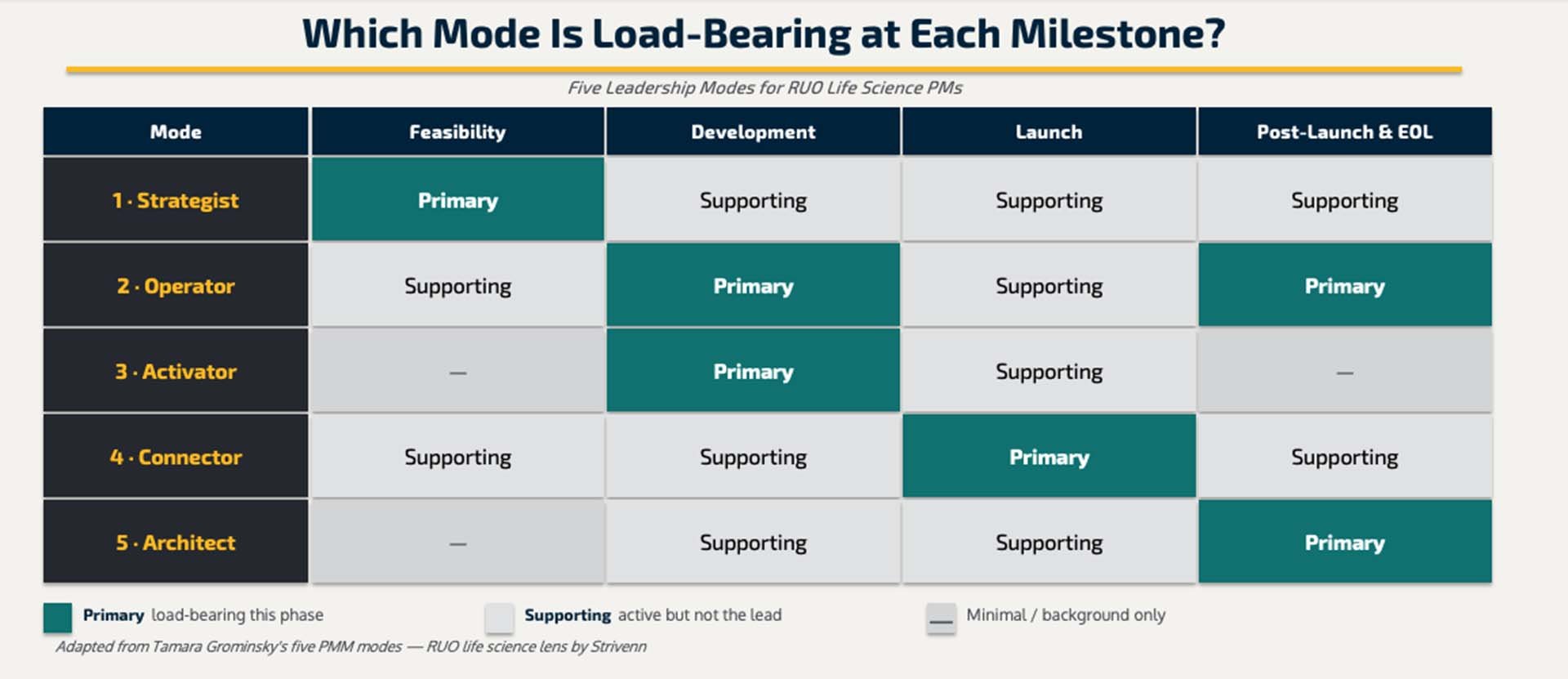
Vertumnus Knew the Season
Vertumnus did not shift form randomly. He read what the moment required and responded with exactly the right posture. That is the discipline available to you. At each milestone/phase gate, one or two modes will be more load-bearing than the others. The skill is recognizing which, and being willing to step into them, even when they feel unfamiliar.
You already have these modes. You use them in fragments every week. The work is making the shift intentional.