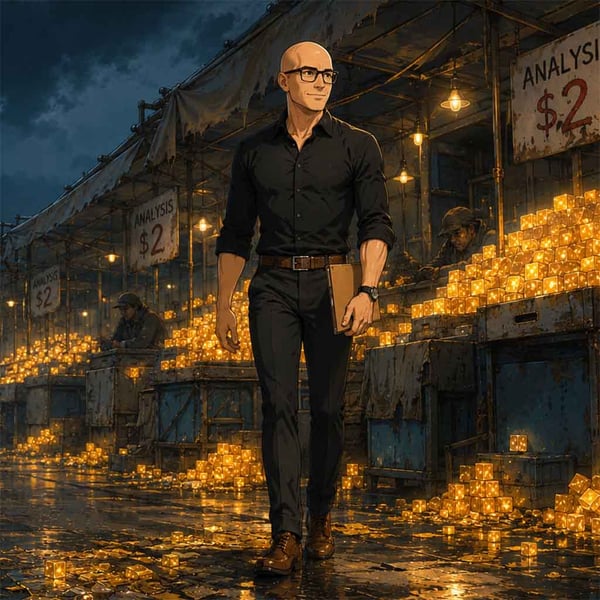

This is a (stylised) story about a product launch that should have worked.
Nadia had spent months cultivating the pre-eminent researcher in single-cell sequencing. She had flown to his institute twice. She had walked his lab. She had given him the platform on a beta agreement and waited.
During testing he was effusive. Throughput he could not believe. Accuracy that would change what was possible in personalised oncology. By the time the conference launch came around, Nadia knew what was coming, but she did not know it would be quite like this.
The presentation was extraordinary. He framed the platform as the single biggest improvement in single-cell throughput and accuracy he had seen in a decade. The results were staggering. He walked the room through how this could revolutionise personalised oncology, and the room moved with him. Heads nodding. Murmurs in the rows. By the time he reached the closing slide, the audience was already half on its feet.
The applause was real.
The afternoon Nadia trusted
The booth is three deep until the conference closes. The sales team is taking names and filing the trip as the strongest pre-launch signal the company has ever recorded. By the time the conference dinner ends, Nadia is mentally drafting the launch update for her Chief Executive Officer (CEO). Oncology expert endorses platform at flagship venue. Pre-launch traction strong across target segment. Finance will unlock the next tranche. The board will see a marketing function delivering.
She goes back to her hotel room that night and looks at the persona deck on her laptop. One figure on the cover. An expert in oncology. Decision criteria listed neatly underneath. Influence. Validation. Publication. Advocacy. Every box ticked at the conference that afternoon.
She sleeps well.
That is the moment the story turns. Nadia does not feel it turn. She will not feel it turn for six more weeks.
What Nadia cannot see
Three days after the conference, a quote goes out to a research university with a core facility that owns the screening platform Nadia's company is trying to replace. The lead Principal Investigator (PI) signed off on the evaluation. The procurement office is in the loop. The sales lead has called this account a high-probability win since March.
What Nadia cannot see is the email the lab manager sends to her institutional finance officer on Tuesday afternoon.
The lab manager has done the maths. Three years of consumables, ten users, the protocol revalidation she would have to fund from the same grant pool that pays for student stipends. The maths does not work. She tells finance the platform is impressive but the operational economics do not justify the switch. Finance agrees in two lines. The PI hears about it three days later and while he pushes back, he is not armed with the right information to make the business case.
The deal is dead before the sales team has called back to book the next demo.
Nadia's Customer Relationship Management (CRM) system still shows the account as active. The forecast still has the deal in week eight.
This pattern repeats. Four more accounts across the next four weeks. Each time, the failure happens in a room nobody from the company is in. Each time, the killing question is operational economics or protocol stability or service terms. Each time, the deal dies before it reaches the stage the sales motion was built for.
A note on what is happening underneath. Life science tools sales typically run through a buying committee of five to eight people across science, operations, procurement, and sometimes IT. The persona deck collapses that committee into a single figure who tends to look like the most visible role, which is usually the methods authority. The visible role is rarely the deciding role. The deciding conversations happen in rooms the marketing function does not have signal from, because the deck never told the team to look there.
Nadia is still living in the methods session.
The week the numbers arrive
It is week eight. The Chief Financial Officer (CFO) sends Nadia a one-line message. Numbers are following pipeline projections. Call me when you're free.
Nadia knows what is coming. She walks to the CFO's office anyway, because the alternative is sitting at her desk and feeling the floor move.
The launch is forty per cent below forecast.
The CFO is not angry. She is something worse. She is asking for an explanation.
Nadia starts to talk about competitive entry, sales cycle elongation, procurement timelines in academia versus pharma. She hears herself doing it. The words are coming out of her mouth and she can hear they are wrong. The CFO is not asking why the market is hard. The CFO is asking something simpler.
Why did we believe this would work?
Nadia does not have an answer to that question yet.
What the forensics show
She spends the next week tearing the launch apart by hand.
The picture is unambiguous and it is not what the persona deck told her to expect. Across thirteen failed or stalled accounts, the signal from the methods authority at the conference was the highest-quality signal the company got. Every authority in the target segment had said yes. The deals kept stalling.
Lab managers killed them at Total Cost of Ownership (TCO). Lead PIs deferred because the methodological switching cost did not fit their direction. Bench scientists abandoned the platform within fourteen days of demo because they couldn't maintain protocol stability on their own samples.
The pre-launch testing had been calibrated to the authority audience. It tested nothing that the actual killers of the deal cared about.
The deck on Nadia's laptop has one person on the cover. The deal-killers were three different people, none of them were even in the deck. The persona research was silent about three of the four roles that actually decided whether the platform got bought.
This is the moment the story turns for real. The one Nadia missed at the conference.
The four roles hidden behind one persona
The buyer is not a person. It is a committee in motion, with four roles the persona deck has been treating as one.
.png?width=200&height=200&name=The%20Scientific%20Authority%20(KOL).png) |
1. The scientific authority (KOL).Senior PI, group leader, or recognised expert who first validates the platform and whose name appears on foundational publications. Drives scientific consensus and peer influence. Does not sign purchase orders. Does not own platform budget. The KOL is a signal source, not a buyer. |
 |
2. The lead PI in the buying lab.Group leader at the evaluating institution. Controls research direction, owns the grant or programme budget, signs for capital equipment within authority limits in academia, recommends up the chain in pharma research. Cares about scientific fit and methodological switching cost. |
 |
3. The lab manager or core facility director.Runs operational economics. Evaluates Total Cost of Ownership (TCO), consumable footprint, maintenance burden, throughput per Full-Time Equivalent (FTE), and integration with the existing equipment stack. Owns the core facility profit and loss in academia. Sits adjacent to procurement in pharma research. Most common killer of capital purchases. |
|
|
4. The bench scientist or research associate.Runs the experiments. Evaluates user experience, protocol stability, training time, and failure rate on actual samples. Feedback reaches the lead PI within two weeks of any demo. Controls adoption past the second protocol run. |

The persona deck collapsed these four into one. The collapse is why the launch missed.
What Nadia walks back into the room with
The architectural answer is not better KOL research. It is four queryable buyers instead of one persona. Each grounded in evidence specific to the role they play. The authority queried about science. The lead PI queried about direction and switching cost. The lab manager queried about TCO three months before launch, not three months after. The bench scientist queried about whether the protocol will hold.
Four queryable buyers. Four evidence bases. Four sources of signal that were never decompiled.
Nadia goes back to the CFO with an answer to the question that was actually being asked. Not the deflection about competitive entry. The real one.
We believed this would work because our persona research had one buyer on the cover. The buyer who killed our deals was somewhere else in the building. We have not been wrong about the science. We have been wrong about who we were selling to. Here is what we change from this launch forward.
The CFO does not smile. She nods. She has been waiting for this answer for two weeks.
The applause from the conference session is gone now. What was happening underneath it can finally be heard.
For the structural account of why this pattern is the default in life science tools and diagnostics commercial work, read our pillar page on why buyer persona research fails in life sciences. For the architecture that gives Nadia four queryable roles instead of one persona, our synthetic customer hub walks through how it is built and how teams use it.
The fix is not just better research. The fix is understanding the buying roles people play and the evidence each role actually needs.