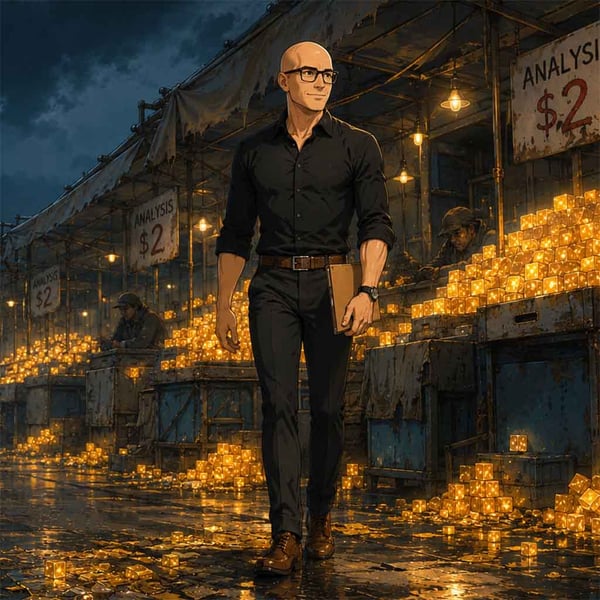

I have been home from Mark Schaefer's Uprising for a little over a week. I've spent a lot of time thinking about the phrase "trust portfolio" and a framing of personal branding I'd missed.
That framing came during a fireside chat between Mark Schaefer and Joe Pulizzi. Burn the Playbook, the title of Joe Pulizzi's latest book is a good title for what is happening in my head and leads to two confessions I owe before the rest of this post will make any sense.
Confession one
I have not been ignoring personal branding for the last twenty years. I have been doing it. Building my own profile with help from Mark Schaefer's RISE community, working through the principles in his book KNOWN, and last year giving a talk on personal branding at ACS Fall 2025 in Washington DC that was almost entirely built off the framework in that book.
I knew the work. I had run the playbook on myself.
What I had not done was connect the dots between employee personal brands and a corporate brand architecture. Personal branding was something I was doing for my own ends, career capital, speaking opportunities, my Forbes contributions. I'd never really created the mental map of how that fit into the overarching brand hierarchy, certainly not at scale.
Confession two
This one stings more.
I have been building trust portfolios for life science clients for years without knowing that was what I was doing. Working with the right KOLs to tell the right stories in the right places. Surfacing scientific authority that the corporate brand alone could not carry. It works. It has always worked.
I have also tried to extend that work inside corporate marketing teams. Get your application scientists publishing. Get your senior commercial leads on LinkedIn with their own voice. Get your R&D leadership writing about the problems they actually care about.
Build the same kind of portfolio internally that we build externally with KOLs. However there always seemed to be more resistance than I could understand.
Not because the idea is wrong. Because the pitch was wrong.
Why it kept dying
I was pitching it as a content programme and asking the client to get their people posting on social media. Yet there was always a reluctance, a friction I couldn't seem to overcome.
I thought it was because marketers and product teams are already exhausted and couldn't face the idea of trying to shepherd their scientists.
The simple ask to let's add a programme that gets twenty of your scientists posting in their own voice lands as another headache, not a strategy.
The energy dies in legal review and never recovers.
I had diagnosed the failure as cultural, risk-averse companies and conservative scientists. All true, all real, none of it the actual problem.
The actual problem was that I was selling the wrong thing to the wrong buyer.
What Pulizzi and Schaefer reframed
When Joe Pulizzi sat on stage with Mark Schaefer at the Uprising they described corporate marketing as the equivalent of putting your whole pension into a single stock. One logo. One voice. One channel of credibility.
The alternative was a trust portfolio. Ten stocks. Two will be stinkers. Two might be high flyers. The work of marketing is to manage the portfolio, not protect the single bet.
The machinery is the same machinery I had been pitching for years. The same machinery I had been running on myself. Distinctive voices. Humans publishing in their own name. The brand architecture is completely different.
This is not a personal development exercise. It is a corporate asset allocation decision.
The pitch is not to the comms team. It is to the CFO and the CEO. Single-stock concentration risk is a balance sheet problem, not a content calendar problem. Once it sits on that side of the conversation, the approval gravity stops being a reason to dismiss the work and starts being a budget line item to design around.
That is the line that broke my thinking.
Why the timing is unforgiving
For most of the last twenty years, the single-stock bet was fragile but workable. The corporate brand sat at the centre of the funnel. Demand generation pushed traffic toward it. Sales picked up the warm leads.
AI search has changed the maths.
Bain reports that 44% of online buyers now start their commercial journey in a large language model. Their analysis of around half a billion citations found that 89% of unbranded prompts in B2B categories are fulfilled by non-brand-owned media. Third-party reviews. Analyst commentary. Social posts. Individual creator content.
AI systems do not recognise logos. They recognise patterns. Repeated expertise. Identifiable authorship. Consistent ideas across multiple credible humans pointing in the same direction.
The signals your single corporate voice was built to emit are not the signals AI rewards.
The channel that increasingly decides whether buyers find you is fed by humans who do not work for your communications team. The single-stock bet is no longer fragile. It is brittle.
We already half-run this play
Life sciences has been operating a trust portfolio for sixty years. We call it a key opinion leader (KOL) strategy. We invest in clinicians, scientists and authors whose endorsement carries the field forward. Advisory boards. Symposia. Co-authored papers. The portfolio is real.
It is also incomplete in two directions.
Externally, Pharmaceutical Commerce reports that fewer than 20% of traditional KOLs maintain a meaningful social media presence. Industry analysis suggests around 70% of the most influential healthcare professionals online sit on no pharma KOL list anywhere. The Digital Opinion Leader is harvesting credibility in the channels AI now reads, and most life science teams are barely tracking them.
Internally, the picture is worse. The application specialists, field scientists, senior commercial leaders and R&D voices already inside the building are mostly treated as cost centres. Latent media properties, sitting unbuilt, while marketing teams chase external advocates because the internal pitch keeps failing in the way I described above.
The external half of the portfolio is partial. The internal half is largely empty.
Cisco is perhaps the poster child for an employee personal branding case study. Roughly six or seven years ago, the company recognized it was losing the talent war to "cooler" brands like Google and Apple, and made a deliberate strategic pivot: rather than relying on a single corporate voice, Cisco would invest in the personal brands of its own people. What began as a modest pilot with 20 employees eventually scaled into one of the most ambitious workforce advocacy programs on record, culminating in the CEO announcing a plan to train all 84,000 employees to develop their own personal brands.
What made the initiative distinctive was its explicit rejection of salesmanship. Employees were given a clear directive: "don't sell the stuff".
They were instead encouraged to share authentic stories about how Cisco's technology impacts the world. The pilot alone saw roughly a 25% success rate, surfacing employees who were already natural content creators, such as one young woman who had been independently blogging about the company's global footprint. This focus on genuine human storytelling, rather than scripted brand messaging, is precisely what makes the Cisco model more effective for building trust in an era saturated with AI-generated content.
The closest published life sciences parallel is a LinkedIn case study showing Thermo Fisher Scientific recorded 18% of global hires engaging with employee-shared content before applying, against an industry benchmark of 12%.
Pipeline numbers, surfaced by humans, in channels AI watches.
Where this gets harder
Three challenges worth naming, none of which are reasons to dismiss the work.
- Compliance burdens are bigger in life sciences than anywhere else. The FDA and HHS spent the back half of 2025 tightening enforcement on social media activity by pharma employees and contracted creators. The May 2025 warning letter to Sprout Pharmaceuticals over a CEO's Instagram post is sitting on every regulatory affairs lead's desk for a reason. A trust portfolio in regulated pharma needs MLR review, pre-approved content libraries, adverse event monitoring and clear authorisation rules. It is harder, but it still works.
- Flight risk is real. When a credentialled creator leaves, the audience often follows. The lazy response is to under-invest in people on the assumption they will leave anyway, which guarantees the outcome you were trying to avoid.
- Internal politics are fierce. Elevating ten employees as creators creates asymmetries in visibility, retention conversations and compensation expectations. Senior leaders sometimes resist this with a passion, that resistance is itself a signal of how much the corporate-brand-as-only-stock model is still load-bearing inside the organisation.
The better response is two-sided.
On the inside, build a culture people genuinely want to work in. Trust portfolios are not built on coercion or quotas. They are built on application scientists, commercial leads and R&D voices who actually want to publish, because the company they work for makes that worth doing. Culture is the substrate. Without it, no programme survives its first reorganisation.
On the outside, treat alumni as part of the portfolio rather than a loss on the books. The big consultancies have understood this for decades. McKinsey, Bain and BCG run formal alumni networks because they know that a credentialled former employee speaking warmly about the firm in their next role is worth more than almost any campaign. Life science companies almost never do this. We treat departures as ending the relationship rather than entering its second phase.
Diversify across roles and seniority. Assume some attrition. Invest in relationships rather than rented voices. Then design the alumni half of the portfolio with the same intent as the active half.
Each is a design problem. None is a reason to keep concentrating the bet.
What I am changing
I came home from the Uprising and pulled apart the way I pitch this work to clients. The diagnostic was set one floor too low.
The question I have been asking is whether your brand is showing up in AI answers. The deeper question is whether you have a portfolio of credible humans whose consistent expertise is being read, cited and synthesised by the systems your buyers now use to choose. Answer the second question, and the first answers itself.
I had been running the playbook on myself for years. I had not been running it for the people I was paid to advise.
I had heard differently. I had not learned differently.
A week of processing and a half-read book later, I am pitching the work differently too.
The trust portfolio is a balance sheet question.
It might be the most important one your marketing function asks in 2026.