
logo
MCP server
ARCHITECTURE AND GOVERNANCE 

The Strivenn MCP server

Built to survive a governance review

Like magic that explains itself

You have watched a synthetic customer take your positioning apart and hand back something sharper than the version you walked in with. 


Then the questions start. Your CEO wants to know whether an answer from this thing can sit in a board pack. Procurement wants to know where your customer evidence lives and who else can see it. Your AI governance reviewer wants to know what the system is permitted to do when nobody is watching.


Why not just upload the files?


You can. Drop your voice of customer transcripts and a CRM export into ChatGPT or Claude, and you will get useful work back: themes summarised, patterns surfaced, a first messaging draft. For some jobs, that is all you need.
 
What you will not get is a governed synthetic customer that will give you consistent results across teams. An upload gives a model access to information. It also gives that model license to fill any gap in your evidence with a confident inference, because helping you reach an answer is what it was built to do. You will rarely see the join.
 
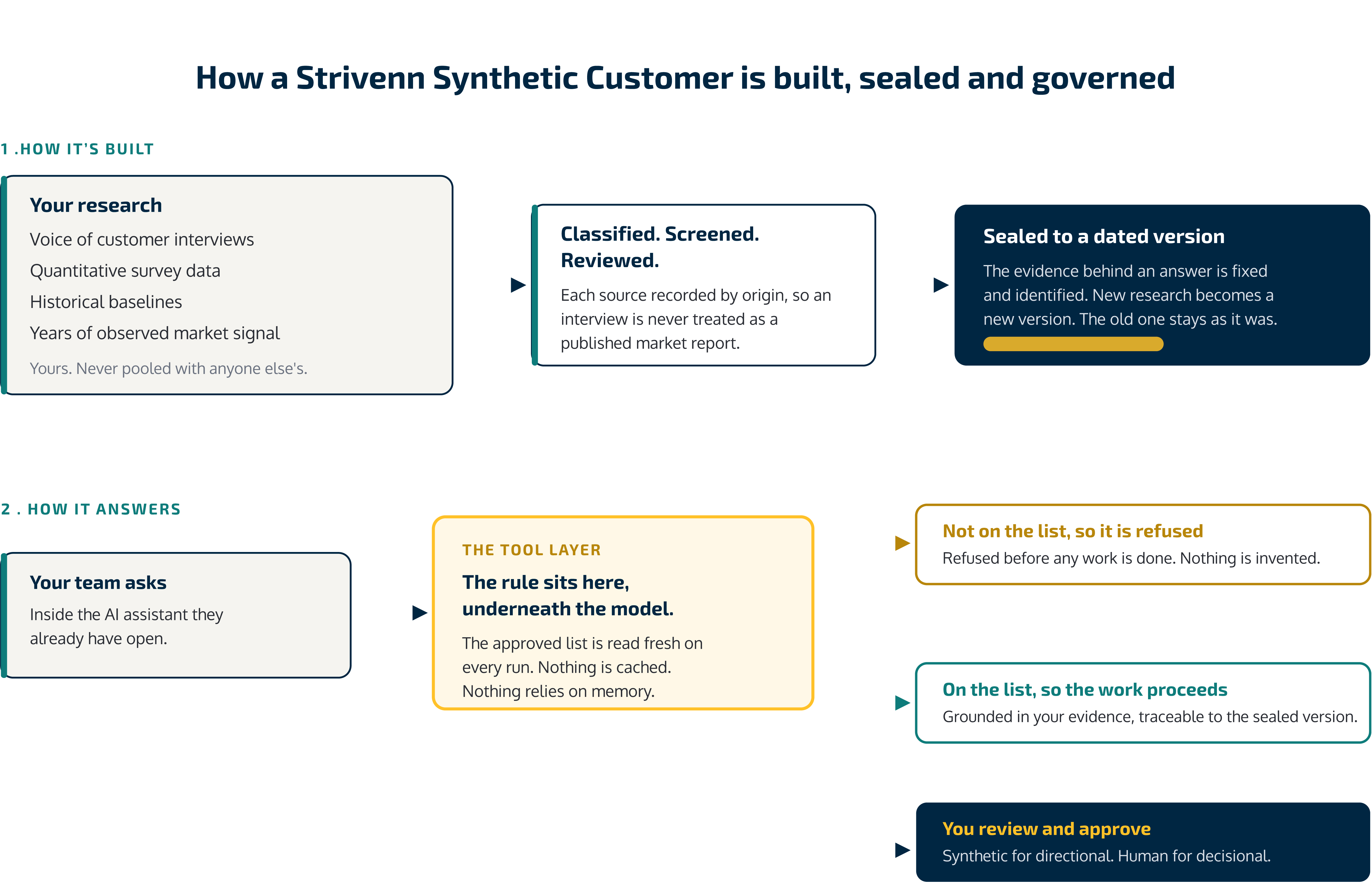
A Strivenn synthetic customer puts structure around the same evidence. It answers from the evidence attached to a defined buyer profile rather than from everything in the window. It shows you what supports an answer, so you can separate customer evidence from system inference. You can pin it to the evidence that existed on a given date. 
 
Any model can read your customer research. Whether you can trust what it does after reading is a different question, and that is the question your reviewers are actually asking.

The whole mechanism, on one page


strivenn-mcp-architecture 26 Aug2


Three principles for peace of mind

GOVERNANCE AT THE TOOL LAYER

Claims and responses you can trust

Your core claims have been approved by regulatory. and others have been retired and must never appear in published work again. In most AI systems, a policy like that lives in a document, and the model is asked to remember it. Memory is not a control.


In this architecture, the policy is a live list the system reads at the moment of use. Every tool that produces content takes an optional destination identifier. If you supply an identifier that isn't on the list, the request is rejected. The list is never cached, so outputs align the minute the policy changes. Retired claims will never resurface, which means they cannot be published by a new starter, a rushed campaign, or a model trying to be helpful.


That is what governed at the tool layer means. Apply the same pattern to brand names, to approved terminology, to anything your compliance function currently polices by review. A research library has nothing to govern, because all it does is return documents you went looking for.

WHEN IT SAYS NO

When no is the useful answer

General-purpose models are built to help. A governed synthetic customer sometimes has to do the opposite.


If your evidence does not answer the question, "we do not know yet" beats a polished paragraph. It tells you exactly where your evidence base is thin, and it names the next question worth taking back to real customers. A gap you can see is a research budget you can justify. A gap the system papers over becomes a claim in a launch deck that nobody can source six months later.

Answers traceable to source and version

 
A synthetic customer that quietly changes its mind is useless inside an approval process.
 
Each evidence base is sealed to a dated version before it answers anything. So when you cite an answer in a March positioning brief and somebody challenges it in September, you can point at the exact version that produced it.
 
New research lands as a new sealed version, and the change is visible instead of silent.
 
Regulatory and legal reviewers tend to relax at this point in the conversation, because reproducibility is the thing they were about to ask for.
 
strivenn-technical-stack Aug 26


Approval from the first connection

On Claude Team, Claude Enterprise or ChatGPT Enterprise, an organisation owner has to approve the connector before anyone in your organisation can reach it. You cannot do that from your own account. On individual and small team plans you can connect it yourself in a few minutes.
 
We tell you this before you buy rather than after, because discovering it afterwards would be a poor way to begin.
 
If the approval sits with somebody else, ask us for the note. One page, written for the person signing it off: what the connector does, what it reaches, what it refuses, and where your evidence lives.
FOR IT AND AI GOVERNANCE

Governed like any business tool

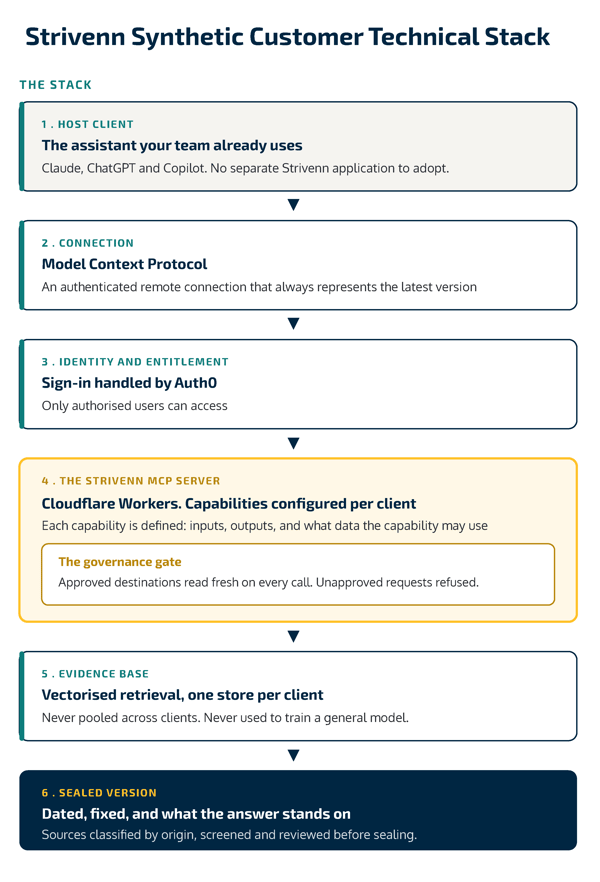
Your team reaches the synthetic customer inside a supported AI environment: ChatGPT, Claude or Microsoft Copilot, depending on your organisation's technology and approval requirements. That environment connects to Strivenn through a controlled interface, which in some implementations uses Model Context Protocol. The synthetic customer then works only from the evidence and capabilities configured for your organisation. There is no new application to roll out and no login for anyone to forget.


For reviewers, the architecture is deliberately unremarkable. Access is authenticated, and in managed environments it is gated behind organisational approval. Retrieval is scoped to your evidence store, so the synthetic customer cannot reach information outside it. Capability is enumerated: the connector exposes a fixed set of tools and nothing beyond that set exists to be invoked. Requests falling outside the available evidence or the granted permissions are refused rather than improvised.


In plain terms: no unrestricted access to information, no route to operate beyond its approved role, and it can be reviewed, versioned and switched off like any other business tool rather than treated as an open-ended prompt.

Synthetic for directional,
Human for decisional

The Market Research Society has published on where synthetic respondents fail. ESOMAR reached the same conclusion. Read both before you buy anything in this category, including ours.


Their criticism is fair, and it lands hardest on the thing most vendors are selling: a model prompted to imagine a buyer, producing answers drawn from an average of the internet and presenting them with the poise of primary research. That critique also applies to us the moment the evidence underneath goes thin, which is precisely why the sealing, the traceability and the refusal behaviour above exist.


A Strivenn synthetic customer stands on primary research. Voice of customer interviews. Quantitative survey data. Historical baselines that show how the market moved. Years of observed market signal. That changes what the output is worth. It does not change the rule. Use it to stress-test thinking between research cycles, then validate with real buyers before you commit.


The human still owns the decision

A synthetic customer can challenge your assumptions, interrogate the evidence you already own and expose the gaps in your thinking before a launch does it for you. It should not decide whether you launch a product, approve a claim, enter a market or commit investment. Your voice of customer programme, your customer interviews and the people accountable for the final call all stay exactly where they are.


Anyone selling you a synthetic customer that closes the loop on its own is selling you something that will fail a professional review, and that review is coming.

Better use of the evidence you already have


Your organisation has already bought the interviews, run the surveys and filled the CRM. Most of it is sitting in a folder somebody has to remember to open. A grounded, governed synthetic customer turns that evidence into a buyer your team can question on a Tuesday afternoon, and into an answer you can defend when the questions come from above you.

What you'll walk away FROM THE CALL with:
A diagnosis of where your content is drifting from the buyer
The two highest-leverage points to close the gap
A one-page summary you can defend internally

Frequently Asked Questions

Why can we not just upload our voice of customer and CRM files into ChatGPT or Claude?
Does this replace primary voice of customer research?
Can we see where an answer came from?
What happens when the evidence does not support an answer?
Is our evidence shared with other Strivenn clients?
Can we reproduce an answer months later?
What stops it publishing an offer or link we have retired?
Do we need IT approval before we can use it?
Does it use Model Context Protocol?

Championing Responsible AI

As a BSI AI Management Practitioner, Matt is equipped to implement the ISO/IEC 42001:2023 framework, conduct AI System Impact Assessments, and deploy best-practice risk controls, backed by the internationally recognised BSI Mark of Trust.

mark-of-trust-practitioner-AImanagement-black-logo-En-GB-0824-yellow