
Marketing loves to call itself the voice of the customer. But how often is that voice actually heard when the decisions get made?
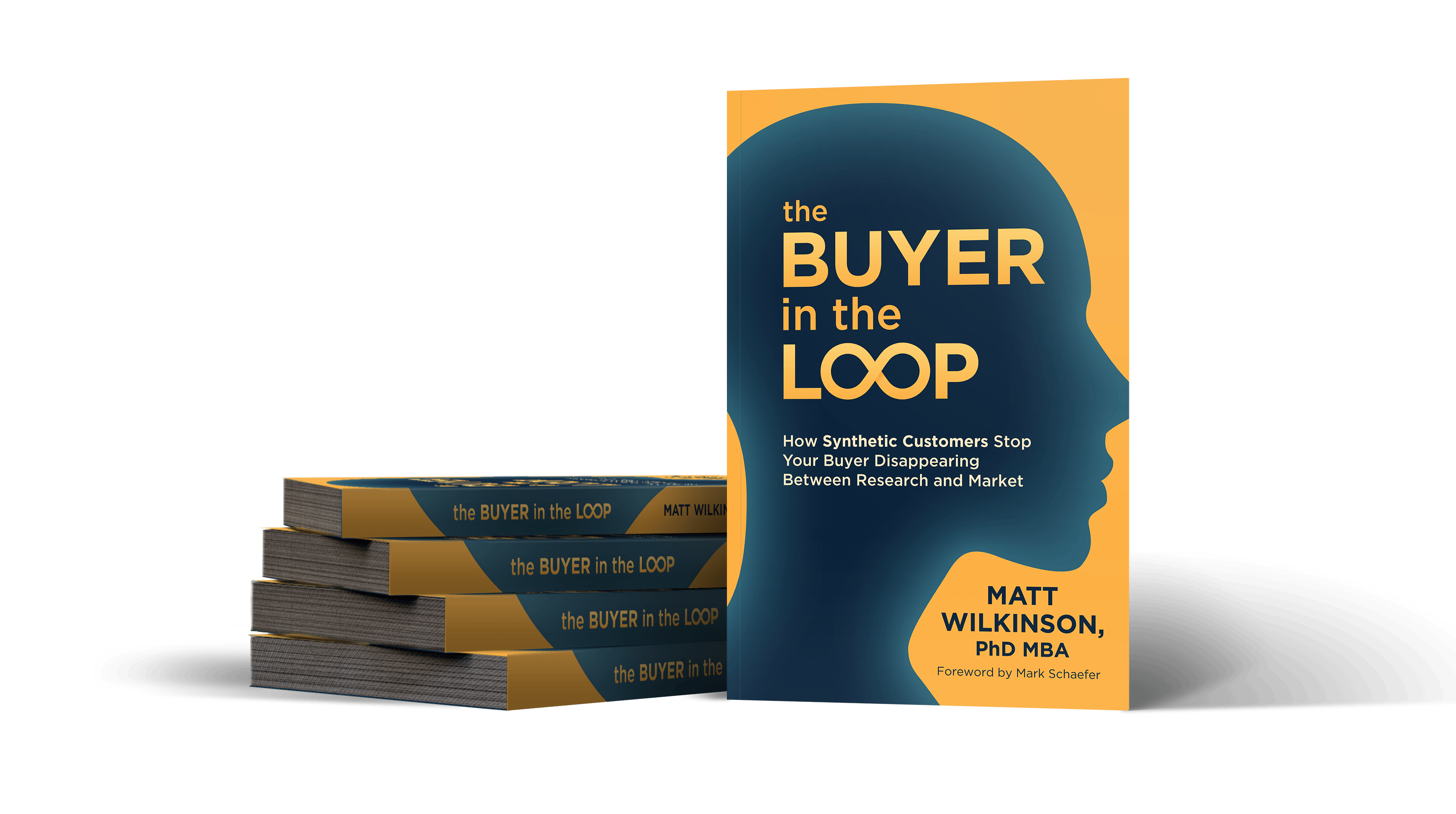
This is why I wrote The Buyer in the Loop: to explore how customer understanding gets lost between the research and the final commercial decision, and how grounded synthetic customers can keep it alive.
So imagine my delight when I met a marketer who was already putting that thinking into practice at Marketing Week’s Festival of Marketing (an event I highly recommend UK-based marketers attend).
His team has turned existing customer research, from panel surveys to ethnographic studies, into grounded synthetic personas. Copywriters and marketers can question them as they work, bringing real customer evidence into decisions where the customer would otherwise be absent. When that evidence becomes outdated, the team returns to real customers to refresh it.
The data is real. Only the personas are synthetic.
I happened to have a copy of my book in my bag. I gave it to him and told him I wished I'd interviewed him for it.
It was gratifying to see the book's central idea working in someone else's hands. But the rest of the day raised a harder question.
If AI can make every marketer better, what's stopping it from making every brand the same?
Individually better, collectively converging
The problem had surfaced that morning on the debate stage, in a session so full of agreement that one panellist called it the worst debate ever. AI, another panellist argued, makes each of us individually a bit better and all of us collectively a bit worse. Distinctiveness drives brand growth, and a tool that nudges everyone towards the same competent answer wears it away.
The opposing side did not dispute the point. A Unilever speaker cited a 2025 LMU Munich meta-analysis of 28 studies and around 8,000 people: humans working with generative AI lift the floor to "good enough", and the work is still not distinctive. Over lunch the phrasing got blunter. AI is very good at averages. One guest called the output digital landfill. Another worried about AI writing content for somebody else's AI to summarise.
I wrote about the root cause last week. Generic AI has never met your customer. Without your own customer evidence, generic AI draws on much the same publicly available knowledge as your competitors. Different prompts may produce different answers, but they're drawing from the same pool of understanding. Put the same average into every marketing team and the same average comes out. The floor rises. The ceiling stays put.
Your customer knowledge is the moat
So what separates two brands using the same model? What each knows about its own customers that nobody else does. How those customers behave, what they say on the phone, why they left, why they stayed.
That knowledge is fragile. I said as much at the table. I have watched client after client run excellent research and then see the customer's voice fade as the work moves through approval chains and into rooms where nobody was in the interviews. Organisational gravity pulls every message away from buyer truth and toward internal consensus.
The distinction the marketer I mentioned earlier drew between grounded synthetic customers and ungrounded ones matters, and it blurs easily.
Research would have killed Hells, and Liquid Death
There is a second thing to protect, and grounded data alone will not save it.
During a fireside chat, Sir John Hegarty took questions and was in no mood to flatter the room. "Data is knowledge," he said, "but it doesn't have answers." His examples were ideas that research would have stopped dead.
Camden Town Brewery, which he chaired, called its lager Hells. He pictured the research coming back six months later with a firm no. They launched it anyway, because they loved it. Hegarty recalled it took a ten-minute boardroom conversation, where most brands would have spent eighteen months on research, agencies and then more research.
He also cited canned water brand Liquid Death, and how most brands would have been told “you can’t do that” but to survive a brand has to engage and entertain.
Neither was the average answer. Both challenged convention. AI might generate ideas like these, but it takes human judgment to recognise their potential and courage to back them.
Here I have to be careful with my own argument. Synthetic customers can turn into that eighteen-month research process at higher speed. Put a brave idea in front of a panel of personas, ask them to vote, and they may well call it ridiculous. Use them that way and you have built a faster way to kill Hells.
So I give them a different job. A grounded synthetic customer is very good at telling you what your buyer is wrestling with and where your message will meet friction. That context is what lets a surprising idea land.
Let synthetic customers inform the decision. Don't let them make it.
Good enough has a case
The strongest pushback came over lunch, and it deserves a hearing. AI can now produce creative work that customers can't tell apart from human work, at a fraction of the cost. An MIT Sloan study found people preferred AI-made content until they were told who made what, and then they favoured the human work.
If the results are as good, why pay more?
For stock photography and routine copy, that argument holds. It also raises an uncomfortable question.
If AI can easily replicate your creativity, how creative was it in the first place?
Clicks, leads and sales are within AI's reach. Hegarty aims higher: he calls a corner of someone's mind the most valuable real estate in the world, and that is where brands are built.
When everyone can produce good enough, good enough is no longer an advantage. It's the starting line.
Protect what AI cannot average
I left the festival with one question: What does a great marketer bring that AI cannot?
Two things.
First, the customer knowledge your competitors cannot download. The understanding of what makes your buyers tick, kept alive through grounded synthetic customers.
Second, the courage to do something unexpected. The nerve to back an idea the data would never have voted for.
Grounded synthetic customers can keep the customer in the room. Hegarty reminded me that we still have to be brave enough to make the leap.
Customer understanding gives a brand its truth. Human audacity gives it its edge. Keep both, and AI will make your marketers better while your brand stays your own.
The Buyer in the Loop explores how to keep that customer understanding alive in every commercial decision, from the first brief to the final pitch.