
A Halloween story about the customer who never disappeared.
You can feel it when a market goes cold.
Demo requests slow to a trickle. Reps come back from key accounts with polite nods and no next steps. Then someone at the quarterly review says "soft market", and the whole room relaxes, because a soft market is nobody's fault.
Helen had said it herself. She ran strategic marketing for a diagnostics portfolio, held a PhD from a bench she still missed, and had spent eleven years learning how to defend a number. She believed the market had gone cold. She was about to find out who had really gone missing.
The buyer was warm once
Eighteen months before the product update launch, Helen sat in on twelve customer interviews. One stayed with her.
Ivy managed a hospital lab. She talked about the run that fails at four in the afternoon, with samples queued and clinicians waiting on her. She said she did not need the analyser to be faster. She needed to believe the result without double-checking. Helen wrote that line on the whiteboard herself, and for a few weeks Ivy was the most present person in the building.
Ivy left the building
Then the process went to work. Nobody decided to shut Ivy out.
The brief went first. Product management needed a feature hierarchy for the stage gate, so Ivy's need to trust the results became "enhanced reliability". At launch review the claims team asked, fairly, what "believe the result" would mean in a regulated document, and the line went. By the time sales received its deck, Ivy was a logo on slide nine and a stock photo of a woman holding a pipette the wrong way.
Nobody noticed. Each cut looked like good housekeeping.
Sam kept seeing her
Sam, who ran customer insight for Helen, kept reporting sightings.
A lab manager on a forum, complaining about late-afternoon reruns in words that could have come straight from Ivy's transcript. A rep back from a key account, saying the customer had asked whether she could trust the result and he had nothing on the deck to answer with. A competitor's new homepage leading on confidence at the end of the shift.
Each time, the organisation explained them away. It was just anecdotal evidence. One rep having a bad week.
Ivy's words kept returning. Sam put them back into the brief. Review removed them. They appeared in the next draft anyway. Nobody could quite explain why the same sentence kept finding its way back into the building.
The launch went out on time and on budget. Every internal dashboard was green. Demo requests never came. Deals sat at stage three with "timing" in the notes field, and when the quarter closed short, the leadership team agreed it had been a soft market.
The market went cold
In The Sixth Sense, Malcolm comes home to a wife who no longer answers him, and decides the marriage has gone cold.
Helen read the quarter the same way. The market had stopped answering, so the market must have changed.
Then Helen turned up the volume
There is a scene halfway through the film where Malcolm replays an old recording of a patient session. In a stretch of silence he turns the volume all the way up, and a voice he never heard at the time comes through the hiss. It had been on the tape all along.
Helen's version was less cinematic. Sam's team went back to the raw material underneath the persona, the slide, the brief and the deck: all twelve interviews and every lost-deal call. They built it into a synthetic customer that could only answer from what those buyers had said, with every answer traced back to the transcript it came from. Nobody mistook it for Ivy, and a conversation with her would always count for more. It brought her documented words back into meetings where nobody had heard them for eighteen months. Then Helen asked it what Ivy would make of the campaign.
The answer came back with its sources attached. Measured against Ivy's own words, the hero headline described a machine she already owned. Four o'clock had gone missing from every page. The answer quoted interview seven word for word, with the timestamp there to check.
Helen sat with it for a long time before she understood which way round the haunting ran.
Ivy had never left. She was still in her lab rerunning samples at the end of the shift. The company had vanished from her world.
Like Malcolm, it had kept talking to someone who could no longer hear it, and blamed her for the silence.
Nobody needed exorcising
Helen went looking for someone to blame and found nobody. The CEO had asked reasonable questions about throughput. Claims had protected the company. Product had needed its hierarchy. Every message had drifted for a sound reason, and the organisation had done what organisations always do.
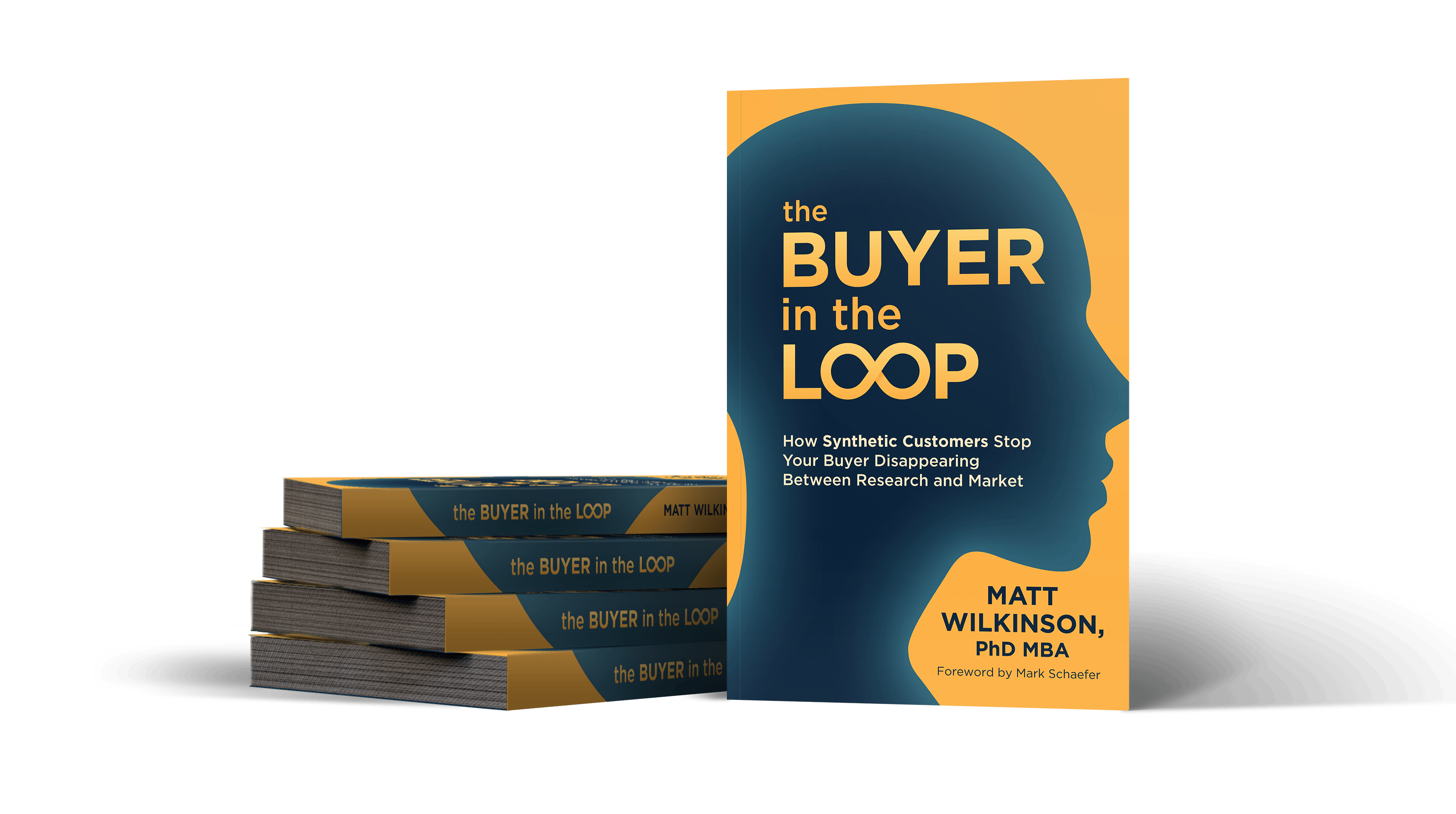
In my book The Buyer in the Loop, I call this organisational gravity: the force that pulls every message away from buyer truth and toward internal consensus. The buyer exits in three places: at inception, at launch and at the pitch. Gravity needs no villain. It gathers where approval authority sits, which is usually furthest from the buyer, and it works through capable people doing their jobs well. That is what makes it so hard to see. A nameless force cannot be designed against.
"Matt Wilkinson has named one of the scariest hauntings in modern marketing: the buyer disappears like a ghost between the research deck and the campaign launch." Ann Handley
So she changed the process. She took the recording into the next leadership meeting, put the CEO's throughput question to the synthetic customer, and let the room hear an answer built from Ivy's own words. The model now sits at the stage gate. In launch review, claims can test a line against what Ivy said and how she said it, with the source transcript a click away. Before key account meetings, reps rehearse against it and hear the question real customers ask. Sam's team still talks to real lab managers every quarter, and every new transcript goes into the model. When someone proposes "enhanced reliability", somebody checks it against what Ivy actually said, and four o'clock comes back into the room.
Six months later the same rep walked back into the same account. The customer asked whether she could trust the result at four o'clock, and this time the answer was on slide one.
Look down before you agree
The boy in The Sixth Sense explains the rule early, and most of the audience misses it. The dead walk around like everyone else. They only see what they want to see. They have no idea they are dead.
Ann Handley is right that the buyer disappears between the research deck and the campaign launch. From the buyer's side, the vendor is the one that vanished, still talking and still wondering why nobody answers.
Sometimes the silence is evidence that you've become invisible to your customers. So the next time someone in your building says the market has gone soft, do what Malcolm did at the end of the film. Look down at your hand, and check whether the ring is still there.
The Buyer in the Loop is about the force that turns your best customer insight into a ghost, and how to keep the buyer present from the first brief to the final pitch.