

What happens to your company's credibility when the person everybody trusts walks out the door?
I had never asked that question until earlier this year, in a fireside chat at Mark Schaefer's Uprising conference. Joe Pulizzi started talking about something he called a trust portfolio, and I assumed I knew where he was going. I have spent years building thought leadership for executives. More people posting, more reach, employee advocacy with a new label.
Then Joe talked about it the way an investor would, and the floor moved. I had always treated these voices as a marketing tactic. He was describing risk. A brand that speaks through one corporate voice or one celebrated founder has made a single-stock bet. Lose that voice, and a large slice of your credibility leaves with it.
The idea connects with Mark's long-standing work on personal brands and community: credibility increasingly lives with people. I took the question to my longtime friend and collaborator, Dr Mara Singer of the University of North Texas. Mara had been invited to contribute to a special issue of Administrative Sciences called Making Marketing Effortless: Creating Online Brand Communities, and we decided to see whether the idea survived academic scrutiny. Some of what we found surprised us both.
Volume stopped impressing anyone
Generative AI has pushed the cost of branded content close to zero, and your competitors have exactly the same tools. Publishing more no longer impresses a buyer.
Disclosure makes it worse. Across thirteen experiments, Schilke and Reimann (2025) found that telling audiences AI was involved reduced trust by lowering perceived legitimacy. When anyone can generate the message, buyers start judging the messenger.
In fairness, AI content can stand up on its own. Graefe and Bohlken's (2020) meta-analysis found no overall credibility penalty for automated news when readers judged the text alone. Your buyers rarely judge the text alone. They ask a colleague and look up who wrote the protocol. AI can help produce an answer, and the lived experience, independence and accountability that make someone worth believing still have to come from a person.
From a hunch to a research framework
Mara and I published the paper last week: "Trust Portfolios in Online Brand Communities". It is a conceptual paper. It builds a framework and sets out propositions for others to test, and it makes no claim to have proved the outcome. What it gives a marketing leader is a way to identify credibility risks that conventional marketing dashboards miss.
The first surprise was the age of the phrase. Rick Borchelt used "trust portfolio" in science public relations in 2008, long before it reached content marketing. In our paper it means the configuration of credible human voices around a brand, and which voices carry credibility matters more than how many there are. I made the investment case on this blog in Your corporate brand is a single-stock bet. This piece is about what the research added.
Fifty experts cannot replace one customer
The paper identifies six credibility-bearing roles: employee expert, executive or founder, customer advocate, content creator, moderator and ordinary member. Each earns belief differently, and each fails differently.
Picture a life science community. A core facility manager can tell a prospect how your instrument behaves at 7am on a Monday with a queue of users waiting. Your application scientist can explain why the signal drifts. A forum moderator makes the whole exchange worth trusting by keeping it fair. Fifty application scientists still cannot answer the question only a customer can.
We call this role-question fit, and it should make every advocacy programme manager uncomfortable. You can celebrate five hundred employees posting every week while your buyers have no independent customer to believe.
Adding more voices of the same kind may expand your reach. Adding different kinds of credible voices expands the questions your brand can answer.
Map where your credibility sits
The figure adapts the paper's framework. One axis runs from a single focal actor to a distributed network of voices. The other runs from little or no governance up to command-and-control. Moving right adds voices; reaching the zone takes different kinds of voice.
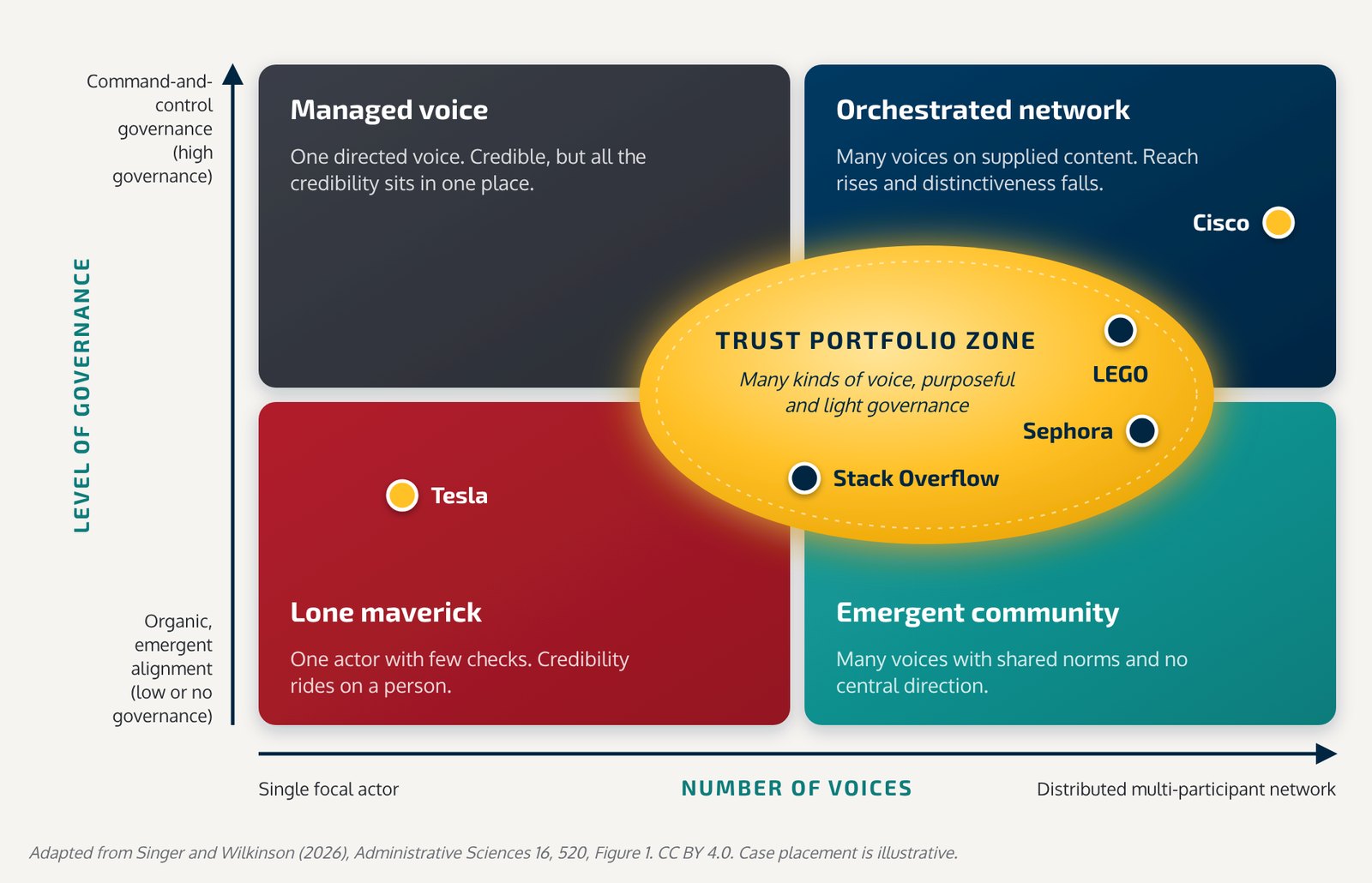
Tesla sits alone in its corner: its own annual report calls the company "highly dependent" on Elon Musk. Cisco reported that 99.9 percent of its #WeAreCisco Instagram and Twitter content was employee-generated, which spreads credibility across many people and still concentrates it in one role. LEGO, Sephora and Stack Overflow sit nearer the trust portfolio zone, where many kinds of voice operate under purposeful, light governance.
When control starts to cost credibility
Here is the contradiction most leadership teams miss. Their instinct is to control the people who speak for the brand. Govern the community and trust can grow. Push that control into what independent voices say, and belief starts to drain away.
The paper calls this the governance-visibility paradox. Disclosure strengthens employees and paid creators, because it makes their interests clear. Script what an ordinary customer says, and you destroy the independence that made them worth listening to. Hand customers a script and you have bought their reach and spent their credibility.
Sephora shows the workable line. It sets rules for its review community and verifies purchases, and it leaves the verdict to the customer. Govern the space. Leave the speaker alone.
Trust travels without you
The special issue asked how marketing becomes effortless, and the paper's answer is precise. As a portfolio matures, more of the communication, validation and governance that sustains trust originates in the community. The work remains. Its origin moves.
That is where a trust portfolio stops being a defence. When customers teach customers, employees become recognised authorities and members vouch for each other, trust travels through relationships into rooms your brand could never enter on its own. Your job shifts to helping those people succeed and making sure they get the credit.
Mark's thinking on community offers the simplest test I know: would members still talk to each other if the brand stopped posting for a week? If they would, the effort has moved.
Run the audit before your CEO asks
The paper's five-step audit turns a vague question about trust into a question about exposure:
- Map the voices speaking for or about your brand, and the role each plays.
- List the questions buyers ask most often, and which role can credibly answer each.
- Check whether credibility sits with a few individuals, one role, or many.
- Review how each voice is governed, and whether affiliations and payment are visible.
- Find the questions with no credible voice, then earn those voices by helping the people who could answer them succeed.
Back to that fireside chat
I walked out of the fireside chat between Mark and Joe with a question I still cannot shake. For years, marketing leaders have measured how many people their brand can reach. The more important question now is how many people can credibly speak for it.
And whether those people would still be trusted if your brand stopped speaking altogether.
If this has you thinking about your own voice, watch for Mark's Known 2.0. Known is one of the most important books I have ever read, and as an alpha reader of the update, I can tell you it could not be better timed.
My thanks to Mara for carrying this work through peer review with such care.
Read the paper: Trust Portfolios in Online Brand Communities: Distributed Human Credibility, Trust Transfer, and Effortless Marketing, Administrative Sciences 16, 520 (2026). Open access.