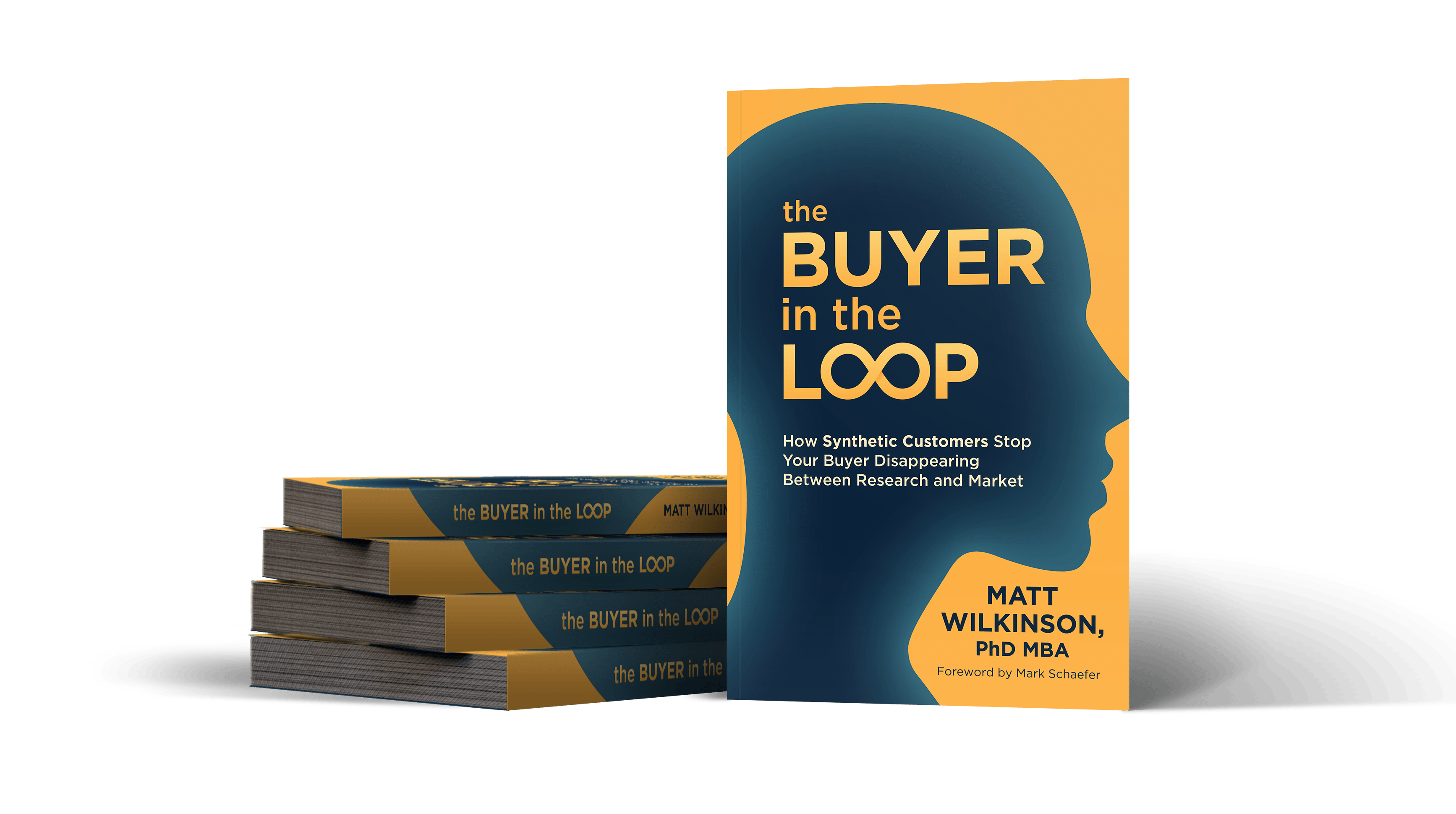

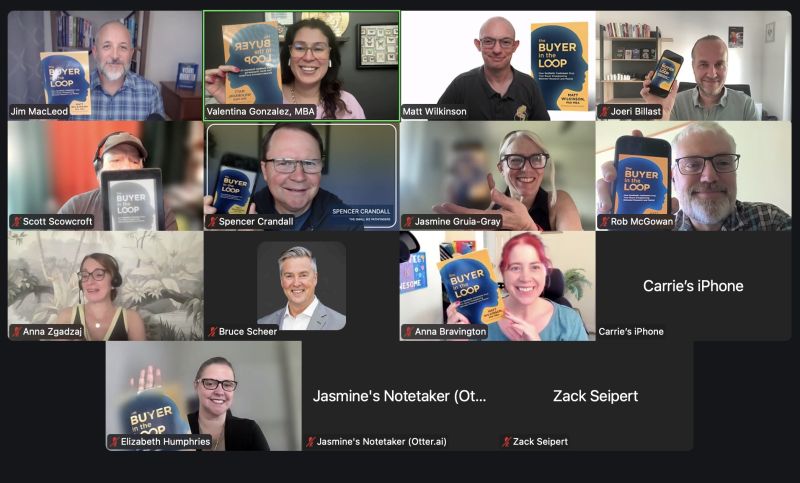
It is a Tuesday lunchtime call for the RISE Book Club, and Anna Zgadzaj, founder of Marketing Well, is not asking about the cover design, the illustrations or the acknowledgements page. She is on page 25. "I'm in a few marketing groups," she says, "and people just hate their jobs at the moment. They're not valued, they're not getting paid well."
The room, hosted by Valentina Escobar Gonzalez for a live discussion of The Buyer in the Loop, goes quiet for a beat. Everyone on the call recognises the feeling. Most of them are living it.
The same force, a new target
Organisational gravity is the structural force that pulls buyer-centric messaging back toward the room it was written in. Every approval, every well-intentioned edit, every stage gate pulls a little harder. The book names it as a physics problem rather than a people problem, because no single person in the process is doing anything wrong.
Zgadzaj's comment on the call adds a layer the book touches on but doesn’t explore fully. Organisational gravity does not just wear down the message. It wears down the marketer fighting against it. Fifteen years of watching positioning survive the brief and die in the edit will do that to anyone. A growing number of marketing leaders are naming the toll out loud rather than absorbing it quietly.
The mechanism behind it is not mysterious. A piece I wrote for Forbes Agency Council sets out three specific, research-backed reasons approval chains drift from the buyer:
- a documented failure of perspective-taking,
- groups defaulting to what everyone already knows,
- and bad buyer news travelling slowly upward through anyone with more authority than the person reporting it.
It is worth reading for the mechanism behind the metaphor.
In The Buyer in the Loop I propose that we need to design around organisational gravity in order to reach escape velocity and counter messaging drift.
It works the same way for standing. Pushing harder against a structural force does not resolve it. Designing around it does.
AI makes the old problem faster
Rob McGowan, founder of McGowan Advisory, picked up the thread a few minutes later. He pointed to something uncomfortable: the same forces that push marketers to the sidelines inside a traditional approval process are showing up again inside AI adoption. "A lot of AI advancement seems to do that exact same thing of pushing out the marketers and disempowering them," he said, "substituting LLM judgment for the judgment of marketers."
The irony here is specific. A synthetic customer built to keep the buyer present in the room can just as easily become the excuse to remove the marketer from it. A chief executive watching a model produce plausible-sounding positioning in seconds can conclude, reasonably on the surface, that the department producing the same thing in weeks is no longer earning its budget line.
That conclusion is short-sighted. It is also common, which is what makes it dangerous.
Ownership is the only lever
The answer I suggested on the call redefined the workload rather than defending the existing one. If marketing owns the customer, and owns the insight that comes from sales conversations, support tickets and direct research, AI becomes a tool that extends that ownership instead of a substitute for it.
The time AI frees up from production work has to go somewhere. The teams that spend it studying their buyers, coding objection patterns from lost deals, building a live picture of how the market is actually changing, earn a harder case for keeping their seat. Concretely, that means the marketing leader who once wrote a positioning brief from memory now builds one from a coded set of sales call transcripts and win-loss interviews, refreshed on a cycle rather than left to go stale. The teams that spend the freed-up time producing more content, faster, from the same shallow understanding they started with, are proving the sceptical chief executive right.
A smaller team is still likely
None of this means every marketing team keeps its current headcount. AI genuinely compresses production work that used to require several people, and a chief executive who reduces a content team accordingly is not automatically wrong. Some of the roles organisational gravity has protected for years, the ones built entirely around producing more assets faster, are the roles most exposed.
The distinction that matters is between production headcount and insight capability. A smaller team that owns a live, evidence-grounded picture of the buyer is in a stronger position than a larger one that does not, regardless of how the AI adoption story plays out inside any given company. Shrinking the wrong part of the function is a real risk. Shrinking the part that actually understands the customer is the one that costs the business later, usually at the exact moment a launch goes wrong and nobody can say why.
What the call actually answered
Zgadzaj's question was not really about synthetic customers. It was about whether marketers still have enough standing to introduce something new at all, or whether the diminishing she has watched happen across her own network makes that fight harder every year. McGowan sharpened it further: what should marketers actually be doing, specifically, to prove their judgment still matters?
The answer I gave on the call, and the argument this book makes, is the same one.
Own the customer.
Capture what sales hears, what support absorbs, what buyers say when nobody from the company is in the room.
Feed it back into the decisions that follow. It is the oldest job marketing ever had, done with more discipline than most departments have had time for in years, now under AI-era pressure to prove it still matters.
The people on that RISE Book Club call were not hypothetical. They were marketers who have felt exactly what page 25 describes. Organisational gravity has already found them once. It doesn't need AI's help to find them again; we can fight this phenomenon together by relentlessly keeping the buyer in the loop.
The Buyer in the Loop covers organisational gravity, escape velocity and the buyer-presence gap in full, including the chapters this RISE Book Club conversation kept circling back to. Get your copy today.