
Why Sales and Marketing Alignment Decays After a Go-to-Market Project
Six months ago the go-to-market project finished well. Everyone said so. Product, marketing and commercial sat in the same room for two days, argued properly for the first time in years, and came out with one buyer everybody recognised. The deck was good. The positioning was defensible. You took it to the CEO and it held.
This week, in a pipeline review, three people described three different customers again.
Nobody broke anything. Each of those three people is describing a buyer they have good reason to believe in.
Alignment decays on a schedule
Your teams hold different vintages of the same buyer.
Marketing holds the version from the research: rigorous, six months old, unchanged since sign-off. Sales holds last Tuesday's call, where a lab manager said something nobody in the workshop had heard before. Product holds the interviews behind a brief written two years ago, because that is what the roadmap was costed against.
Three functions, three timestamps, all sincere. Put them in a room and it presents as a disagreement about strategy. Underneath, it is a disagreement about dates.
The decay starts the day the project ends, and it runs faster in life science than in most sectors because the buyer keeps moving. Budgets get re-mandated. A competitor publishes a claim you now have to answer. An installed instrument comes off warranty. Funding shifts and a nice-to-have becomes unjustifiable. Meanwhile the artefact carrying your buyer stays exactly as it was on the day it shipped.
The deliverable cannot answer
Here is the mechanism. A go-to-market project answers the questions you asked during the project. That is what you paid for, and it is usually money well spent. The decisions that follow it ask different questions.
Would this buyer accept a claim phrased this way, now that a competitor has published theirs? Does the positioning still hold for the mid-market variant nobody had scoped in March? What does she do when procurement pushes total cost of ownership above performance?
The deck has no answer, so the room supplies one.
That is the moment organisational gravity gets its opening. Every approval cycle after that pulls the story a little further toward the people furthest from the buyer, and every edit is defensible on its own terms. Nobody notices the drift, because there is nothing left in the building that can push back with evidence.
The stakes are set early
If that sounds like a soft problem, look at when this sector's own postmortems say outcomes actually get decided. Peabody and colleagues examined 28 diagnostic companies in BMJ Innovations and sorted them into six successes, fourteen failures and eight zombies, solvent but going nowhere. The finding that matters here is what predicted the sorting. Scoring only the first two phases, concept and feasibility, already produced a clear gradient in eventual success. Commercial fate was substantially set before most teams would say the launch had begun.
Those early decisions happen after the research closes and before anyone is measuring. They are precisely the decisions with no buyer in the room.
The buyer stays behind
Look again at what a good project leaves you. It leaves conclusions. Slides, a messaging framework, a positioning statement, a set of verbatim quotes, all of it true on the day it was written. The buyer stays behind with the consultancy, along with the one capability that made the workshop work: the ability to ask a question that was not on the discussion guide.
This is why teams re-buy research every eighteen months and re-run the same alignment exercise with a different logo on the deck. Alignment was produced as a state, in a room, on a date. Nobody bought the capability to reproduce it on a Tuesday afternoon eleven months later.
Learning looks exactly like decay
Two processes are running at once, and they surface as the same symptom.
The first is decay. The research ages, nobody refreshes it, and the story drifts back toward the room it was written in.
The second is growth. Sales holds last Tuesday's call because last Tuesday's call happened and the research never predicted it. Product heard something at the user group that changes the brief. That divergence is your commercial team finding out something true ahead of the artefact, which is the whole point of having people in the field.
From a pipeline review the two are indistinguishable. Three people hold three buyers, and you have no instrument that tells you which of them is out of date and which is out in front.
So the room settles it by seniority. The most senior version wins, or the loudest one does, and that selects for authority over evidence. Real learning gets thrown out alongside genuinely stale material, and the team watches it happen, which is why the field stops bothering to report the next thing it hears.
What resolves this is somewhere for new evidence to go. A shared buyer that takes last Tuesday's call as an input turns divergence into an update everybody can see. Learning gets absorbed into the version everyone works from. Decay gets exposed, because the moment the new transcript lands, the old position stops being supportable by anything except habit.
The same standard applies to a synthetic customer, and harder. A grounded synthetic buyer that nobody refreshes is the same photograph with a chat interface, and it carries more risk than a PDF because it answers fluently. Fluency reads as currency. It rarely is. Feed it this quarter's lost deals, the objection that started appearing in April, the transcript from the call sales ran last week, and it stays an instrument for learning rather than another thing to be right about.
It also stays in its lane. Synthetic for directional, human for decisional. Use it to pressure-test a claim, rehearse an objection gauntlet, sharpen a discussion guide before you spend on fieldwork. Validate with real buyers before you commit to a price, a market size or a launch date.
A test you can easily run
You can measure your own half-life without buying anything.
Take the positioning from your last go-to-market project. Ask the three functions who own it, separately and without a meeting, to write down the single biggest reason a target buyer says no today. Then compare those three answers with the objection list in the original research.
If the three answers differ from each other, alignment has decayed. If all three differ from the research in the same direction, the research has aged and your team has already moved past it. Either way you hold a rate rather than a suspicion, and a rate is something you can design against.
Take that to the CEO before the next launch instead of after it.
Nobody broke it
Go back to the pipeline review. Three teams, three customers, no villain anywhere in the story. The project worked. It produced alignment as an event, and events end.
The alternative is a buyer who never leaves: one grounded synthetic customer every function can query, absorbing what the field learns as it arrives, still in the room on the Tuesday afternoon when somebody wants to soften the headline.
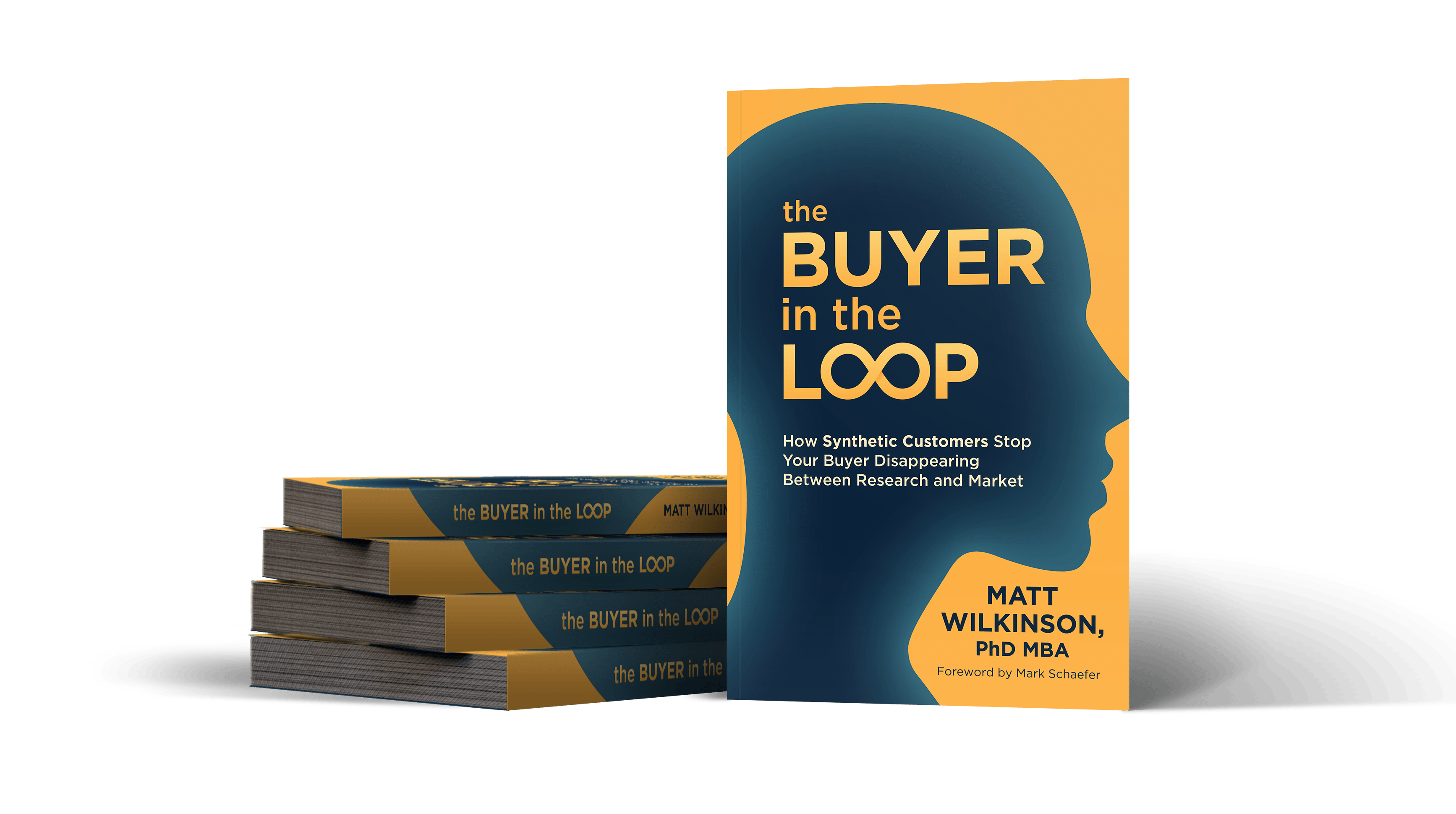
That is what The Buyer in the Loop is about, and it is out now. Get your copy at strivenn.com/the-buyer-in-the-loop.