
A lab manager just typed your product name into an AI, read three sentences, and moved on. She works at one of the four in five labs that entered 2026 being told to cut costs, and none of those three sentences gave her a reason not to pick the cheaper option. In 2026 that is sadly the normal state of affairs for a life science instrument purchase, and it is why go-to-market strategies that worked two years ago are missing their mark.
Three forces are rewriting the rules for life science commercialisation. The first is budget, and that four-in-five figure is real: Mordor Intelligence puts it at 81.1 percent of labs started the year with cost reduction as a primary operating mandate, and 81.9 percent willing to abandon brand loyalty for the lowest total cost of ownership.
The second is how buyers buy. Gartner found that 67 percent of B2B buyers now prefer a rep-free experience and 45 percent used AI during a recent purchase, so the scientific buyer is researching you alone, through an AI front end, before a rep is ever involved.
The third is the regulatory and funding squeeze. NIH indirect-cost turbulence ran through 2025, the BIOSECURE Act was signed at the end of that year, and tariffs on imported instruments have made every purchase slower, more scrutinised and more sensitive to sourcing.
Put those together and the life science instrument buyer in 2026 is more cost-driven, more self-directed and more risk-averse than the buyer your current positioning was built for. That is the go-to-market problem. Everything the industry calls a gap is a symptom of it.
The four gaps are really just one gap
Search "life science go-to-market gaps in 2026" and every result tells you the same story. There are four gaps, they say.
- Sales and marketing are misaligned.
- Your positioning sounds like everyone else's.
- Nobody really understands the buyer.
- The sales cycle is long and the stakeholders are many.
Fix these four things, usually by hiring the agency writing the article, and your commercialization problem goes away.
It is a tidy list. It is also wrong in the way that matters most, because it treats four symptoms as four diseases.
Sales-marketing misalignment, messaging sameness, weak buyer understanding, execution drift: these are not four separate failures you can fix one at a time. They are four places where the most important part of any sale has gone missing: the buyer.
Everything downstream of the buyer leaving the room is a wound, not a cause. Only 34 percent of life-science teams tell Highspot their sales and marketing functions are well-aligned on goals and process. You can run every alignment workshop on the calendar and that number will not move, because the two teams are not misaligned with each other. They are both misaligned with a buyer who is no longer in the building.
Organisational gravity pulls away from the buyer
There is a structural reason this keeps happening, and naming it changes what you can do about it.
Call it organisational gravity. It is the force that pulls buyer-centric messaging back toward the room it was written in. Every approval stage is a small tug. Product wants the feature emphasis restored. Regulatory wants the claim softened. A senior leader wants the company heritage acknowledged. None of these people are wrong to ask, and none of them are the buyer. The structural problem is that the people furthest from the buyer usually hold the most approval authority, so the message gets tuned for internal comfort rather than buyer relevance, one reasonable edit at a time.
By launch, the positioning has drifted. Nobody made a bad decision. The buyer was simply never in the room to object when the heritage paragraph went back in. Your persona deck was in a folder. A folder cannot push back at 11pm when someone softens the headline.
An absent buyer is expensive now
This has always cost you something. In 2026 it costs more, because the three forces above punish the absence directly.
Cost-first procurement is the first. When four in five labs enter the year told to cut, positioning built on internal comfort language, time to market, global footprint, technical excellence, does not survive contact with a buyer who has been handed a budget target. If your message cannot answer "why you and not the cheaper option" in the buyer's own terms, cost wins by default.
Rep-free, AI-mediated research is the second. Your first impression is no longer made by a rep who can read the room and adjust. It often isn't even the carefully curated version you put on your website.
It is made by content an AI bot scrapes from a myriad of sources on the internet and compiles into an answer while the buyer is alone, forming a view you never get to correct. Undifferentiated positioning does not just fail to stand out in that setting. It fails to get retrieved at all - and you risk becoming part of the "unconsidered set” that never appear in an AI search result.
These combine to turn a quiet inefficiency into a significant commercial risk.
Buyer presence, not more buyer data
Here is where most advice sends you in the wrong direction. Told the buyer has gone missing, the instinct is to gather more buyer data. Another voice-of-customer study, a refreshed persona, a new segmentation study. More insight.
You are probably not short of insight. You have VoC studies, CRM records, win-loss notes, call transcripts. What you lack is buyer presence. Data is a photograph of the buyer taken at one moment. Presence is the buyer's voice showing up in real time, at the moments the photograph cannot reach: the Tuesday brief review, the Wednesday meeting where someone wants the heritage sentence added, the late draft where the headline gets softened for comfort. Those are the moments organisational gravity does its work, and a persona in a folder is never at any of them.
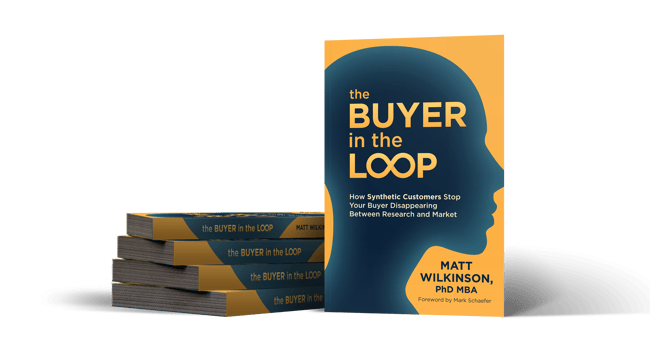
This is the argument I make at length in The Buyer in the Loop. The fix for the go-to-market gap is not more research and it is not another framework. It is keeping the buyer present as a permanent operating condition, so that when the message starts drifting toward internal comfort, someone in the room can answer with what the buyer actually thinks. A grounded synthetic customer, built from your real research rather than an AI roleplaying a buyer type from average internet data, gives your team that presence at every stage after the brief. In one case, a grounded synthetic customer built only from public signals drove email open rates above 35 percent in a sector where 25 percent is considered strong.
Surely alignment fixes this
The strongest objection to all of this is worth stating plainly. If the four gaps are really one gap, why do so many capable teams keep attacking them separately, and why does alignment work at all?
Because it does help, up to a point. Getting sales and marketing into the same room around the same positioning removes friction and duplication, and no serious team should skip it. The objection has real weight: therefore alignment is necessary.
Internal alignment on its own is not sufficient, and the reason is structural. Alignment synchronises the people in the building with each other. It does nothing to keep the buyer in the building. Two perfectly aligned functions can march in step straight past the buyer's actual priorities, which is exactly what happens when both are working from the same eighteen-month-old persona deck. Alignment without buyer presence gives you a coordinated version of the same drift. The buyer still left the room. Now everyone left with them, together.
Put the buyer back in the room
Let’s go back to that lab manager, reading three sentences about you on a screen and moving on. She is cost-driven because her budget told her to be. She is researching alone because that is how buying works now.
She is cautious because the regulatory and funding ground keeps shifting. None of that is the gap. The gap is that when those three sentences reached her, the lab manager they were built for had been edited out of them, one internal adjustment at a time.
The lab manager was never going to be in your approval meetings. The synthetic customer who speaks for her can be.
If you want to find where your buyer is going missing, book a 30-minute strategy call. You walk away with a diagnosis of where the buyer exits your process, your two highest-leverage points to fix it, and a one-page summary you can defend internally.
The full argument, the moments organisational gravity does its work, and how to build buyer presence that lasts, is in The Buyer in the Loop, out on 22 July 2026 with a foreword by Mark Schaefer.