
Nobody remembers the launch meeting, but everybody remembers the pipeline review twelve months later.
They remember the launch missed its targets, not by a catastrophic margin. By the margin that lets everyone say the science was right and the market simply was not ready yet. You know that is not what happened.
The value proposition read well in the room where product, medical and commercial signed it off. It read badly to the buyer who never sat in that room.
By the time the gap surfaced in a pipeline review, the launch window had already closed.
Most launches miss the number
This isn't unusual. Deloitte found that 58 percent of launches missed commercial expectations. McKinsey places the figure closer to two-thirds. ZS found that differentiated science improves the odds, but even strong clinical profiles fail without commercial execution.
Science earns attention.
It doesn't guarantee adoption.
Those studies focus on pharmaceuticals, but the same pattern appears wherever technical superiority collides with buyer inertia. NanoString's Prosigna assay was technically sound. It still could not dislodge an entrenched incumbent, generated a fraction of its projected revenue, and the company eventually sold it on. The pattern connecting a pharma statistic to a diagnostics case study is not clinical. It is structural: the same organisational gravity that pulls a launch brief toward internal consensus operates whether the product under it is a drug or a diagnostic kit.
Where grounded testing earns its keep
A synthetic customer built from real evidence gives a team something a launch readiness dashboard cannot: a rehearsal against the objections a buyer will actually raise, run before the field force meets them cold. Unlike most AI claims, this one is beginning to accumulate serious evidence. Researchers at Stanford and Google DeepMind built generative agents from two-hour interviews with more than 1,000 people. Those agents reproduced participants' own survey responses with about 85 percent of the accuracy that participants achieved when answering again two weeks later - substantially better than generic demographic personas.
CVS didn't replace customers. It rehearsed before meeting them.
Using synthetic twins grounded in millions of consented responses, the company compressed weeks of research into simulation sprints, and still validated everything with real people.
That sequencing is the whole method.
Take your last five lost deals, name the objection that killed each one, then query the synthetic customer on those same objections.
Where the model answers in language your buyers never used, that is the grounding gap, and it is worth finding before the brief goes to creative rather than after the launch report goes to the board.
Synthetic testing fails too
Here is the strongest case against relying on any of this. A study published in Political Analysis, the Cambridge University Press journal, compared large language model outputs against real survey data and found that 48 percent of the resulting coefficients differed significantly from the human responses. Among those, the direction of the relationship flipped entirely 32 percent of the time. That is a model confidently telling a team the opposite of what its buyers actually think. Nielsen Norman Group has documented the same weakness from the user research side: synthetic respondents skew agreeable, flattering a concept rather than stress-testing it.
A fluent answer is not the same thing as a true one.
These aren't merely academic concerns. They're serious enough that ICC and ESOMAR rewrote their global research code specifically to require human oversight wherever synthetic data stands in for a real respondent.
That case has real force, and it is the reason the honest version of this method draws a hard line. An ungrounded model invented from average internet data will produce exactly the failure modes above, because it is answering for nobody in particular.
We see the same distinction in practice. There are places where synthetic customers work, and places where they don't. A grounded synthetic customer built from the interviews, transcripts, and objections behind your own lost deals isn't pretending to represent humanity. It's helping you interrogate evidence you've already collected.
Test it before the market does
Go back to that missed launch. The gap between the room and the buyer was findable months earlier, in the same five objections that killed your last five competitive evaluations, tested against a synthetic customer grounded in the evidence those losses generated. That test would not have replaced the field validation that came after it. It would have made the field validation a confirmation instead of a discovery, closer to what actually counts as a launch rather than an announcement.
Markets are expensive teachers. Synthetic customers won't replace them, they simply let you fail while the lesson is still cheap.
The chapter that names this
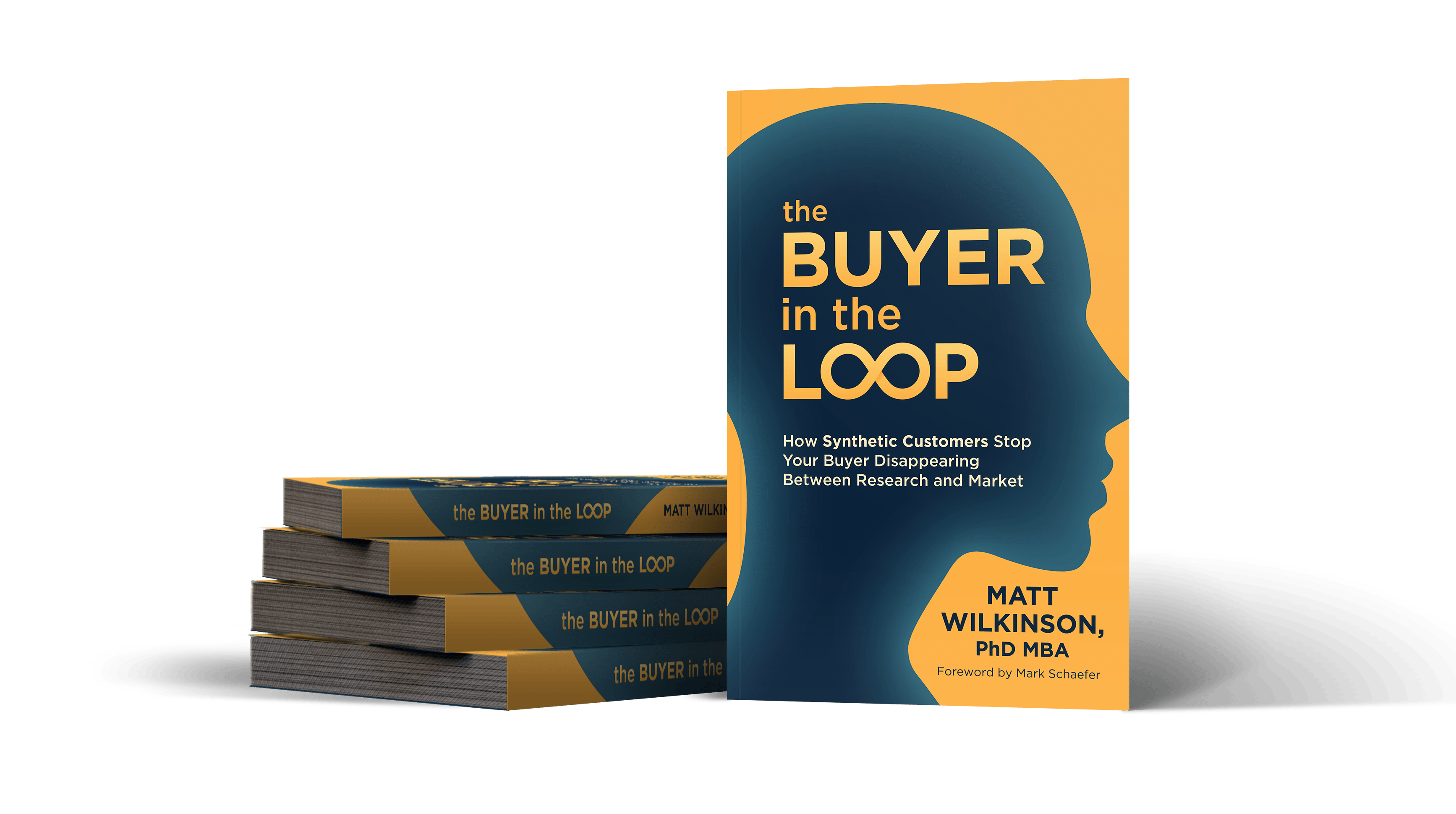
The Buyer in the Loop gives this exact tension a full chapter rather than a marketing slide, and shows product, marketing and commercial leaders how to use a synthetic customer for what it is actually good at without mistaking it for what it is not. Get the book at strivenn.com/the-buyer-in-the-loop.