
I was 95 kilometres (60 miles) into a 121 kilometre ride and my quads decided to cramp up. It is hot, the cramp is excruciating, there are 26 kilometres left, and there is food in my back pocket that I cannot bring myself to eat.
Two bananas and a gel and a half across the whole ride. I can’t stomach eating anything more, and every time I try to eat something I start cramping worse. By the evening my appetite is back and I eat a full meal without difficulty.
I carried everything I needed for 121 kilometres and 1,600 metres of climbing. What ran out somewhere around kilometre sixty was my ability to take any of it in, and everything that happened afterwards was decided by then.
Your team has this problem with buyer research.
The evidence was never opened
You are six weeks from launch. Someone asks whether the messaging still matches what buyers actually said, and everyone agrees it is a fair question. The segmentation study is on the shared drive. The win-loss summaries sit in the folder beside it. Nobody opens either one, and the campaign ships on the version everyone already had in their heads.
No decision was taken. That is what makes it hard to see.
Ask which failure you had
There are two ways a buyer goes missing from a commercial decision, and they need different fixes.
In the first, the evidence was present. You brought it to the review, you argued it, and it lost to someone with more capital in the room. That is organisational gravity, the structural pull of every decision back toward internal consensus. You know this one because it leaves a scar.
In the second, nobody argued anything at all.
Put this to your team about the last launch that underperformed.
Was the buyer evidence argued down, or was it never opened?
Most leaders assume they experienced the first. Most describe the second once the question is put to them directly. The distinction decides your fix, because arguing harder does nothing for a failure where no argument took place.
You can run the same test on your pipeline in ten minutes. Take three deals sitting longer than your average and ask the rep what the buyer said, in their own words, about the problem they are trying to solve. A rep who answers with your product's positioning is telling you the buyer was never in that conversation.
Absorption has a ceiling
Endurance riders train for what happened to me on that road, and they train for it specifically. Absorption rate is a physiological ceiling. It is trainable, and it has to be raised weeks in advance, because it cannot be raised at kilometre 95. No cyclist believes they can decide to absorb more while cramping.
Commercial teams have the same ceiling and no equivalent training. Call it the absorption threshold: the amount of buyer evidence a team can metabolise during a decision. It has nothing to do with how much evidence you own.
Which gives you the working test.
Evidence that requires synthesis at the point of need counts as absent.
Three interview transcripts two clicks away, each costing forty minutes of thinking to turn into an answer, have the same commercial effect as three transcripts you never collected. Proximity is irrelevant when mental capacity is the constraint. And because nothing visible fails, the deficit accumulates behind numbers that still look fine.
More research makes it worse
The standard response to a launch that missed is to commission another study.
Think about what that actually does. A fifth banana in the pocket of a rider who cannot eat is weight. It holds exactly the nutritional value it held this morning, none of it reaches the muscle, and it has to be carried up every remaining climb. Your team already owns more buyer evidence than it consumed last quarter. The next study joins the queue behind it.
We see the pattern in our own data. In our exhibitor surveys at ELRIG Drug Discovery 2025 (n=104) and SLAS 2026 (n=43), the largest single group of commercial teams sat in unstructured exploration: AI tools available, no programme guiding their use. In those organisations, 69 percent of individuals were not using AI daily despite having full access. Where a structured programme existed, daily use ran between 53 and 73 percent.
That survey measured AI adoption rather than research use, so it does not prove the absorption argument. It offers a parallel worth having. Access alone did not produce habitual use. Structure was present where usage was higher.
The discipline answer deserves a hearing
There is a serious objection here and it should be dealt with directly.
The objection says this is prioritisation dressed up as physiology. Teams that genuinely care about buyers do go back to the research. Marketers who make the time make the time. Calling it structural hands any leader a ready excuse for their next board meeting.
Start with the ordinary case. Your team ran the interviews and nobody can hold all of it in their heads. Six weeks out, writing the product page, they work from what they believe rather than from what buyers said, because reaching for the evidence takes time nobody has. A critic can call that a choice about priorities, and on a team with a launch date they would have a case worth arguing.
So take the priorities away.
You are running a small company on your own. You conducted every customer interview personally. There is no committee, no approval cycle, nobody diluting anything. And at nine in the evening, writing that same page, you still write from what you believe, because reaching for the evidence costs energy you spent hours ago.
That is the experiment with the politics removed, and the failure still happens.
Prepare the evidence. Trigger the evidence.
Two mechanisms raise the threshold. Both have to be installed before the pressure arrives. Once the team is overloaded, it is too late to start building.
- Prepare the evidence. Buyer evidence synthesised in advance, so that consulting it costs a question rather than an afternoon. This is what a grounded synthetic customer is: your interviews, your win-loss calls, your buyers' real objections, held in a form your team can query in the moment they are deciding. Ninety seconds instead of forty minutes changes what a team under pressure will actually do.
- Trigger the evidence. The buyer question fires on the calendar or the stage gate rather than on someone's judgement, because judgement is the first thing to go under load. In an NPD process, that means a named question at gate three and gate four, owned by the product lead, answered in the gate document. You eat before you are hungry.
Neither replaces primary research. Raising the threshold changes how much evidence reaches an ordinary Tuesday decision, and it leaves the decisions that warrant real buyers exactly where they were.
If you are the whole commercial function, start smaller. Take your three most recent customer calls, pull every sentence where the buyer described their problem in their own words, and keep them in one file you open before you write anything. Twenty minutes, nothing to maintain. Within a fortnight you will notice how often what you were about to write differs from what they said.
Eat before you are hungry
I finished the ride. Slowly, with cramp, and only because a fit rider carries enough margin to survive a bad decision made forty kilometres earlier.
Your launches have that same margin and you are spending it the same way. Go back to the room six weeks out. Where the threshold has been raised, the messaging question takes four minutes to answer, because the buyer is already in a form somebody can question. Nobody volunteers forty minutes they do not have. Nobody has to be the person who slows the launch down.
The research you already paid for becomes an asset only when it can be burned. Until then it is weight.
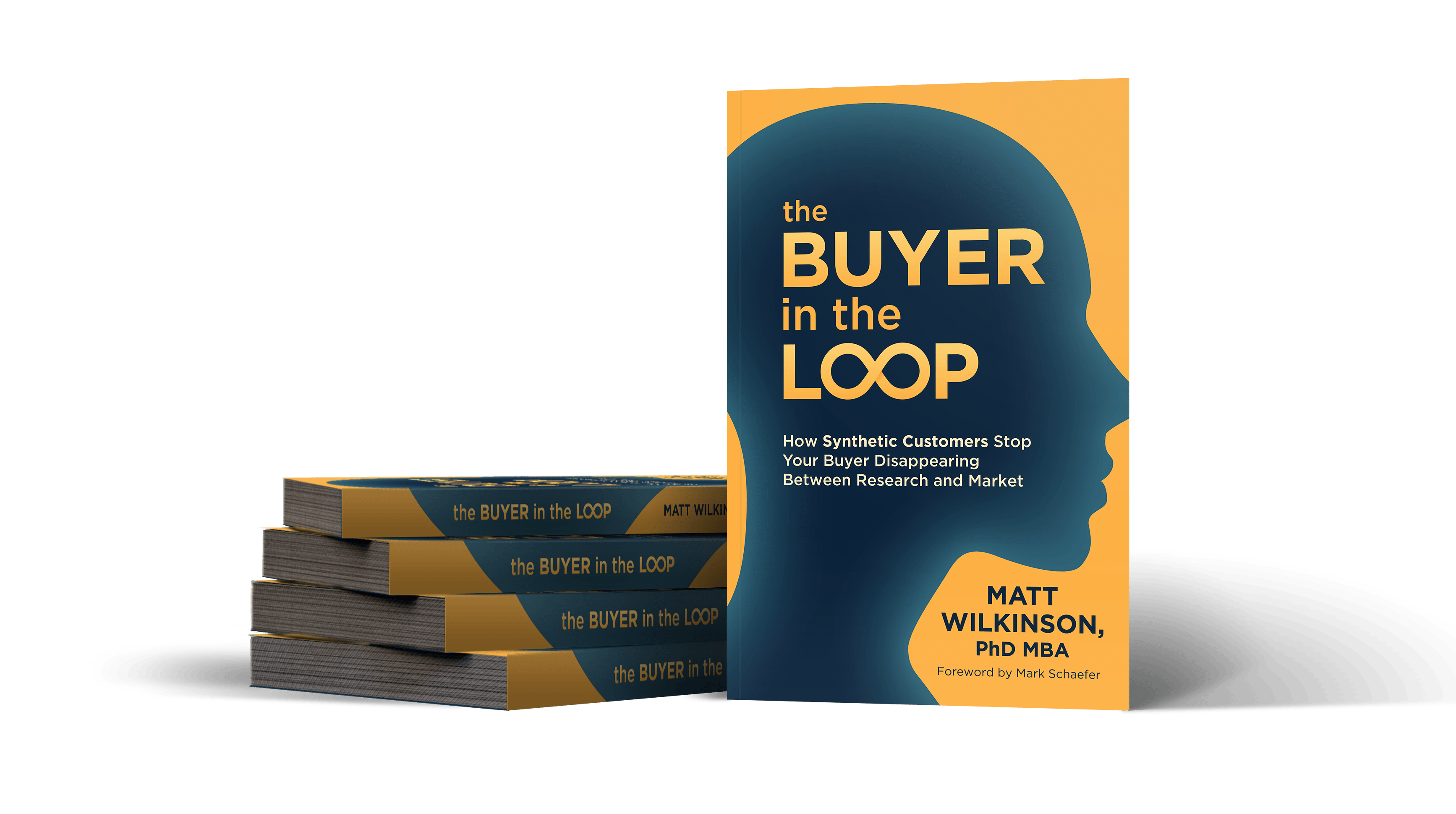
This absorption problem is one expression of a larger force I call organisational gravity: the pull that gradually removes the buyer from commercial decisions. The Buyer in the Loop explores that force, the three points where the buyer exits the process, and how to build a commercial process that keeps them present.