
A Medium article on the history of innovation cycles caught me this week and would not let go. It traces the long economic waves of innovation that were mapped by Kondratiev, and how each one was set off by a cluster of new technology, with each one rewriting how business works. I finished it thinking about us humans. If the whole economy moves in these long waves, does marketing move the same way, and if it does, where are we standing right now? So I went looking.
What I found starts with an uncomfortable scene. Right now, a buyer is sizing you up, and thanks to AI you are not in the room. They are asking an answer engine to compare you against two rivals, and it answers with a version of your positioning that drifted from the one you built. Handoff by handoff, the evidence-based message you wrote for launch reached the public web as something closer to an internal brochure. You could defend the original to your CEO. You cannot defend what the buyer just heard.
This is the seventh wave of marketing. And it has a buyer problem.
Marketing moves in waves
The economist Carlota Perez, in her book Technological Revolutions and Financial Capital, studied every major technological revolution since the cotton mill and found the same shape each time. A new technology arrives. Capital floods in. There is a frenzy of overbuilding and overpromising, then a reckoning, after which the technology quietly does its real work and the genuine productivity lands. She called the first half installation and the second half deployment. The gains everyone expects at the start tend to arrive years later, once the data, the skills and the business models have caught up.
Marketing has its own version of these waves. The catalysts change, the channels change, and each surge reorganises how a brand reaches the buyer.
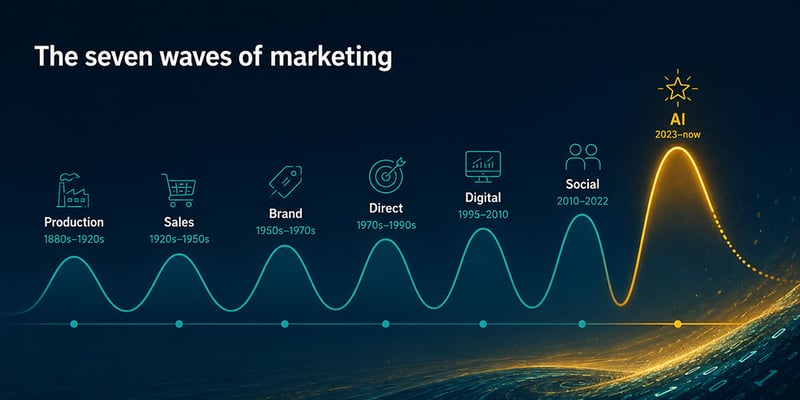
Production
Era: 1880s-1920s
Catalyst: Mass manufacture
Dominant practice: Build it and demand follows
Channel: Print, signage
Sales
Era: 1920s-1950s
Catalyst: Radio, oversupply
Dominant practice: Persuasion at volume
Channel: Broadcast radio
Brand
Era: 1950s-1970s
Catalyst: Television
Dominant practice: Brand management, segmentation
Channel: Network TV
Direct
Era: 1970s-1990s
Catalyst: Computing, databases
Dominant practice: Measurable response
Channel: Direct mail
Digital
Era: 1995-2010
Catalyst: Internet, search
Dominant practice: Inbound, SEO and SEM
Channel: Web, email, Google
Social and martech
Era: 2010-2022
Catalyst: Smartphones, automation
Dominant practice: Content and personalisation at scale
Channel: Social, mobile, programmatic
AI
Era: 2023-present
Catalyst: Generative and agentic AI
Dominant practice: AI-assisted creation, answer-engine optimisation, synthetic research
Channel: AI answer engines
Reading the dates, the pattern is hard to miss: the waves are getting shorter.
Hold the model lightly. The dates are loose, the boundaries blur, and a neat story like this always flatters the person telling it. Historians have argued for years that marketing's tidy eras owe as much to hindsight as to history. I'd suggest treating it as a working lens and keeping your scepticism handy.
Every wave gets shorter
Television took two decades to remake the discipline. Search took fifteen years. Social and martech moved faster still. The AI wave is rewriting how buyers discover and compare and we're only three years in. AI Overviews already appear on close to half of Google searches, and a large share of B2B buyers now run their research through generative tools before they speak to a single supplier.
The window to adapt keeps narrowing. So the cost of standing still compounds.
For a regulated life science brand, that pressure bites harder than most. Your claims move at the speed of regulatory approval. The answer engines move at the speed of the web. The buyer is forming a view in that gaping chasm between the two.
Adoption ran ahead of value
Here is the part that should keep you up at night.
Almost everyone has an AI licence. Survey after survey puts marketer usage between 87 and 94 percent heading into 2026, up from roughly half two years earlier. Tooling is no longer the differentiator. It is the baseline.
But, only around 6 percent of organisations are pulling real bottom-line value out of it. The rest are stuck. They have the licences, the logins and the dashboards. They do not have the outcomes to show for it.
Look closely at why, and the blocker is rarely the model. It is fragmented data, thin governance and systems that cannot feed AI anything worth acting on. Our own exhibitor surveys at ELRIG and SLAS say the same from the ground, across 107 and 43 respondents: data quality is the single largest barrier, named by 44 percent.
This suggests we are (unsurprisingly) firmly in Perez's installation phase, almost to the letter. The capital has gone in, the infrastructure is costly, and the value has been deferred to a deployment phase most teams have not reached.
Licences bought. Value unproven.
The buyer keeps going missing
Every wave creates a new way for the buyer to slip out of view, and there is a name for the force behind it. Organisational gravity. The steady pull that drags every launch back toward the language of the organisation and away from the language of the buyer. It is why the message you built from real evidence arrives at the sales deck sounding like a product spec. The buyer's words evaporate progressively with every internal review, until they fall out of orbit altogether.
The seventh wave makes that problem worse. In the digital wave you could at least watch the buyer search. You saw the queries, the clicks, the paths. Now that research happens inside a model you cannot read, drawing on content shaped by everyone except the buyer.
The instinct is to throw more AI at the problem. Generate more content. Spin up more campaigns. Automate the funnel and leave the machines running unsupervised. That is botsitting, and it is exactly how the 6 percent stays at 6 percent. Faster production of content that has lost the buyer is a quicker route to noise.
Escape velocity asks for something quieter. Keep the buyer present in the room when the decisions get made.
Grounding changes everything
This is where the grounded synthetic customer earns its place, and where one distinction decides whether it works.
A synthetic customer is a queryable representation of a real buyer, built from real voice-of-customer evidence. Interviews, sales-call transcripts, win and loss data, the actual language buyers use about their actual problems. You can put a message, a claim or a positioning choice in front of it and get a directional read in minutes rather than weeks. This is the discipline behind PersonaAI.
The research backs the method, with one sharp caveat. Well-grounded synthetic respondents reach up to 90 percent alignment with human data on structured tasks like ranking, pricing and concept screening, and they compress research cycles hard. The caveat is grounding itself. Ask a language model to role-play a job title and it drifts to the mean, flattens the variance and agrees too readily. Build the representation on real evidence about a specific segment and it starts to behave like a buyer you recognise.
So the rule holds. Synthetic for directional, human for decisional. Use the synthetic customer to pressure-test positioning before it ships, to screen a claim before regulatory ever sees it, to keep the buyer present across the hundred small choices where the message usually drifts. Reserve the high-stakes calls for real people. The synthetic customer is the deployment-phase discipline that lets a team realise value while everyone else is still admiring their tool stack.
For the marketer who owns positioning, the payoff is specific. You walk into the CEO's office with a buyer you can interrogate live, not a slide that asserts what buyers want. You defend the message with evidence rather than opinion. And when product marketing writes the next launch brief, it starts from the same buyer you did.
Proof beats promise
So start small and start now. Take the one decision where your buyer goes missing most, a launch message, a positioning line, a claim you are about to stand behind, and put it in front of a grounded synthetic customer before it ships rather than after. One decision, one buyer, one read. You do not need a research budget or a thirty-person team to begin.
It holds at both ends of that range. Nanocrine, an emerging company, pressure-tested every conference message against grounded synthetic customers before it printed a word, and left a major show with more than sixty qualified conversations, looking larger than its size. Pivotal Scientific, a lean firm, put one grounded buyer to work across positioning, prospecting and sales preparation, with three people running the same assistant for three different jobs. The positioning work alone reframed the firm at board level, away from looking like another agency and toward the consultancy it actually is. Different sizes, same discipline: the buyer kept present while options were still being discussed.
What the sceptics get right
A fair reader will push harder still, and they should. The 6 percent figure cuts both ways. It is evidence that most teams are stuck in installation. It is also ammunition for anyone who reads AI marketing as the next round of martech inflation, all spend and little return. Forrester is already calling time on the AI hype period.
The honest position holds both. The value gap is real, and it is closing for a small group who treat AI as a way to understand the buyer rather than a faster way to talk at them.
Your buyer is deciding, and you are not in the room
Right now, a buyer is forming a view of you inside a conversation you cannot see, advised by a machine you did not brief, drawing on a version of your buyer that may not be yours.
The seventh wave will not wait for you to feel ready. It is shorter than the last one, and the value is going to the few who close the gap between buying the technology and using it to keep the buyer present.
You were sized up in your absence. The work now is to make sure the buyer in the room is the real one, built from evidence you own.
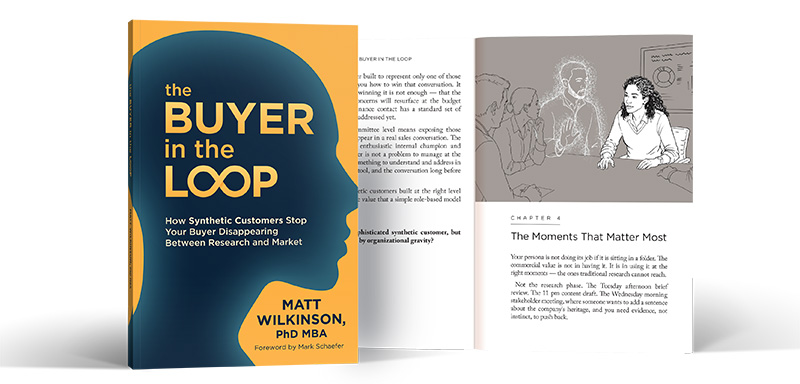
If you read this far, you'll probably enjoy my new book The Buyer in the Loop which is now available at Amazon at a special pre-order price of $2.99 for the Kindle edition. Visit Amazon.com or Amazon.co.uk to pre-order your copy today!