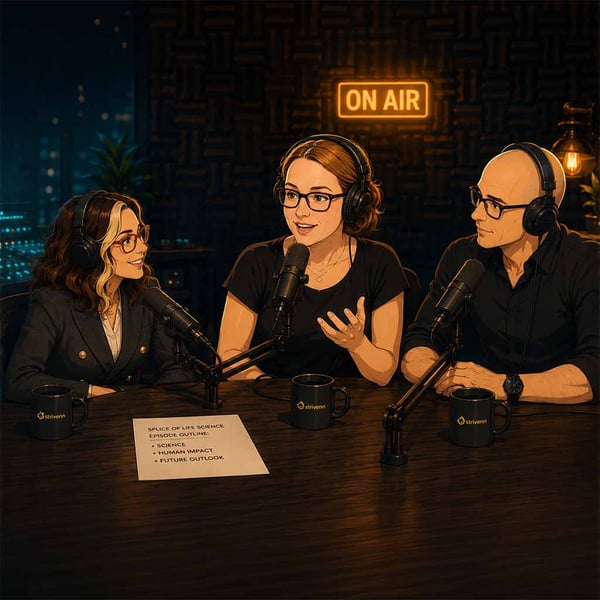

For product marketers: the real competitor isn't another platform, it's switch costs the buyer can't make feel safe to approve.
Shownotes
Your scientific advisory board just told you the product works. It never told you whether anyone in that building is allowed to buy it.
Who this is for: Product managers and product marketing leaders selling into life science tools and diagnostics accounts.
Matt and Jasmine unpack why glowing feedback from a scientific advisory board so often gets mistaken for a buying signal. They walk through how purchase size changes who actually holds approval, why 40 to 60 percent of qualified B2B deals end in no decision at all, and how a simple pre-mortem exercise surfaces the objections a formal board will never say out loud.
Key idea: The real competitor isn't another platform, it's the buyer's inability to make switching feel safe enough to approve.
- Why a scientifically enthusiastic panel is not the same as a buying committee
- How purchase size, roughly the line around $100k, changes who signs off
- What Dixon and McKenna's research on B2B no-decision means for life science sales
- How to spot the gap by asking R&D partners pointed commercial questions
- Why a Gary Klein style pre-mortem gets more honest objections than a formal board
- How to reframe one advisory board agenda to include buyer's journey questions
- [00:20] Intro
- [00:49] The other half of the PM job
- [02:00] Where the gap shows up: the ELISA panel example
- [04:56] The case for a commercial advisory board
- [05:40] People problem or process problem
- [06:33] How to spot this happening to you
- [07:30] $50k versus $400k: does the same board reach both
- [08:58] Inside a CapEx committee
- [09:39] Dixon and McKenna: 40 to 60 percent no decision
- [11:01] Getting out of the office to find the real answer
- [11:51] The pre-mortem alternative
- [13:01] The one question that cuts across all of it
- [14:04] Where to find the full piece
- [14:39] The real competitor
Watch the full conversation, subscribe for more life science marketing strategy, and click here for the complete piece. Book a call with the Strivenn team at strivenn.com/contact if you want help preparing for these commercial questions.
Transcript
Matt Wilkinson and Jasmine Gruia-Gray open with the case for a commercial advisory board sitting alongside the scientific one, then work through where the gap actually shows up, how purchase size changes who holds approval, and what a pre-mortem exercise can surface that a formal board never will.
Intro
Speaker: Matt Wilkinson [00:20]
Hi Jasmine, how you doing?
Speaker: Jasmine [00:21]
I'm doing great. Happy potato day.
Speaker: Matt Wilkinson [00:25]
Is it really? All right.
Speaker: Jasmine [00:27]
Yeah, so if you were Mr. Potato Head, you'd be dancing all around.
Speaker: Matt Wilkinson [00:32]
I'd be having my nose on one side of my face, where my ears are, and an ear on the front of my face.
Speaker: Jasmine [00:38]
I thought you were gonna say I'd be having a spudty day.
Speaker: Matt Wilkinson [00:44]
I was trying to leave the dad jokes for later.
Speaker: Jasmine [00:45]
Yeah. Okay.
The other half of the PM job
Speaker: Matt Wilkinson [00:49]
I've had good advice to leave the potato jokes behind. And speaking of advice and advisors, you recently wrote a blog about advisory boards and how they're made up and making sure that you're asking your advisory board the right types of questions.
So if I was to ask you as a product manager or product marketing manager what your job is, you'd probably say something like understanding the customer, capturing what they need, meeting their needs by building some product or service. And that's half the job description. I think the other half never really makes it into a PM's task list. Understanding how that customer's organization actually decides how to spend money.
And who has to sign off before a check is ever cut? Nobody trains for that half. Nobody tests for it in a scientific advisory board either, because the people in that room are experts in the science. And they've never once had to defend a budget line to a finance director. So the job quietly shrinks to fit what's easy to measure. And the part that decides whether you hit your number gets kind of left outside the room.
So Jasmine, your recent blog built a whole argument around that missing half. Where did that start for you?
Speaker: Jasmine [02:00]
So I was just thinking a couple of weeks ago about some of the patterns I've noticed with product managers in the last few companies I was in. And the product managers are most often held responsible for capturing customer needs, as you mentioned. But for some magical unknown reason, more often than not, in my experience, that stops at the technical jobs to be done. Understanding how the customer's organization actually buys really is also part of the job. It's just rarely written down and it's almost never covered in a scientific advisory board discussion. So it quietly falls off the list and nobody notices until maybe the revenue goals aren't met, or the launch goals aren't met, or there's just some glitch in the buyer's process. And at that point, it's almost too late because the product's been launched.
Where the gap shows up: the ELISA panel example
Speaker: Matt Wilkinson [03:07]
So can you give me a real example? What does that gap actually look like in a session?
Speaker: Jasmine [03:13]
So, if we take multiplex ELISA panels, for example, where there are three principal investigators that had already run the panels in their own lab. And their feedback might be something like lower background than their current kit, and the eight-plex format saved them a second run on precious samples. So what you should be hearing is very technical types of feedback. And it certainly tells you the assay is working. Sometimes that is misinterpreted as yes, the assay is working and therefore I will buy it. But that "and therefore" extension is something that people in the room are interpreting from what's said, it's not actually what might happen.
It says, for example, nothing about a lab running a validated SOP under an audit regulation, where switching to your panel would require concordance data, would require revalidation of a method, and so on. So the pattern is something like the scientific advisory board answers a scientific question accurately, from real experience using the product, all fair. The feedback is positive and it gets filed as a commercial answer in people's heads, in effect a favourable response, so they'll likely buy. But nobody in the room actually said that. They just answered the half of the job the room was built to test.
The case for a commercial advisory board
Speaker: Matt Wilkinson [04:56]
So it sounds a bit like you actually need a commercial board as well as a scientific advisory board.
Speaker: Jasmine [05:03]
That's what I'm advocating for, or at very least, an off-the-cuff group of folks who can answer more commercial questions, more buyer's journey questions. And that group of people may not necessarily just be the scientists. They may be lab managers, they may be procurement officers. There may be other folks across the buyer's journey, depending on the size of the purchase.
People problem or process problem
Speaker: Matt Wilkinson [05:35]
So is this a people problem or a process problem?
Speaker: Jasmine [05:40]
I'd say it's more of a process problem and a clarity of agenda problem. Underneath that, a job description problem too, maybe. So most product managers don't have a scientific advisory board of their own, or let's call it a commercial advisory board of their own. They have what might be considered as visiting rights to the one that R&D convenes. And those scientific advisory boards are already staffed, typically with heavyweight names and key opinion leaders. So the commercial questions might get bolted onto the scientific advisory board agenda, and they come back answered by people who may not necessarily be the right people to answer the commercial questions.
How to spot this happening to you
Speaker: Matt Wilkinson [06:33]
If I was in a PM's shoes, how would I know that this is happening to me?
Speaker: Jasmine [06:37]
I think it's important to listen for the answers to some of their questions. Like I had mentioned earlier, just because somebody is scientifically excited and enthusiastic about a product doesn't necessarily mean they're endorsing the purchase of the product. The other potential is to speak with your R&D partners who are leading these scientific advisory boards and see if you can ask some very pointed commercial questions. And certainly the answers to those questions may be I don't know, because you don't have the right people in the room. And you can follow up with, well, could you put me in contact with somebody who could answer that more commercial or buyer's journey type of question?
$50k versus $400k: does the same board reach both
Speaker: Matt Wilkinson [07:30]
So it's still a perfectly legitimate scientific board. It's just that we're asking the wrong board the wrong question. So there's a wrinkle in this that I think is really interesting. We know that there are purchasing barriers. Walk me through the difference between maybe a fifty thousand dollar sale versus a four hundred thousand dollar one. Clearly they go through different procurement processes. Does the scientific board reach the same people in both?
Speaker: Jasmine [07:52]
Right. I think that's a really important point. On a lower dollar volume purchase, let's just say under $100,000, for the sake of argument, the lab itself may have single purchasing authority, whether that lab is a principal investigator or a core facility director. They may have that signing authority to make that purchase without consulting a wider group. When you start talking about larger purchases, then that one individual has a vote as part of a larger capital equipment or CapEx committee.
Inside a CapEx committee
Speaker: Jasmine [08:58]
Part of that committee may include finance, may include environmental health and safety, may include the department chair, and so on. So the larger committee, as you can imagine, each one of them will have different triggers on what that purchase intent might be and the approval of that purchase.
Speaker: Matt Wilkinson [08:58]
So it seems like you're arguing certainly for larger purchases, for a second more commercially focused board, because the first scientific board can't really see the buying committee because there's no need. There's research that says the committee isn't necessarily the problem. Dixon and McKenna analysed two and a half million recorded sales conversations for their book on customer indecision.
Dixon and McKenna: 40 to 60 percent no decision
Speaker: Matt Wilkinson [09:39]
And found that 40 to 60% of qualified B2B deals end in no decision at all. Not lost to a rival, but they lost because the status quo and not making a decision felt less painful than actually the cost of switching. Is that true? And if it's true, could your commercial advisor now actually help you overcome that?
Speaker: Jasmine [09:39]
This is when I'm gonna pull out that typical statement of it depends. Yes, I think that the data that Dixon and McKenna present, while not specific to life sciences or life science tools, certainly in my experience does apply, and does apply even more so today than it has in the past. And it applies more likely than not in industry than in academia. And here's why: it comes back to the cost and the burden of switching to a new platform or to a new reagent kit and all the work that needs to be done underneath it.
There are concordance studies that need to be done to understand. Okay, these are the data I captured with my current technology. These are the data I'm now going to capture with new technology. What's that bridge between the two? So there are a lot of switching costs, not only from capturing the data, but from the time that's involved in capturing the data and analyzing the data that weigh heavily on this concept of switching and therefore not making a change.
Getting out of the office to find the real answer
Speaker: Matt Wilkinson [11:01]
Interesting. So what gets close to helping people understand this?
Speaker: Jasmine [11:07]
I think it really comes back to product managers getting out of their offices, really sitting down with folks, whether those folks are at the bench or whether they're in different departments like quality assurance, like informatics. Data transfer can be a big issue that can stop deals. And having those types of conversations to understand what would encompass them buying a new technology, and understanding that flip side of what would prevent them from buying the technology, totally separate from the specifications of the technology.
The pre-mortem alternative
Speaker: Matt Wilkinson [11:51]
So you're almost advocating for, rather than a board in the formal sense where you've got a room of people, a more anonymous room where people can speak a little bit more openly, in their own setting.
Speaker: Jasmine [12:02]
Yeah, I think that's a great observation. So I'm a fan of doing what's called a pre-mortem, what Gary Klein had coined as a pre-mortem, where you set up a scenario with folks, whether it's one-on-one or as part of a little bit bigger group. And the premise of the scenario is that the product has already failed. It's not a future state, it's a current state. And ask them why it would have failed in your lab, in your QA scenario, in your informatics scenario. And the answers to those questions, without any of the director levels and higher level folks in the room, are often the most honest answers you're gonna get.
The one question that cuts across all of it
Speaker: Matt Wilkinson [12:55]
Nice. And so is there a single question that sort of cuts across everything that we've covered?
Speaker: Jasmine [13:01]
I think there are two things I would encourage product managers and product marketing managers who are listening. One is, if you only have one chance at an advisory board, I'd suggest at the top of the agenda of that advisory board writing down what's the purpose of this board, and can you insert more commercially oriented or buyer journey oriented types of questions given who is going to be in that room. So that's part one. And then part two, I would run this pre-mortem exercise and see what kind of very honest feedback comes back.
Where to find the full piece
Speaker: Matt Wilkinson [13:46]
Nice, thank you so much for that. Really interesting, thinking that the most technologically set up organizations that are doing their best to listen to the customer maybe just aren't listening to the right ones. The full piece is on the Strivenn website, strivenn.com/thinking, and just use the little search icon to search for "your advisory board answers science questions."
Speaker: Jasmine [14:04]
This has been a fun conversation. I'd encourage our listeners, if you're heading into a new product development gate review with nothing but scientific advisory board minutes as your demand evidence, that's the call to have before the review, not after. And if you'd like advice on how to prepare for those kinds of more commercially oriented questions, we'd love to hear from you, or you can book a call with us at strivenn.com/contact.
The real competitor
Speaker: Matt Wilkinson [14:39]
Your competitor was never the other platform.
Speaker: Jasmine [14:43]
Yeah, it was the buyer who wanted to say yes and never found a way to make that decision feel safe.
Speaker: Matt Wilkinson [14:51]
Well, I look forward to the next conversation, Jasmine. Thank you.
Speaker: Jasmine [14:54]
Me as well. Thank you all, and thank you all for listening to another episode of A Splice of Life Science Marketing. Bye.
Q&A
My scientific advisory board loved the product. How do I know if that's actually a buying signal?
Listen for whether anyone used a word tied to approval, budget, or timeline. Enthusiasm about performance is not commitment to purchase. This week, pick one advisory board member and ask directly what would need to happen at their institution before this becomes a purchase order. Their answer will tell you more about your buying committee than another quarter of positive technical feedback ever will.
We don't have budget for a formal commercial advisory board. What can I do instead?
Run a pre-mortem with one account this week. Pick a single contact, not a committee, and ask them to imagine the deal already failed six months from now. Ask why. No director-level attendees, no agenda beyond that one question. It costs nothing beyond thirty minutes and surfaces objections a formal board would never say out loud.
How do I know if I'm working a $50k decision or a $400k one?
Ask your champion directly whether they can sign the purchase order alone or whether it goes to a capital equipment committee. Under roughly $100k, one lab director often has that authority. Above that, expect finance, EHS and department chairs in the loop. This week, ask that one question of your best-progressed opportunity before you build another deck.
Our R&D team runs the scientific advisory board and I only get bolted-on time. How do I use it better?
Ask your R&D partner one pointed commercial question ahead of the next session, something about switching cost or revalidation burden. If they say they don't know, ask who would. That single follow-up question, asked to one person this week, starts building the commercial contact list your PM job description never gave you.
What's the fastest way to test whether switching cost is killing my deal?
Ask your champion this week what would need to be revalidated, re-approved or re-documented if they switched to you. Don't ask if they like the product, ask what breaks internally if they say yes. One honest answer from one contact will tell you more about deal risk than another round of scientific feedback.