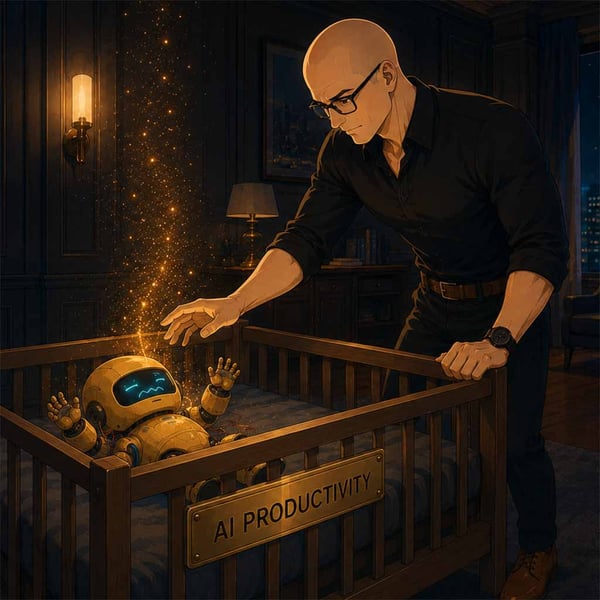
Matt Wilkinson explains organisational gravity and why his new book, The Buyer in the Loop, exists to stop the buyer's voice getting sanded out of marketing.
Shownotes
Every persona gets built with real insight, then filed in a drawer within a month. Matt Wilkinson has watched it happen to his own clients for a decade, and he finally wrote a book about why.
This episode is for commercial leaders, product marketers, and anyone who has sat through a persona workshop that never got used again.
Matt joins Jasmine to mark the publication of his book, The Buyer in the Loop. They cover organisational gravity, the pull of legal review and internal habit that strips a message down until it sounds like everything else the company has ever said, and how synthetic customers can keep a buyer's real voice in the room long after the research wraps.
The buyer never left the room. The room just stopped paying them any attention.
- Why personas lose their grounding within weeks of being built, and what behavioural economics has to do with it
- The difference between a grounded synthetic customer model and one that is just an elaborate way of talking to yourself
- Jasmine's seven-layer cake analogy for what proper grounding actually requires
- Why cognitive surrender is less the risk than voice of customer amnesia
- How organisational gravity operates like legal review, leadership sign-off, and old habit pulling every message back down before it reaches the buyer
Get a copy of The Buyer in the Loop, out 22 July
- [00:18] Cold open
- [00:57] Organisational gravity introduced
- [03:20] Alison, the composite persona
- [06:31] Dune and the stakeholder review
- [08:08] Legal, regulatory, and the sandbag problem
- [09:08] Synthetic customers versus talking to yourself
- [10:37] The seven-layer cake of grounding
- [11:57] Cognitive surrender
- [16:28] Voice of customer amnesia
- [16:56] The vow at the end of the book
- [18:52] Speaker bureaus and knowing your audience
- [19:28] The one line for dinner parties
- [20:15] Where to get the book
Keywords: organisational gravity, synthetic customers, buyer persona, voice of customer, cognitive surrender, B2B marketing, life science marketing, The Buyer in the Loop, Matt Wilkinson, persona grounding, marketing approval process, customer obsession
Watch the full conversation, subscribe for new episodes of A Splice of Life Science Marketing, and visit strivenn.com to get your copy of The Buyer in the Loop.
Transcript
Matt Wilkinson joins Jasmine Gruia-Gray to mark the publication of his book, The Buyer in the Loop, unpacking organisational gravity, synthetic customers, and the discipline of staying obsessed with the buyer.
Cold open
Speaker: Jasmine [00:18]
Hello, Matt.
Speaker: Matt [00:20]
Hi Jasmine, how you doing today?
Speaker: Jasmine [00:21]
Good, good. It's steamy here in Northern Virginia as I know it is in England as well.
Speaker: Matt [00:27]
Yeah, it's a quite comfortable twenty seven degrees C here at the moment.
Speaker: Jasmine [00:32]
All right, your sense of comfortable is very different from mine.
Speaker: Matt [00:37]
Well, you know, twenty seven degrees C, not too humid. I'm pretty comfortable with that. When it gets to sort of thirty two, thirty three, that's stifling. So those sort of four or five degrees difference I think make a big, big difference.
Speaker: Jasmine [00:49]
Yeah, fair enough. And lower humidity makes a big difference too. Yeah.
Speaker: Matt [00:52]
Huge. Yeah. Of course the UK is renowned for being humid when it's hot, so
Organisational gravity introduced
Speaker: Jasmine [00:57]
All right. Well, we've got a little bit of a different turn today that I'm super excited about. So let me kick it off. Somewhere between the interview room where a real buyer rants, and we've all been there, about the painful workflows they've had to endure, and the deck that links those pain points to a value prop and a set of marketing messages.
A chasm opens up. What starts as a scream gets sanded down one reasonable edit at a time until it's quiet enough to present in a stakeholder meeting, and the buyer, the actual person the whole message was supposed to be for, quietly gets walked out of the room. Our podcast host, Matt Wilkinson, calls this organisational gravity.
He means it as close to a law of physics as marketing gets. Every message needs escape velocity to break free of internal gravity and actually reach the buyer. Legal review, leadership sign-off, and 30 years of internal habit all pull it back down. Most messages never make it.
They circle the building a few times, sounding exactly like everything else the company has ever said. And the one person they were built for never receives them at all. He wrote an entire book about it, and it turns out he has an inside on those rooms, unwittingly helping build that gravity for a decade before he decided to name it and build the fix: synthetic customers.
A way to keep the buyer in the room long after the research is finished. So today, the man who spends his career finding the words for other people's buyers is turning the microphone toward himself to give us the backstory on his book, The Buyer in the Loop. Matt, I've watched you build this argument for almost a year and a half, and I'd really like to hear the real stories, the ones you haven't told anyone else.
Behind the organisational gravity and the synthetic customer that's supposed to fix it. Shall we get started? Okay. So one of the characters in your book is Alison. A real person? Or is she five different heartbreaks you've watched happen to five different marketers sewn into one composite? And since I'm asking,
Alison, the composite persona
Speaker: Matt [03:20]
Let's go for it.
Speaker: Jasmine [03:41]
Be honest with me, which part of her might actually be you?
Speaker: Matt [03:45]
So she's definitely a composite. And the name came from being a convenient name as much as anything else. I knew an Alison at primary school, so that's probably where it came from. And how much of it is me? There was so many times I've worked with people and been the strategy lead on a project and had questions about.
Something that was already documented in the persona. And I felt time and time again that we'd been through these exercises of really trying to understand who are we communicating to, who are we building for, who are we selling to. We captured all of this fantastic information, and yet I was having to remind people time and time and time again.
That to go and look in those places. And it was almost like a reflex that as soon as that document exists, it's just filed away. And I must admit, Jasmine, that I know that at one point I built some of these for you. And we built those personas. And I think you even had a confession that the same thing that happens to nearly every persona
Speaker: Jasmine [04:39]
Yeah.
Speaker: Matt [04:50]
happened when I provided them to you as well.
Speaker: Jasmine [04:52]
Yeah, absolutely. It's heartbreaking to admit, but true. I mean, in the moment, it was super important. It was a great cross-functional team that came together to really dig deep into persona creation. And we used a lot of real world experiences to help pull those personas together and give them
Grounding, as you call it in your book, and maybe a month after that it started finding its way into a drawer, or as you call it, onto a rusty hard drive.
Speaker: Matt [05:28]
Yeah, and it's heartbreaking when you put all of this effort into trying to understand it and you go through a process of using these then realise that they don't have the longevity that you think they might do. But I don't think that it's necessarily because of forgetfulness or anything else. I think it's because it's really hard to actually keep putting yourself in your customer's shoes.
You and I were at the Uprising and I used an example of, I think it was yourself and Chad actually, two people of very different size and stature. And if I'd asked you to wear each other's shoes or each other's jackets, they clearly wouldn't fit. And I think that's the problem that so many people have. We're asking ourselves to stand in somebody else's shoes. And it's uncomfortable. And so I think that's why we avoid it.
I think there's a behavioural economics element in here that it's hard. I don't really want to admit that there's maybe problems that we're trying to address here. And it's much easier for me to satisfy the people that are present in the room rather than the person that's really going to help make the organisation successful, which is the customer.
Dune and the stakeholder review
Speaker: Jasmine [06:31]
Yeah, yeah, so true. So to lighten the mood a bit, only you would reach for Dune to describe a stakeholder review. Did approval processes or the little death come to you mid one of those old school hours-long persona workshops you write about, wanting to scream?
Or did you just want an excuse to quote Frank Herbert in a business book?
Speaker: Matt [07:00]
It's probably a little bit of both. I'm a big fan of Frank Herbert's work and I'll admit I've been watching the movies and some of the TV shows of that recently. I'm a big fan of other sci-fi writers as well, the likes of Asimov and Arthur C. Clarke as well. So it was just one of those phrases that just seemed to fit so perfectly. The number of times you go through these approvals.
And you try and write as raw as you can to really communicate with the customer, the person that you're just trying to reach. And all of those messages end up being sanitised by the approval process and taken so far away from the customer that it kind of feels like you're just dying inside every time you see one of those lines of red ink on the page or the track changes come in. And so it just feels like that. And it's even worse with Google Docs because you get notifications as the edits are coming through.
And so each one feels like a little knife to the heart as you go through it, and especially when it's taking it away from wording that you feel really is there to resonate with a customer and not to glorify the brand.
Legal, regulatory, and the sandbag problem
Speaker: Jasmine [08:08]
Same time it's a balancing act, isn't it. You know legal is there to protect the company and not overclaim in some instances. Regulatory is there with the same intentions. Their intentions are not nefarious.
Speaker: Matt [08:25]
Absolutely not. I don't think I would ever claim that they are. But again, their role is to protect. Imagine that there's a flood, whereas a one inch sandbag might do the job, they're there to put a ten foot wall in place to play it safe. They're also not necessarily, and this is maybe the fault of the process as much as anything else, they're not actually necessarily shared all of the information of how to get there. They're just given a document to sign off on. They're not actually part of the process. And so that's something that I do believe is a big issue: that we're very often putting the information in the way of decision making that have never actually been exposed to
Either the customer or maybe the researcher. And I think that's a big miss.
Synthetic customers versus talking to yourself
Speaker: Jasmine [09:08]
So if we pivot just a bit more, you talk about synthetic customers being a grounded model versus the ungrounded model being an elaborate way of talking to yourself. But a grounded one is still built, coded, and questioned by the same organisation.
That's already proven it can't be trusted with the buyer because that's the whole persona in the drawer situation. What actually stops it from becoming a more convincing way to talk to yourself, the it being the synthetic customers?
Speaker: Matt [09:43]
That's a great question. And I think that there's some subtlety here. I think if we build a persona based off of a rim of people, a few insights, a few things, we don't necessarily uncover anything that we don't want to hear. If we're actually going out and listening to what the market's saying, what the customers are saying, we might uncover some uncomfortable truths.
And those are the things that are really important to make sure that we are including in the synthetic customers. That's where the grounding really comes alive because all of a sudden you've got the real truth. And then being able to call on that and be able to interrogate it without having to read 30 transcripts of interviews, but being able to actually say, hey, what would this audience actually say?
And hearing a group of them argue about something, that's really valuable. And so having that really solid grounding is really key here.
The seven-layer cake of grounding
Speaker: Jasmine [10:37]
So one way to think about the grounding is analogous to one of my favourite cakes called a seven-layer cake. So you've got the voice of customer layer, you've got the brand sentiment layer, you've got Reddit, ResearchGate, and other layers on top of that. And that's the full synthetic customer seven-layer cake. Is that what you mean by grounding?
Speaker: Matt [11:05]
Absolutely. Yeah. And I love that analogy because that makes it really tasty as well. Especially if you've got some good frosting. But probably the less said about my love of frosting the better.
Speaker: Jasmine [11:09]
Yeah. Yes.
So, as you and our listeners may know, I've done a little bit of digging into the term cognitive surrender, which was a term coined by two Wharton researchers, Shaw and Nave. Let me ask something a little bit closer to home. You warn
Cognitive surrender
Readers about what you call cognitive surrender, the moment the model's answer replaces your own thinking instead of feeding it. When's the last time you couldn't tell where your thinking stopped and the AI or the synthetic customers started?
Speaker: Matt [11:57]
That is a great question. And from a personal perspective, where do I know whether I haven't? It's difficult to know. I'd like to think of myself as fully embracing kind of the augmented human these days. But I think that when it comes to synthetic customers in particular, they are a fantastic way of capturing what we currently know. They're a really, really good way.
Of taking all of the insight, using that to test a hypothesis, and essentially building a model, not a large language model, but a model in the scientific sense of what we believe our customers to be. But as anybody that's been involved in science knows, a model, a hypothesis needs to be tested. And what we really need to be doing is to be getting all of that information, building those models, which will get us closer than just
Three insights on a PowerPoint slide, build those models and then be able to see what actually happens in reality. And if we can take reality and bring that back into the model and create a virtuous cycle, a real life synthetic customer, real life customer loop, that becomes incredibly powerful. And so I think that we have to be very careful not just to say, hey, we've got these, we're going to trust them explicitly.
What we really need to be doing is saying we've got these. This is better than not having them. But let's see what happens in reality and bring that back in. So there's a situation of constant optimisation, kaizen, as the Japanese would say. But I think there's also something else here that's important as well. AI is moving incredibly quickly. It's honestly exponential trajectory that organisations aren't able to keep up with.
Those capabilities are also changing the way that our customers behave, the way they search, and each new capability that gets released has some impact on our customers. So our customers are not static. There's obviously the geopolitics of the world, there are advances left, right and centre. So we're dealing in a very volatile and uncertain world as well.
So we do need to be careful not to say that we did this work three months ago and it's fixed. A lot of people, their personas don't get refreshed even every 18 months. These days, I think we're in a situation where we've got the ability to actually create these synthetic customers and then update them frequently. And so that's something that I think is a really important thing to be looking at. This isn't just a here's the fix, it stays.
It's here's the fix. Let's test it. Let's see if we get a better improvement and if it improves. And then let's see how we can tweak them even further. What do we learn? How do we bring that information in here? So as much as anything else, I think it is a really important discipline to be making sure that we're listening to our customers more closely, more frequently, and making sure that we're making that information
more available to the teams that need it most, the teams in product development, the teams in marketing, the teams in sales. And that's really what I believe. And I believe that AI has the ability to finally make that far more accessible than ever before.
Voice of customer amnesia
Speaker: Jasmine [14:57]
I think this is a super important point about the value that synthetic customers bring to a project, a campaign, as well as to the wider organisation. And it's what you just said, it's this continuous updating and the availability to the organisation. So, coming back to my question, the way I think about it is,
it isn't so much cognitive surrender as the value of not falling into the voice of customer amnesia trap.
Speaker: Matt [15:36]
Yeah, absolutely. I think so often we forget the voice of customer's there. And even if we do have voice of customer, organisational gravity, the fact that we're sitting in a room, we're communicating with the people in the organisation, it's far easier to accept the edits, to not push back, to not constantly be chasing every little thing that we believe is right, because it's only our opinion, at least if we've got a way
Of running those changes past a synthetic customer, it allows us to have an unbiased approach. This is what they, this is how they're reacting. It gives you a third party. You're no longer talking from beliefs, and marketing is
an art as much as a craft. Yes, there is an art and a craft to marketing and the messaging. And so often that gets dulled by the organisation. So if we can use the synthetic customers to help us keep that edge, I think it's a really powerful approach.
The vow at the end of the book
Speaker: Jasmine [16:28]
So to continue to pull on that thread a bit, you end the book with, I'm quoting now, the buyer who never leaves is the one you never stopped talking to. That reads less like a marketing principle and more like a vow. Is this actually a book about buyers or is it about the version of yourself you were trying not to become?
Speaker: Matt [16:56]
Probably neither. It's probably the version of myself that I aspire to be. So I think that we can always improve our focus on trying to communicate with our customers better. Last Friday I was at a boot camp organised by Future Voices for learning how to work better with speaker bureaus. I've never worked with a speaker bureau.
Speaker: Jasmine [17:01]
Mm.
Speaker: Matt [17:19]
I don't know what they're looking for. And I certainly don't know what their customers that come to a speaker bureau are looking for. So I can look at the conversations that I have and the conversations I've had with people that have booked me for giving talks in their companies and workshops. That's my experience. But not the people that are saying, hey, I don't know who to go to, here's a speaker bureau. And so one of the things that I was trying to learn so much about there and really try to focus on is,
so, what are you actually looking for? Because my positioning to a speaker bureau and through a speaker bureau needs to be different than to the audience that knows me as a domain expert. And that's something I think is just really important. It's having this obsession with focusing on trying to understand the customer better. And over the last few years, that's really become something that I have started to obsess about and figure out how to do a better job at.
And I'm sure I have a long, long way to go before I'm great at it. This is maybe my confession as much as anything else.
Speaker bureaus and knowing your audience
Speaker: Jasmine [18:21]
I don't know that it's as much of a confession as it speaks to the fact of how complex this area is. As humans, we're wildly complex. We have emotions, we have an ego. It takes a long while to get into that headspace just for that reason alone. So I don't know that I'd beat yourself up too much.
Speaker: Matt [18:44]
I'm not. And it's an aspiration. But I think we can always do more to try to walk more faithfully in our customer's shoes.
The one line for dinner parties
Speaker: Jasmine [18:52]
Absolutely. So, last question, and it's a bit of a fun one. So, Mark Schaefer, Ann Handley, Joe Pulizzi, Joeri Billast, they all vouched for this book. Congratulations. Those are some really, really big names in the wider marketing industry. If a year from now our listeners can only remember one line from your whole book and had to repeat it at
every dinner party for the rest of their life, whether you like it or not, which line do you want it to be?
Speaker: Matt [19:28]
It's a great question, and I think it's one where the discernment piece becomes really difficult. But I don't think the buyer ever wanted to leave the room. It's just that everyone in the room stopped paying them any attention.
Speaker: Jasmine [19:40]
Yeah, I'm pausing here because that is a huge mind opening for me. Of course they don't want to be ignored. Of course they want their voice to matter, but yeah, as commercial folks, we have not been listening to them enough. And so I think that's a great line for dinner parties.
So before we close this episode, can you tell our listeners where they can get a copy of your book and where they can reach you if they have questions?
Where to get the book
Speaker: Matt [20:15]
Sure. So the book should be available worldwide through Amazon. So just search for The Buyer in the Loop and Matt Wilkinson and it should turn up. You can also visit strivenn.com slash the-buyer-in-the-loop, with hyphens in between each word, and there's a page there that again will point you to specific Amazon pages. The Kindle version is available for pre-order now, and probably by the time this goes out
the paperback will be available. The book publishes on the twenty second of July. So really excited to get this in people's hands. It's also a little bit nerve wracking, I will admit. It doesn't matter that I've written a blog a week for maybe two years now or more. Blogs can be edited. Web pages you can go back,
you can change what happens when you publish a book, whether it's an EPUB or a paperback. Those words stay. You can't ever take those back. And so that's something that I find is a real honour. It's a real honour that people are interested in reading it. And it was great when early interest took it to the top of the hot new releases and sales and marketing list on Amazon.
So I'd love to continue that momentum, guys. So please do buy. But I think it's a really powerful message. In this age of AI, we have to be more and more obsessed with a customer than ever before.
Speaker: Jasmine [21:23]
Couldn't agree more. Congratulations again, Matt. This is a huge deal. And for what it's worth, I would very much recommend reading it and actually having it on your desk for everyday reminders on what it's like to keep the buyer in the loop.
Speaker: Matt [21:41]
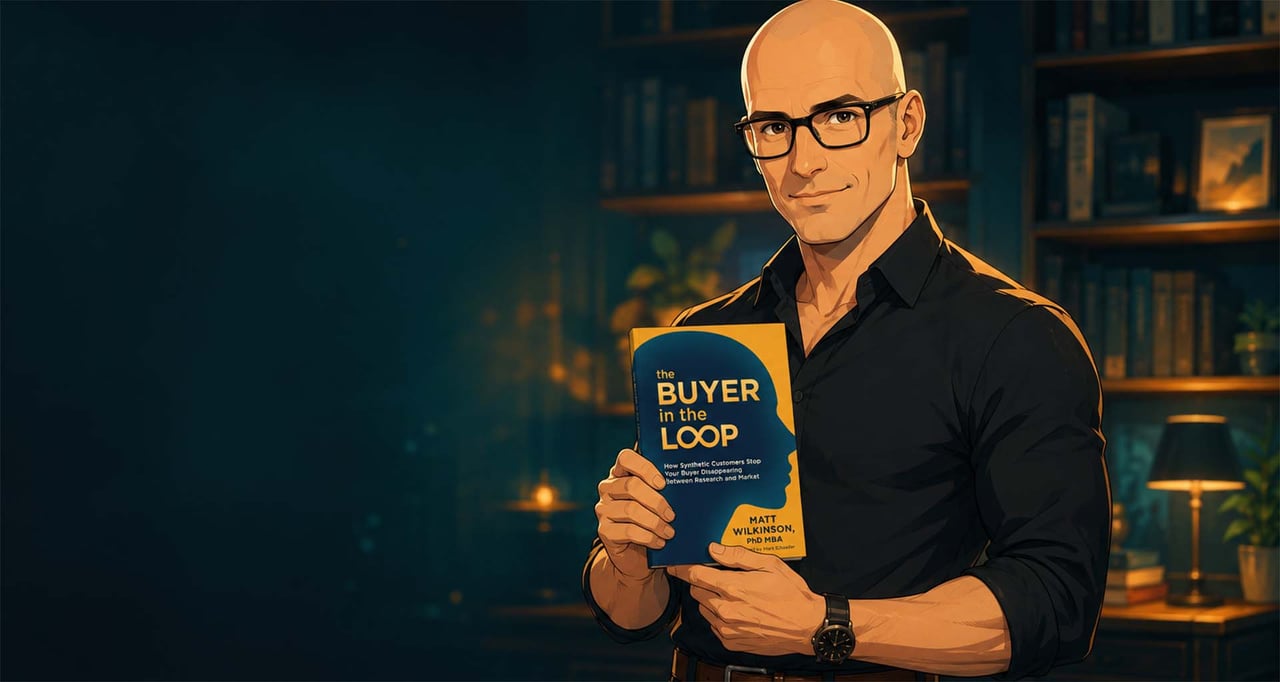
Thank you. And I know we talked about the cover in the past, but just in case anybody's interested, here's a physical copy of the book just to prove it really does exist.
Speaker: Jasmine [21:48]
Yeah. Excellent. Thank you, Matt. This has been fantastic.
Speaker: Matt [21:55]
Thank you, Jasmine.
Speaker: Jasmine [21:56]
Bye for now.
Q&A
What is organisational gravity, and how do I know if it is happening to my messaging?
It is the pull of legal review, leadership sign-off, and old habit that sands a message down until it matches everything else the company has already said. Check your last three approved pieces against the raw customer language they started from. If the buyer's specific phrasing is gone, gravity won.
How do I stop a persona from ending up in a drawer within a month of building it?
Grounding is not a one-off workshop. Pick one live campaign this week and force a single decision through a synthetic customer check before it goes to approval, with a small budget for one round of testing. Habit forms from repeated small use, not a big launch.
What is the difference between a grounded synthetic customer and just talking to myself?
Grounding means the model surfaces uncomfortable truths you did not already believe, built from voice of customer data, brand sentiment, and outside sources like Reddit or ResearchGate. Test one synthetic customer against a real transcript next week. If it only confirms what your team already thinks, it is not grounded.
How often should I be refreshing my personas or synthetic customers?
Matt flags that most personas go 18 months without a refresh while customer behaviour shifts constantly under AI-driven search and geopolitical change. Set a recurring monthly check with a small budget to feed new real-world signal back into the model rather than treating it as fixed.
How do I get legal and regulatory to stop diluting customer-facing language without creating risk?
Matt's point is that legal and regulatory teams are rarely shown the customer research behind a document, so they default to the safest possible wall of caution. Next week, invite one legal reviewer into a fifteen minute readout of the actual customer language before the draft reaches them.