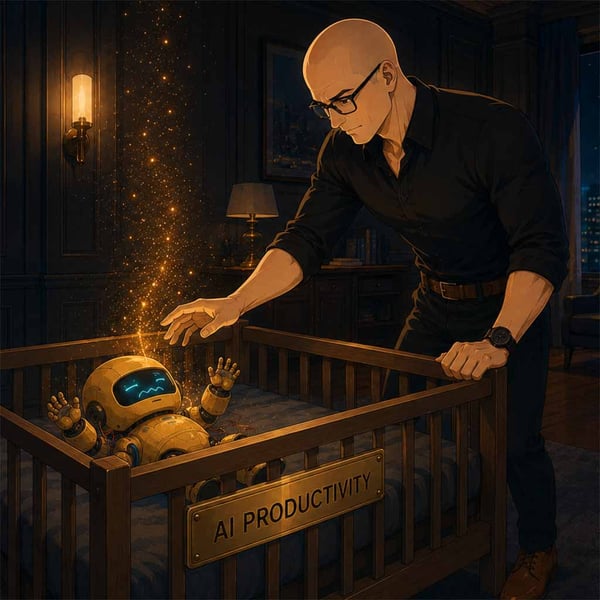
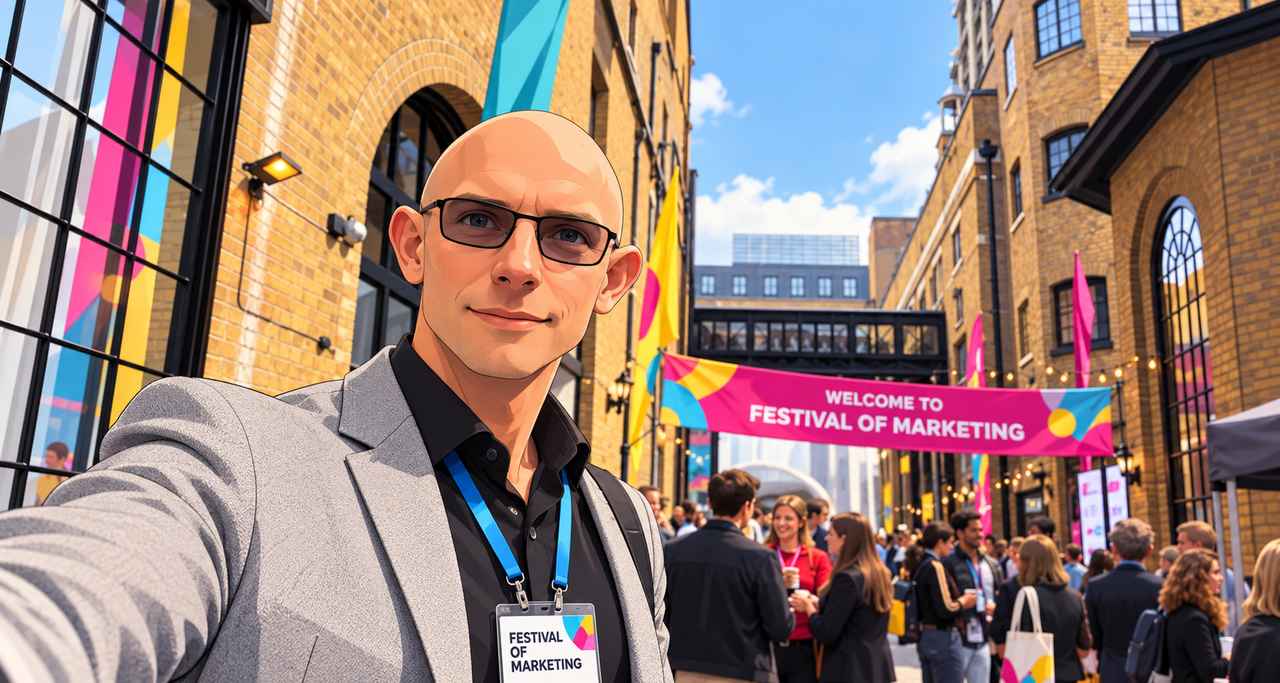
Life science marketers: as AI makes content cheap, win with a bold, memorable brand and by keeping the customer's echo loud.
Shownotes
AI can now produce content faster than any marketing team, so content alone is worth less every month. The brands that survive will be the ones buyers actually remember.
Who this is for: commercial and marketing leaders at life science tools and diagnostics companies.
Matt Wilkinson reports back from the Festival of Marketing, where he joined a Marketing Week roundtable on why AI still needs marketing talent. He and Jasmine Gruia-Gray unpack Sir John Hegarty's case for bold, distinctive branding and look at how brand is formed at every touchpoint. They close on how synthetic customers keep the voice of real buyers alive inside the organisation.
Key idea: As AI pushes the value of content toward zero, life science brands win by being bold enough to be remembered and keeping the customer's echo loud in every decision.
What you will learn
- Why the sea of beige on life science trade show floors becomes a bigger commercial risk as AI floods every channel
- How layered approvals and over-researching sanitise creative work, and what Liquid Death and Camden Town Brewery's Hells did differently
- Where your brand is really formed: field service engineers, application specialists, social media responses and what large language models say about you
- How a UK bank built customer personas from its own data for copywriters, and what that means for life science teams
- Why synthetic customers work best as an echo of real research that the whole team can reach
- How Matt doubled undergraduate recruitment with a fireworks lecture, and why distance from the customer erodes that instinct
Chapters
- [00:20] Back to the Future day
- [01:03] Inside the Festival of Marketing
- [02:30] Sir John Hegarty on owning a corner of the mind
- [04:02] Escaping the sea of beige in life science branding
- [05:57] Brand as experience and word of mouth
- [08:25] The human side of branding and AI personalisation
- [10:34] Synthetic customers at the roundtable
- [12:00] Keeping the customer echo loud across the team
- [14:03] Echoes, research and the fireworks lecture
- [18:05] Wrap-up
Keywords: life science marketing, Festival of Marketing, Sir John Hegarty, brand distinctiveness, synthetic customers, voice of customer, AI in marketing, account-based marketing, B2B branding, life science tools marketing, customer experience, brand memorability
Watch the full episode, subscribe for new conversations on life science marketing, and visit strivenn.com to see how Strivenn helps commercial teams keep the customer at the centre of AI-enabled marketing.
Transcript
Recorded on Back to the Future day, this episode finds Matt Wilkinson and Jasmine Gruia-Gray discussing Matt's experience speaking at the Festival of Marketing. The conversation moves from Sir John Hegarty's call for bold, memorable branding to the experience of a brand at every touchpoint, the limits of AI personalisation, and how synthetic customers keep the customer's echo alive inside life science organisations.
Back to the Future Day
Speaker: Jasmine Gruia-Gray [00:20]
Hello, hello, Matt.
Speaker: Matt Wilkinson [00:21]
Hey Jasmine, how you doing?
Speaker: Jasmine Gruia-Gray [00:23]
Good. Happy Back to the Future day.
Speaker: Matt Wilkinson [00:27]
Is it really nineteen eighty-five or nineteen fifty-five?
Speaker: Jasmine Gruia-Gray [00:31]
Yeah, wish it were, but no.
Speaker: Matt Wilkinson [00:34]
Yep. And I still don't have that DeLorean on my driveway. So there's definitely something wrong with that picture.
Inside the Festival of Marketing
Speaker: Jasmine Gruia-Gray [00:39]
Yes, exactly. We're gonna take a different turn in today's episode. And I thought it would be a good idea for our audience to hear about the Festival of Marketing that you attended and spoke at last week. So can you give us a quick summary and then we can dive into some of the details?
Speaker: Matt Wilkinson [01:03]
Yeah, so the Festival of Marketing is a marketing conference put on by Marketing Week. And unsurprisingly, AI was everywhere. I think every conversation talked about AI and marketing and the role of marketers in the future of marketing. I was invited to be part of a lunchtime roundtable that was sponsored by Marketing Week and then Cognizant and Google Cloud about why AI still needs marketing talent and thinking about the last mile of what's important in terms of AI and marketing.
Speaker: Jasmine Gruia-Gray [01:39]
Super. So was it structured like most conferences where you have a leading speaker and then you have breakout sessions?
Speaker: Matt Wilkinson [01:49]
Yeah, so the leading speaker was Sir John Hegarty, very, very famous British advertising guru, very outspoken, and uncompromisingly dressed, I would say, in a very, very dapper suit that was bright, and you just knew that he was a marketing branding genius just from looking at him. Exactly.
Speaker: Jasmine Gruia-Gray [02:06]
Totally human.
Speaker: Matt Wilkinson [02:08]
There were also breakout sessions, lots of different meeting rooms with different sessions that were going on. So I got to sit in quite a few different panel discussions, fireside chats. There was a lot going on. Fewer keynote talks and more conversations seemed to be the order of the day, at least in the sessions that I chose to join.
Owning a Corner of the Mind
Speaker: Jasmine Gruia-Gray [02:30]
Was there any session that you'd describe as, wow, this really blew my mind and sent my thinking down a completely different path?
Speaker: Matt Wilkinson [02:40]
There was a fireside chat with Sir John Hegarty towards the end that was one of my favourite sessions. And I think it was just really how outspoken he was about the importance of branding. You and I are both part of the Rise community, and we know how brand is more important now than ever. But I think it was just how important being bold and owning a corner of somebody's mind is becoming. If we don't own that real estate in somebody's head, then actually we just don't stand a chance in this new world, because the value of content, the value of output, approaches zero. So it's really about what can we do to be memorable, to stay memorable.
Those are the things that really, really stood out to me. Yes, AI is everywhere. Yes, AI can enable us to do amazing things. You and I talk about this all the time. And I'm constantly blown away by the things that AI is letting us do, whether it's asking the AI to review a website and help me make it better, and it goes away and makes suggestions, through to helping you create content, do research, even edit videos through MCP servers. Being able to connect via an MCP server into Claude and say, hey, create this clip from a video. Those sorts of things are now possible. And that's stuff that wasn't possible before, and I think that's just so exciting.
Escaping the Sea of Beige
Speaker: Jasmine Gruia-Gray [04:02]
Superb. So going back to Sir John Hegarty, what part of his message do you think is most applicable to the brands in life sciences, whether they're the small startup brands or whether they're the large, very well-known brands?
Speaker: Matt Wilkinson [04:23]
I think if I look at the majority of brands, and we saw this when we were walking around SLAS together, how many brands and booths were just forgettable. It was like a sea of beige as we walked around. And so it's really about having something be really distinctive. And it's not just about being bright colours, but it's having a story that holds everything together.
We've got to be bolder than the research actually says. I think that's something that, if we ask too many opinions, we end up going up and down through approval processes and we end up playing it safe. Things become almost too sanitised. You and I heard people talk about Liquid Death as a drinks brand and the amazing work that they've done turning a water company into something that is bigger than just, hey, it's some water. There's a brand that Sir John Hegarty talked about that was made by Camden Town Brewery, which was just down the road from where we were, which is called Hells. Those names themselves would have just not been approved if they'd done too much market research. They needed to really focus on being bold and distinctive and throw out some of the cautiousness that I think really envelops our industry. If I look back at any of the marketing materials that people have put together over the last 20 years that I've been involved in the sector, there are very few that really stay with you as being really, really memorable. And the ones that do sometimes are the crazy, silly things that people go, that was terrible, but that's why I remember it. There are very few examples, I think, of brands being really, really bold.
Brand as Experience
Speaker: Jasmine Gruia-Gray [05:57]
I'm really glad you brought up those two examples, because what strikes me is that they're very focused on bringing forward the experience that a current and future customer would have with the brand. And that experience not only from drinking, but that experience from an emotional perspective. And I was curious to know whether Sir John Hegarty brought that up as he was discussing the importance of brand.
Speaker: Matt Wilkinson [06:31]
So he was less talking about experience in terms of the brand, but it was very much how you encounter it in the first place. His background's in advertising and brand creation rather than in the product side of things. But on Monday I was at Surrey University giving a talk to some of their marketing master's students, and it was part of a service design module. And of course, we know now that brand isn't just how we broadcast the brand, but it's also how people experience it, as you just alluded to. And so one of the most important things that we have to be conscious of is word of mouth marketing. What people say, how they experience the brand at every single touchpoint, really does wrap up into the picture of the brand that people have.
And if people have an issue, we have to be really, really conscious to package that issue and respond to it in a way that allows people to know, okay, they're not perfect, but when there is an issue, I know I can trust them to look after me. And how they're going to look after me and speak to me is going to be really important. As we talked about with Brooke Sellas not too long ago, those things are just so important to make sure that we get right, that we're looking out for the conversations on social media that mention our brand and that we're there and part of the conversation. That we're there to not just broadcast, but to listen, to respond, and to guide other people as to how they might get help in the future, because those are important touchpoints too.
But it's also how people experience the brand when they do visit a website, when they see what they see through a large language model. All of those signals are getting less visibility, but we also have tools that we never had before. And I think that marketing is really going to be changing hugely over the next little while as to what signals have become important, and we can't predict yet where those large language models are going to be picking those signals up from.
The Human Side of Branding in an AI World
Speaker: Jasmine Gruia-Gray [08:25]
Totally agree. At the same time, I think it's wise to remember Mark Schaefer's words about the most human brand wins. And for me, what that means in the life sciences is your brand is communicated through your interaction with your field service engineer, with your field application specialist, with your, of course. Was any of the human side of branding discussed?
Speaker: Matt Wilkinson [08:55]
Not so much in the sessions that I went to. I think that a lot of conversation did focus on where is the role of the human in this new AI world. There was one fireside chat I attended, really about the hospitality industry, but again looking at account-based marketing through their lens and how AI is transforming the work that they're doing, and how basically they can now personalise almost everything they do. It is now possible through the use of personalisation tokens and AI to completely personalise outreach for every single email that you send out.
The question you have to ask is to what extent do you trust the AI? How much oversight do you want to have over those messages? But it's possible to get insights about who you're speaking to, do the research about individual companies, about individual people, and really tailor outreach messages to people at such a specific level. I gave a webinar last year for SAMPS talking about how you could use AI to scale content in a way for account-based marketing. Even that approach is now updated, and that's less than 12 months later.
Speaker: Jasmine Gruia-Gray [10:03]
Mm-hmm.
Speaker: Matt Wilkinson [10:04]
We have to look at the place for the human being and where those human-to-human interactions really matter, and invest in those. We have to look at what should the AI be doing, what should the human be doing, and how do we orchestrate our marketing activities so that we position the customer at the centre of everything we do. And what we do is we don't just create more, but we're creating better. And we're creating with the benefit of the customer in mind rather than overloading them with messaging.
Synthetic Customers at the Roundtable
Speaker: Jasmine Gruia-Gray [10:34]
Right. So that's been a theme for both you and I in what we write about weekly. How did you carry through that theme into your roundtable session?
Speaker: Matt Wilkinson [10:48]
So that was interesting. We only had an hour. There were maybe 15, 20 people around the table, so there wasn't a lot of time for each of us to speak. There were a lot of people talking about the AI tools that they were using, the way that things were changing. One of the most interesting stories came from a gentleman at a UK bank that actually was doing something very similar to our grounded synthetic customers. So finding a large company in financial services using the data that they'd already got about their customers to build personas that they could then help their copywriters, their marketers, to use to help them do a better job.
And so I think that the more we can use AI to better understand the customer's condition, the better. This is something that isn't surprising from what I talk about and what I write about, but it came across time and time again. AI is about efficiency, but it's about effectiveness as well. And if we're going to be effective, we have to keep our focus on the customer and the human rather than just focusing on outputs or volume. Those metrics that very often marketers are measured on have to change in the same way.
Keeping the Customer Echo Loud
Speaker: Jasmine Gruia-Gray [12:00]
I completely understand what you're saying. For a long time, the product manager or the product marketing manager was responsible for bringing the customer's voice inside the company. Unfortunately, what often happened was that voice maybe trickled to a few, and maybe that voice stayed around for a few meetings, but then dropped off. And it seems to me that these synthetic customers are a way to not only bring the voice into the company, but maintain that voice through whatever you're doing, whether it's creating new copy or developing a new product.
Speaker: Matt Wilkinson [12:47]
Yeah, for me that's something that I'm a huge exponent of, because I think it democratises that knowledge. One of the things that's really important is to make those tools then available within the system. So whether they're using Copilot or Claude or ChatGPT, whatever those tools may be, making sure that they're able to access that knowledge really brings that insight to life. Nobody wants to do the mental gymnastics to read through lots and lots of voice of customer research and interviews every time. They'll work from memory, and that gives us a very shallow understanding of what the customer condition really is. And it's easy for us to look at that compass at the start of a campaign and then easily get blown off course by the internal messaging and the internal interpretation of what's being said. So the truer we can stay to what we've heard, the better. And
Speaker: Jasmine Gruia-Gray [13:41]
Yeah.
Speaker: Matt Wilkinson [13:41]
if we can then share that across a team rather than just having it in the hands of the strategist or the research team or whoever has spoken to the customer, we have a better chance of really putting the customer at the heart of everything we do.
Speaker: Jasmine Gruia-Gray [13:58]
Well, it becomes the most true echo, if you will.
Echoes, Research and the Fireworks Lecture
Speaker: Matt Wilkinson [14:03]
Hmm. And that is all it is. I think you used a really important word there. It is an echo. We talk a lot about, we see a lot of work with digital twins, and I've seen some people talking about these synthetic customers and some of the work maybe using them in a way to replace research. And there's a lot of conversation around can you replace research? Can you use them to test ideas? And the answer is absolutely yes, you can. But should it replace research? No. And should it replace the touchpoints where you would normally speak to customers? I don't think so. But if you can keep those echoes louder throughout the process, you stand a better chance of staying true to the customer. And I think that one of the biggest challenges most of the companies that we work with have is that there isn't a lot of that testing of campaign ideas before things go to market. There isn't a lot of that back and forth with the customer. It's almost, I used to work in the lab, so therefore this is what I would have liked. And as you get further and further away from the time that you spend at the bench, those echoes fade.
My first ever marketing campaign was when I was a postdoc at the University of Amsterdam. My boss at the time was an associate professor. He'd just been given responsibility for undergraduate recruitment and bringing people in. And believe it or not, the Dutch didn't really want to go into the centre of Amsterdam to study because it was noisy, it was dirty, there were too many tourists. They preferred to go to some of the other universities. So I said, well, why don't we host a fireworks lecture? He hadn't heard of a fireworks lecture, and so we put together a fireworks lecture, which was, we had explosions, we set fire to things, we had a big container of oxygen that we burnt some magnesium in. We had a whole host of fun, bright lights, explosions, fire. It was great. And we appealed to the childlike chemist in all of the attendees, and we had a lot of fun doing it. And we doubled undergraduate recruitment that year, mainly because we'd shown a different side to what it was like to be there.
Everybody's got laboratories, everybody has lecture theatres, but I think we were the only school that actually had a fireworks lecture and showed how much fun chemistry was. And the only reason that that was successful was that we were still so close to having been a student looking for places. If I went to do that now, I'd be so out of touch with what is important to an 18-year-old going to university that I wouldn't know that language unless I really studied the 18-year-old's condition, because they're going to have other worries than I did. And I think that's something that's just really, really important to bear in mind: the further we get away from the customer's condition, the less in touch we naturally are with it. And many marketers haven't necessarily walked in the customer's shoes. They haven't walked in the sales team's shoes. And so how can we really expect them to be able to understand the customer condition that well?
Wrapping Up
Speaker: Jasmine Gruia-Gray [18:05]
I loved how you brought together the two elements of this episode, experiencing the brand and the emotion of the brand, along with the customer echo. And so I think this is a great spot for us to end today's episode. And thank you for sharing with us what you learned at the Festival of Marketing this year.
Speaker: Matt Wilkinson [18:29]
Thank you, Jasmine. It was a great event and I look forward to hopefully going again next year.
Speaker: Jasmine Gruia-Gray [18:35]
Cool. Well, thank you everybody for listening to another episode of A Splice of Life Science Marketing, and we'll see you again soon. Bye for now.
Speaker: Matt Wilkinson [18:44]
Thank you, Jasmine. Bye bye.
Q&A
How do I tell whether our brand is part of the sea of beige?
Pull your last trade show booth photo, your homepage and three recent emails, remove the logo, and lay them beside two competitors. Ask one colleague from sales to pick out yours. If they hesitate, you have a distinctiveness problem. Then write the one corner of the buyer's mind you want to own as a single sentence. Any asset that cannot be traced back to that sentence is a candidate for bolder treatment. The whole exercise costs an afternoon.
How can a small team make creative work bolder without it dying in approvals?
Agree decision rights before the work starts. Name one owner and one reviewer, set a deadline, and limit feedback to whether the idea is true to the customer and on brand. Test the bold option with three to five customers, or with a grounded synthetic customer, before it enters review so the discussion runs on evidence. Hegarty's point was that a name like Hells would never have survived heavy research, so protect the idea from committee dilution.
Where should we keep humans in the loop as AI personalises our outreach?
Map your customer journey and mark the moments where trust is won or lost: a failed instrument install, a protocol question, a complaint posted on social media. Keep those human. Let AI handle account research and first-draft personalisation for routine outreach, with a person reviewing a sample of messages each week. Next week, sit down with your field application specialist, review ten AI-personalised emails together, and ask whether any of them would embarrass you in front of the customer.
What is a synthetic customer, and how do we start without a big research budget?
A synthetic customer is an AI persona grounded in your own voice-of-customer evidence: interview transcripts, win-loss notes, support tickets and sales call recordings. Start by collecting ten real customer conversations you already own, then build one persona from them inside the AI tool your team already uses, whether that is Copilot, Claude or ChatGPT. Give it to your copywriter and product marketer and ask them to test their next draft against it. It works as an echo that keeps your research in daily use.
How do we stop the voice of the customer fading once a campaign is under way?
Make customer evidence the first input at every stage gate, from brief to final copy. Store the source interviews and the synthetic persona where the team already works, and add one standing question to every review: what did the customer say that supports this? Refresh the persona each quarter with new conversations so the echo reflects how buyers think now. Most importantly, book at least one real customer call a month for anyone writing copy, because the echo fades fastest when nobody hears the original.