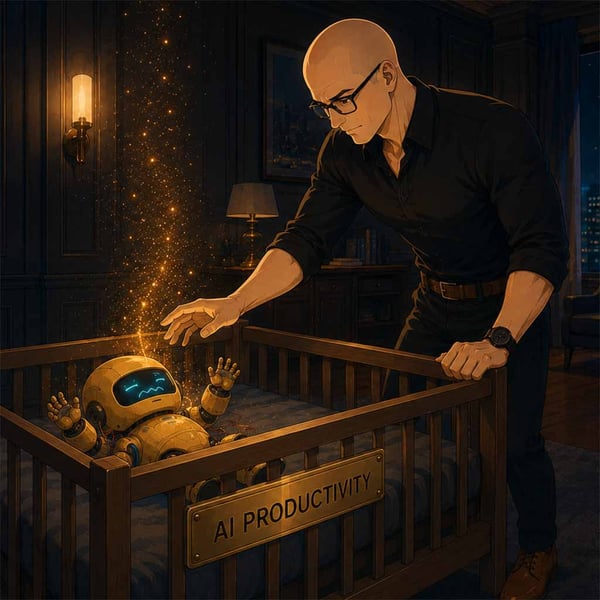

Jeff Bezos kept an empty chair in early Amazon meetings so everyone remembered the customer who was missing. Most decision rooms in life science still have the absence, and the research that could fill it sits unread on a shared drive.
Shownotes
Jeff Bezos kept an empty chair in early Amazon meetings so everyone remembered the customer who was missing. Most decision rooms in life science still have the absence, and the research that could fill it sits unread on a shared drive.
Who this is for: for product managers, marketing leaders and commercial teams at life science tools and diagnostics companies.
Jasmine Gruia-Gray talks to Matt Wilkinson on his blog The Empty Chair, opening with research showing that genuine dissent moves a group further than an assigned devil's advocate. They test whether a synthetic buyer is just another assigned critic, why each function remembers a different outlier customer, and why sales cannot simply play the customer. They also draw the line where synthetic buyers stop and real customer conversations take over.
Key idea: The empty chair reminded the room the customer was missing; a synthetic buyer built on your own research now lets it answer back.
What you will learn
- Why each function remembers a different outlier customer, and how that steers decisions towards the wrong problem
- How organisational gravity wears down the people fighting to bring voice of customer into the room
- Why a grounded synthetic buyer agrees or disagrees according to the evidence you give it
- Where synthetic customers stop: pressure-test with them, then go back to real buyers before you commit
- A first step you can take this week with a decision already on the calendar and research you already hold
Chapters
- [00:00] Introduction
- [00:42] The empty chair and the assigned critic
- [04:17] Why the chair stays empty
- [06:24] One chair or five: the buying committee
- [07:21] Why not ask sales to play the customer?
- [09:36] Will a synthetic customer just agree with you?
- [11:54] Assigned dissent and the synthetic buyer
- [12:53] Will synthetic buyers eat the research budget?
- [14:49] What to do next week
- [16:03] Speed or trust: a client example
Keywords
synthetic customers, synthetic buyer, voice of customer, life science marketing, product marketing, buying committee, confirmation bias, organisational gravity, customer research, AI in marketing, go-to-market strategy, decision making
If this was useful, watch to the end, subscribe for new episodes of A Splice of Life Science Marketing, and read The Empty Chair, the blog that started this conversation. Matt's book, The Buyer in the Loop, goes deeper on keeping the buyer present through the whole commercial process.
Transcript
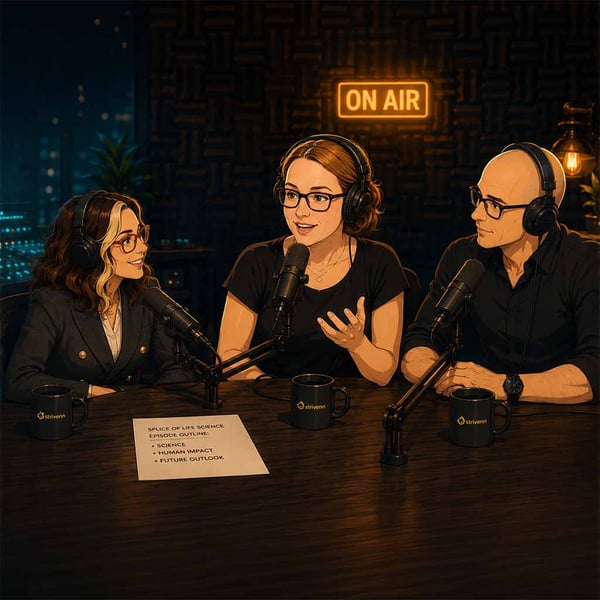
In this episode of A Splice of Life Science Marketing, Jasmine Gruia-Gray and Matt Wilkinson discuss Matt's blog The Empty Chair, which starts from the empty chair Jeff Bezos kept in early Amazon meetings to stand in for the customer. Jasmine presses on whether a synthetic buyer can influence a decision when everyone in the room knows it was built for the purpose, and Matt sets out where synthetic customers help and where real buyers must take over. The transcript has been lightly edited for repeated words, false starts and clear mishears.
Introduction
Speaker: Matt Wilkinson [00:20]
Hi Jasmine, how you doing?
Speaker: Jasmine Gruia-Gray [00:21]
I'm doing very well, Matt. And yourself?
Speaker: Matt Wilkinson [00:24]
I'm good, thank you. I'm excited to be here again.
Speaker: Jasmine Gruia-Gray [00:27]
So today we're gonna talk about a blog that you wrote. And while I don't have an empty chair, I have an empty couch behind me. So we're gonna use that as the proxy. There you go. Okay.
Speaker: Matt Wilkinson [00:39]
I do have an empty chair behind me.
The empty chair and the assigned critic
Speaker: Jasmine Gruia-Gray [00:42]
So in 2002, a group of researchers put 201 managers and employees into decision-making groups and tested two ways to stop a group from only looking for evidence that confirms what it already wants. Some groups got an assigned devil's advocate, others simply had members who genuinely preferred a different option. The genuine disagreement worked better. The assigned critic, the one everybody knew was playing a role, did less to break the bias.
That matters for anyone trying to bring the customer into the room. Dissent only bites when the room believes it's real. Which is what makes this week's topic, I think, a little bit tricky. Your piece starts with the empty chair Jeff Bezos left for the customer in Amazon's early meetings, and its fix is to make that chair argue back with a synthetic buyer built for your own research.
I like it, but a synthetic buyer can be an assigned critic by design. Everyone in the room knows it was made, and we already know how easily a room waves off pushback, even from a real customer. I've been in many rooms where folks say, the customer doesn't really understand the product, so let's dismiss that feedback. So the question I put to you, Matt, is whether a synthetic critic can influence a decision at all. Now, where did the chair come from for you?
Speaker: Matt Wilkinson [02:29]
A few weeks ago, my friend Anna had reminded me of the Jeff Bezos story. And he used to drag an empty chair into the room that would represent the customer. And the reason he did that was to try and make sure that everybody around the room knew that the customer, the most important person in the room, wasn't there. Bill Price, Amazon's first global vice president of customer service, says he sat in that first meeting where that chair stayed empty. And he said it had a profound impact on the way that people responded to questions, because it helped to remind them that the customer wasn't there and that they had to be the advocate for the customer.
So I then joined a call with someone I'd not had the pleasure of meeting before, a gentleman called Ruben Pastilha. And as I signed on to the call, I was greeted by an empty chair. Now, he'd joined the meeting and run off to refill his glass of water. And so I was staring at an empty chair in the middle of my screen, and I'm like, this is perfect. So we started the conversation talking about empty chairs and this whole story, and how the customer is absent in nearly every single room where decisions are made in organisations about the customer.
Bezos didn't solve the absence. He just tried to make it impossible to ignore. So your question about whether it can influence the decision, well, I think that depends. The grounded synthetic customers that we've been building are designed to be the voice of customer when the customer isn't there. But it only really works if you care about being customer focused and believe in the research and the data that you've already collected. If you don't believe in that and you don't believe in the methodology, then you've just built a nicer looking empty chair.
Why the chair stays empty
Speaker: Jasmine Gruia-Gray [04:17]
I think that's a good point. And I've sat in a lot of those meetings too, and I've never seen an empty chair, by the way. But I get what proxy you're trying to imply. What do you think stops people?
Speaker: Matt Wilkinson [04:33]
First up, I don't think the story's that well known. An empty chair that sits there all meeting is an accusation. It says the person whose money you're chasing has no idea this conversation is happening, and that most of what you're about to decide is a guess. Nobody wants that in their eye line at any time. I think we just have to be really careful to recognise that, one, people don't know the story. Two, people just assume that what we're doing is for the benefit of the customer. And often I think that that's a bit of a fallacy.
Speaker: Jasmine Gruia-Gray [05:04]
Here's where I'd consider taking it a step further. If everyone in that room already claims to speak for the customer, is the real problem that there are too many customers in the room, not too few?
Speaker: Matt Wilkinson [05:19]
Well, I think that there is that version. We talk about confirmation bias, and I think very often we remember our last few interactions and measure them against our KPIs. So it might be that we remember the positives, it might be that we remember the negatives. You know, regulatory might remember the most litigious customer they ever met. The CEO might remember whoever complained loudest last quarter. So all of these experiences are true. No one's doubting that, but they're probably not a true representation of the different customer groups that we actually need to be selling to. They usually remember the outliers rather than the norm. And if each of us is remembering outliers, we may be solving for the wrong problem.
Meanwhile, the real evidence that was collected, painstakingly and at great expense, through research, through interviews, through people entering data into a customer relationship management system, is sitting there, rusting away on a hard drive, not being asked the questions when it's most important to ask them.
One chair or five: the buying committee
Speaker: Jasmine Gruia-Gray [06:24]
So if a buying committee has five different roles in that committee, which is often the case when you're dealing with complex scientific equipment, does that mean the empty chair actually has five different occupants?
Speaker: Matt Wilkinson [06:40]
Possibly. We know that sales are getting more and more complicated and, depending on the size of the sale, we can be seeing up to twenty people in a buying committee. So we know that this is a big problem. We know that people will have different roles, they'll be measured in different ways. But I think we need to start realistically looking at who's the person that uses something, who makes the decision and who can maybe block it.
I think it's really about trying to understand who it is we actually need to influence and how we're going to do that. What data do we have and how do we bring that data alive in the room when decisions are being made?
Why not ask sales to play the customer?
Speaker: Jasmine Gruia-Gray [07:21]
I would offer that sales teams often do a version of this, you know, as they're thinking through the selling process and the buying process: who's going to be their coach, who's their technical advisor, who else is involved in the decision making, what kind of budget is there, so on and so on. Why not just ask someone in sales to sit in the chair and play that customer role?
Speaker: Matt Wilkinson [07:49]
Well, one, sales are busy selling, as they should be.
Speaker: Jasmine Gruia-Gray [07:52]
Right.
Speaker: Matt Wilkinson [07:52]
But sales say they roleplay. But no sales manager I have ever spoken to has had the time to actually roleplay regularly. And on the occasion a roleplay does happen, they play the last customer they met, which is useful for rehearsing a pitch, but risky for deciding a message. It's the same problem we started with. I think it's important to note.
Very often I'll be using tools like Humantic AI to map a buying group and look at the personalities involved. Sales work with discrete individuals, and that's exactly the way it should be, and we need to have real pinpoint evidence. But the number of times you speak with sales teams and they struggle to separate out the individual and be able to form an aggregate opinion for an entire market.
So sales focuses on individuals and individual organisations. And that's what they're supposed to do. They're there to build individual relationships. Marketing needs to elevate itself and be able to work on a broader scale, being able to work on segments and entire groups, messaging that works across organisations, not just specifically for one organisation. So we have to look at where the skill sets are as well.
But also, what's the KPI? Bring sales into all of these meetings and they're never going to hit their targets, because all they're going to do is end up in the same rooms. And then there's another challenge. If people have been fighting to bring voice of customer into a room, then they will fall foul of organisational gravity as well. So they will start to realise that the fight is no longer worth having, because they know that somebody in the room is going to override them. So we have to be really careful to realise that we need objective data very often to help us make better decisions.
Will a synthetic customer just agree with you?
Speaker: Jasmine Gruia-Gray [09:36]
Okay, that makes sense. So you create the synthetic customers, they can either be an individual or it can be a panel of different personas. Why wouldn't these synthetic customers just agree with you?
Speaker: Matt Wilkinson [09:52]
Well, it depends. First of all, we do have to overcome the challenge of AI sycophancy, which I think we can do to an extent. But the real trick is really down to the evidence that you collect. So it's not so much about having data that supports or refutes a position. It's really about saying, well, what do we actually know our customers have told us?
And it's about bringing that to life and bringing that into decision making in a way that can be incredibly helpful and provide different lenses to remind us that the customer's there and to remind us what they've told us, whether that's what they've told us online through social listening, as when we talked to Brooke Sellas not too long ago. If it's through telling us because we've run interviews with them and we've invested in qualitative research. Well, maybe it's because we've captured that data in our customer relationship management system. Maybe it's because of the feedback we've received from technical support.
So all of that is a phenomenal set of data that organisations have at their fingertips. And it's sat there, not being used when we're trying to make better evidence-based decisions, if we brought that to life in a meaningful way.
Speaker: Jasmine Gruia-Gray [11:02]
So who is accountable for curating all these pieces of data that may sit with other functions?
Speaker: Matt Wilkinson [11:12]
Well, I would argue that it could be anybody. We really shouldn't be curating the data, though, in terms of whether it says it's positive or negative. It shouldn't be something that gives us confirmation bias. It should ideally be an outside view, somebody that is distinct from the decision-making process. You don't necessarily want the rep who's just had a difficult conversation to be saying, well, I'm not going to include that particular bit of information in the CRM. But organisations do that anyway to an extent. We flatten things out. We try to make sure that the message that's heard internally is, shall we say, more to our advantage perhaps than what it really would be if we were more truthfully representing the customer.
Assigned dissent and the synthetic buyer
Speaker: Jasmine Gruia-Gray [11:54]
So going back to the 2002 study I opened with: assigned dissent works less well than genuine dissent because the room knows that's the role. The synthetic buyer fits the description of assigned dissenter, as I mentioned. So how is that going to work? Will a room discount what the synthetic buyer says?
Speaker: Matt Wilkinson [12:21]
Well, I'd actually disagree that a synthetic buyer fits the role of an assigned dissenter, because that assumes that they only ever disagree, which they don't. They provide a lens through which you can look at decisions. And they agree or disagree based on the alignment between the suggestion and the evidence base that you've already given it. So if something aligns with what we know about our customer, it's gonna say so. So it's actually a pretty neutral perspective. It's just a way of bringing the evidence that we've collected to life.
Will synthetic buyers eat the research budget?
Speaker: Jasmine Gruia-Gray [12:53]
Okay. Going back to your example in the blog, when Ruben comes back and you spend 40 minutes on things you say no language model would have raised, finishing a doctorate with no idea which door to walk through, sitting between science and commerce. If the most valuable part of your own story is the human conversation, won't synthetic buyers quietly eat the budget for real conversations?
Speaker: Matt Wilkinson [13:23]
I really don't believe so. We know that marketing already spends quite a bit of money on conducting voice of customer research. Once you've got that voice of customer research, what we're doing is bringing that to life. It's a fraction of the cost of going out and capturing that research in the first place.
But it really comes down a little bit to human judgement and where you choose to use a synthetic customer. If it's to bring the research to life and make sure that the insights you've already invested in are there to help support decision making, then that's totally appropriate. But if we're trying to claim that we can predict individual human outcomes and conversations, absolutely not. And I don't think I've ever claimed that we should, or that that's something that these sorts of technologies can do.
They're fantastic at being able to bring to life what we already know. But they're never gonna help us really be able to understand the emotion that somebody feels behind seeing something. And I think that we have to be really, really careful with that. The rule I hold is to pressure test an idea with the synthetic customers and then, at the appropriate stage, go back to real buyers before you commit to anything. So it's about keeping that voice of customer research alive in between the points you would have been speaking to customers anyway, to help you make better decisions along that journey. You've got the research already. It's about turning that into something that's really, really useful.
What to do next week
Speaker: Jasmine Gruia-Gray [14:49]
Super. So for a product manager or marketing manager that's listening today, what do you recommend they do?
Speaker: Matt Wilkinson [14:57]
You probably don't even have to go all the way to creating a synthetic customer, but you can look at a decision that's already on the calendar and then look at the research that you know. Maybe it's the voice of customer research that you've already captured about the project. Maybe it's about objections from the last three deals that you heard. Bring that all together.
Based on the information that we've already captured in the context window, help me decide what are the best routes forward for this decision. Help me sanity check it, then look at it in different ways, challenge any assumptions that come through, and really be able to start thinking about how do I turn the data that we have from being a forgotten-about document into a lens through which we can look at our decision.
Speaker: Jasmine Gruia-Gray [15:45]
I find the sanity checking part of things super helpful. Sometimes I just get too close to a decision. I have my own biases, and the synthetic personas really help to sort of pull me out and be a little less biased.
Speed or trust: a client example
Speaker: Matt Wilkinson [16:03]
Yeah, I mean, we had a great example recently where, talking to a client, the thing that they thought would be most important would be speed. And speed is great. Fast turnaround time is fantastic. It helps, but only if it significantly changes the overall workflow rather than the time slice that that piece of product is working on. What's far more important is the overall impact it has on reliability, on trust, on the ability to be able to walk away from something, to be able to figure out, well, okay, this is now working, I don't have to worry about it.
So there are things where we say it's quicker. Great. That can be meaningful. But sometimes the most important thing, and this again depends on who you're selling it to and the use case for that particular product or service, but very often what's more important is: I just need to be able to trust that what I'm hiring this product to do, it's going to do.
Speaker: Jasmine Gruia-Gray [16:57]
Yeah. So thanks again, Matt. For those of you listening, the full blog is called The Empty Chair and it's on the strivenn.com/thinking page. We'd welcome your feedback on this as well as all of our other blogs.
Speaker: Matt Wilkinson [17:17]
Thank you, Jasmine. Great to talk to you as always.
Speaker: Jasmine Gruia-Gray [17:19]
You as well. Bye for now.
Q&A
We have no synthetic customer yet. Where do I start next week?
Pick one decision already in the diary, such as a messaging choice or a launch priority. Pull together the research you already hold on it: interview notes, objections from your last three deals and recent technical support themes. Load that into Claude, ChatGPT or Microsoft Copilot and ask it to challenge your proposal using only that evidence. Note every point where it pushes back and bring those to the meeting. One person, one afternoon and no new budget.
How do I stop an AI persona simply agreeing with me?
Ground it in evidence and make it show its working. Instruct the model to answer only from the material you supply and to cite which source supports each point. Ask it for the strongest objection a buyer would raise before you ask what it likes. Anything it cannot tie to a source gets discarded. When it agrees with you, that agreement should trace back to something a customer actually said, which is what makes it worth taking into the room.
Who should curate the customer evidence we feed it?
Someone at arm's length from the decision. The person pushing a proposal has every incentive to leave out the awkward call notes, and so does the rep who had the difficult conversation. Next week, ask a colleague outside the project to gather the raw material, including negative feedback, unresolved complaints and lost-deal reasons. Tell them to include it unedited. The value of the exercise depends on the evidence being the customer's view as recorded, before anyone has smoothed it.
Will leadership dismiss what a synthetic buyer says?
They will if it arrives as an opinion. Present each point as something customers have already told the organisation, with its source attached: this interview, that win and loss review, these support tickets. That shifts the debate from whether the AI is right to whether the evidence is right, which is a conversation leaders are used to having. Keep the first outing small, one decision and one page, so the method earns trust before it asks for any.
When do I stop using synthetic buyers and go back to real customers?
Before you commit money, a launch date or a public claim. Use the synthetic buyer to pressure-test ideas between the points where you would be talking to customers anyway. As you work, keep a list of the questions it cannot answer well, particularly anything about how a buyer feels when they see something. Take that list into your next two or three real customer calls. That keeps your spend on live research focused on the questions only people can answer.