
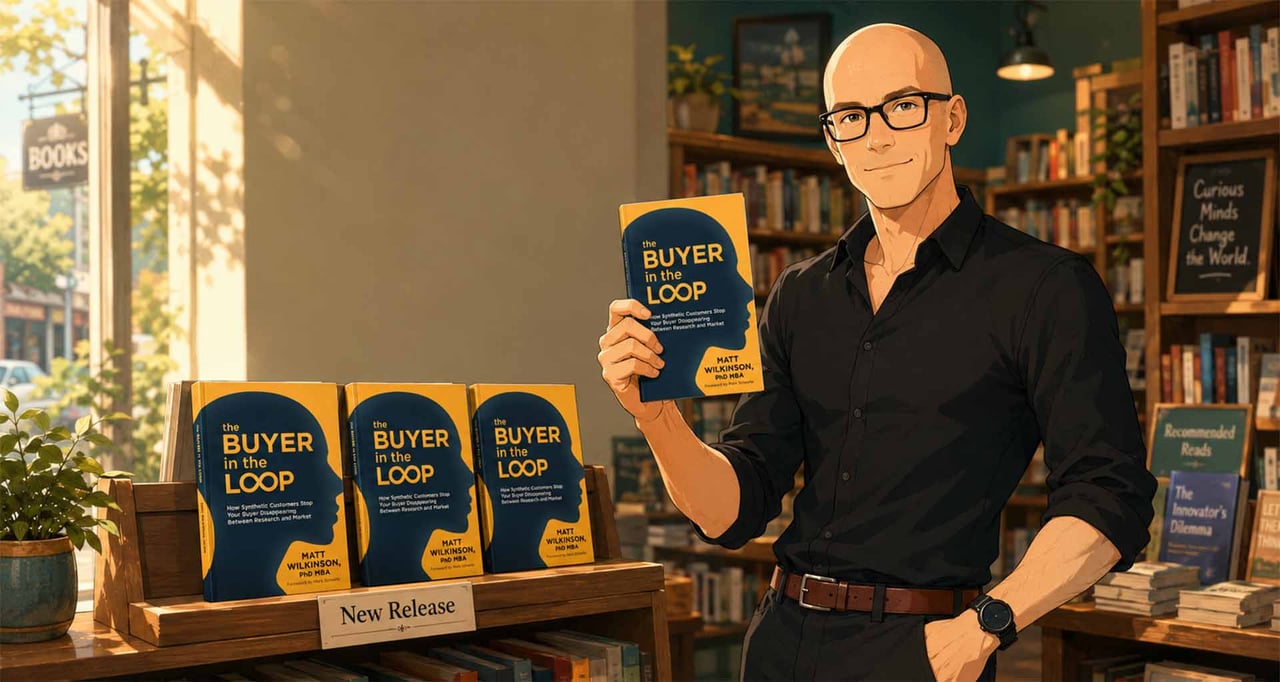
Every function carries its own private customer in its head. Matt Wilkinson and Jasmine Grui-Gray on the shared buyer that ends the guesswork.
Every organisation knows what groupthink looks like. Fewer have a name for group forgetting, which is what happens when months of buyer research collapse into a single customer quote that supports what the team had already decided.
This one is for marketing leaders, product leads and commercial teams in life science tools and diagnostics who own the positioning and have to defend it upward.
Matt Wilkinson joins Jasmine Gruia-Gray to talk about the origin of his new book, The Buyer in the Loop, and the decade of frustration behind it. The conversation moves from persona decks that get read once and never reopened, through the approval chain that chips away at buyer language edit by edit, to what it actually takes to build a synthetic customer grounded in evidence you already own. It closes on the practical question of where a team should start.
Key idea: Every function in the building carries its own private mental model of the customer. A grounded synthetic buyer gives the whole team one shared buyer to interrogate instead.
What you will learn
- Why voice of customer research survives collection and then quietly disappears through the project that commissioned it
- How the approval chain removes buyer language one small edit at a time, and why no single person is at fault
- Where the idea of organisational gravity comes from and why naming a condition is the first step to treating it
- What grounded means in practice, and which evidence sources belong inside a synthetic customer
- The tell that separates a grounded synthetic customer from a model roleplaying a job title
- Why sales holds a deep and narrow view of the buyer while marketing holds a broad and shallow one, and what happens when you combine them
Chapters
- [00:42] Buyers forming opinions inside AI conversations
- [03:40] Why the first book was abandoned
- [05:20] Group forgetting and the one quote that survives
- [07:46] Personas that serve one project and vanish
- [10:08] The question that changed in client conversations
- [11:05] The approval chain as a chisel
- [13:13] Where organisational gravity comes from
- [15:22] Naming a condition before you can treat it
- [17:33] What grounded actually means
- [20:08] Telling grounded from ungrounded
- [21:27] Two places to start tomorrow
- [24:14] Where to find The Buyer in the Loop
Watch and subscribe
Watch the full conversation and subscribe for new episodes of A Splice of Life Science Marketing. The Buyer in the Loop is available on Amazon worldwide. More on keeping the buyer present at strivenn.com.
Transcript
Matt Wilkinson and Jasmine Gruia-Gray discuss the origin of The Buyer in the Loop, why a decade of separate blog posts turned out to be one argument, and what it takes to keep the buyer present in the rooms where commercial decisions actually get made. Lightly edited for readability.
Opening
Speaker: Jasmine [00:01]
Hello, hello, Matt.
Speaker: Matt [00:03]
Hey Jasmine, how you doing?
Speaker: Jasmine [00:05]
Really well. It's a sunny day here and so I'm excited to kick off another episode of A Splice of Life Science Marketing.
Speaker: Matt [00:13]
Me too. It's sunny here as well. It's been a fantastic summer here in the UK, a little bit dry. We haven't had much rain at all. But other than that, I'm certainly not going to complain.
Speaker: Jasmine [00:24]
Okay, so fantastically hot in addition to nice, but hopefully you're on the nice side now.
Speaker: Matt [00:32]
Absolutely, yeah. For me it's a perfect summer temperature right now. So, lovely.
Speaker: Jasmine [00:37]
Right, great. All right, shall we kick it off?
Speaker: Matt [00:40]
Let's go for it.
Buyers forming opinions inside AI conversations
Speaker: Jasmine [00:42]
So in reports that came out earlier this year in 2026, IBM and the National Retail Federation surveyed 18,000 consumers across 23 countries and found that 45 percent of them now use AI somewhere in their buying journey. Forty-one percent use it to research a product before they will talk to a salesperson.
In Adobe's 2026 AI and Digital Trends Report, a separate study of 4,000 consumers, they found that one in four now treat an AI platform as their main research tool, ahead of brand websites and ahead of reviews. So if you work in life sciences marketing and you haven't touched a synthetic customer or an AI research tool yet, that's not a footnote. Forming an opinion about your product in a conversation you were never invited to, or you didn't invite yourself to.
Here's what actually changes. The same Adobe report found that half of customers give a piece of marketing two to five seconds. Let me repeat that. Half of customers give a piece of marketing two to five seconds before they decide it's worth their attention.
It used to be that a clumsy message still got a second chance after that. A buyer would read a brand site, then a review, then ask a colleague, and somewhere in that chain a bad edit got caught or corrected. When a quarter of buyers skip that chain entirely and form their first impressions inside a single AI conversation, there's no second chance built in anymore. Whatever made it through your internal review is the message. Nothing downstream is going to fix it for you.
So the pressure isn't really on the tool. Buyers already trust it enough to lead with it. The pressure is on what happens before the message ever reaches that conversation, inside your own building, in the room where someone decides what the buyer is allowed to hear.
That's the room you, Matt, have written your new book about. Not a better AI tool. A decade of blog posts about persona docs, sales handoffs and legal edits that turned out to be one argument wearing a different set of clothes. So before we get into the book itself, I'm curious. What's the story behind the story? What actually happened on that flight home from Sintra, Portugal, that turned ten years of separate blogs into one book?
Why the first book was abandoned
Speaker: Matt [03:40]
So yeah, I'd started writing a book earlier this year. It was about AI adoption in the life sciences and I was getting bored writing it. And I thought, if I'm getting bored writing it, people are going to get bored reading it. But I thought it was an important book. I just kind of felt that every time I wrote something, something changed, at least at the frontier of what was possible. And yet, as we know, organisations are still struggling to adapt to AI.
While I was in Sintra, there were a number of conversations that happened. It was a fantastic retreat organised by Joeri Billast, the host of Future CMO Stories, author of The Future CMO, and a really, really good guy. And of course one of his key invitees was Mark Schaefer, author of How AI Changes Your Customers and Marketing Rebellion, just to name a few of my personal favourites, not to forget Audacious as well.
And so as we were talking about things, I started realising that what I've been so passionate about over the years has been something I'd always thought was just a little bit frustrating. We collect all of this voice of customer. I've been involved in creating persona decks for people. Sometimes they were really detailed, sometimes they were really thin. Obviously the more detailed ones were potentially more useful, the thin ones not so much. I'd interviewed so many customers and got so many pieces of information for organisations. And yet so much of that data just got forgotten.
It would end up in a deck, the presentation would be there, and yet as the project went on, people spent less and less time going back to that source of information. All they did was read it once and go, right, I know what we need to do, here are three things that I'll take with me. And eventually all of that work would be distilled into a single customer quote that helped support what the project team would agree on themselves, rather than what their corpus of interviews was actually telling them. So it was a great example of group forgetting rather than groupthink.
What I've been experimenting with ever since custom GPTs became available was using that kind of functionality to create councils, to create better and better representations of our customers so that we can use them to capture all of that knowledge. And so that was really the book that I wrote. Not just about where in that process we lost sight of the customer, but also maybe one of the ways to help keep the customer present. It's not the only way. Is it a fix-all on its own? No. But I do really believe that AI gives us a chance to look at the processes we currently have in place and use AI and organisational change to put far more focus on the customer than we've ever had before.
Personas that serve one project and vanish
Speaker: Jasmine [07:24]
So to put maybe a bit of a finer point on it, in the ten years of you pushing the PDF versions of AI up a hill, so to speak, did any client ever say it back to you first, name that pattern before you did, and you just didn't hear it yet?
Speaker: Matt [07:46]
I don't think people ever named the pattern because they didn't see it. What I observed, and of course you and I have famously said a number of times that I worked on a persona project for you, is that those personas just disappear. They serve a very narrow purpose as part of a project. While they're a tool that can be used across a whole range of different parts of the business and marketing campaigns, they get used for a specific thing and then they get forgotten about.
What I would hear more often than not would be, we started some persona work here. Or, here they are, they're not finished. And then even once they were finished, you might have a series of questions, the sorts of things that from a content marketing perspective are the key questions, the things that we need to do. And even people I worked alongside in agencies with, you would have to remind them to go back and look at the persona docs where all of that information was captured. Because they were a key part of the strategy. They were the personification of the strategy in many ways. So what I heard was almost an absence of that information being shared, and a kind of a somewhat embarrassment.
And I think if you look at ethnography and hidden needs research that I learned from Professor Keith Goffin, what I really took away from that was to look at the things people say that show they're working around things, that show they're not necessarily telling you, they're not lying to you, but that what they're telling you about what they think they do isn't actually what they do.
And that's one of the things I've observed time and time again. People say they're focused on the customer. And yet actually what they really are is focused on each individual's mental model of the customer, rather than the shared agreement about who that customer is. And that's a problem I'm trying to solve.
The question that changed in client conversations
Speaker: Jasmine [09:59]
So did that realisation change the first question you ask in a new client conversation?
Speaker: Matt [10:08]
Yeah. Absolutely. Because now the question is very much more along the lines of, tell me about your customers. Who is it
Speaker: Jasmine [10:17]
Mm-hmm.
Speaker: Matt [10:18]
you think you serve? When was the last time you spoke? When was the last time you actually codified information? How are you storing information? All of those things change. And it's not just how are you capturing the information and where are you storing it, but how are you bringing it to life? I think that's a really important piece of the puzzle.
The approval chain as a chisel
Speaker: Jasmine [10:39]
What I was also listening for, that I don't think I heard you say, is you're actually now much more dialled in to the cross section of their own approval chain and where that sits relative to the buyers, and that intersection is where you tend to focus the beginning of conversations.
Speaker: Matt [11:05]
Well, it's definitely part of it. I think the approval chain probably comes downstream of really understanding what they know about their customer. The approval chain is one where the voice of the customer can get eradicated very, very quickly. So even if a marketer has done their best work and they've really focused in on all of that customer research and they're using all the language that they've heard, that approval chain is where that messaging gets chipped away.
Imagine it as if it's a sculpture. The marketer has taken a great big block of sandstone and carved a beautiful statue from it. And then legal come along and they chip a little bit off. And other people in the process come along and chip a little bit off. And I'm not just pointing fingers at legal here, or regulatory, but everybody that touches that piece of art is chipping a little bit off. And what they put back in is maybe stuck on with superglue and it doesn't really fit. And it certainly doesn't represent the customer.
So I think that's really where for me we have a problem, in that we don't have the shared view of what's important to the customer as we go through those chains. And so having a customer that can sit alongside that process, to try to keep each of those changes in line with what a customer might actually want to hear, I think that's a really important thing to be able to offer people.
Where organisational gravity comes from
Speaker: Jasmine [12:40]
So I'd like to dig in a little bit more. I love the chipping away analogy that you use to describe this term you call organisational gravity. Some might say that term is a rebranding for being risk-averse. It could be a rebranding for groupthink or committee culture. What's the story behind why you thought it was necessary to give it a new name?
Speaker: Matt [13:13]
So actually organisational gravity isn't necessarily new. A gentleman called Mike Cohn came up with an idea, and it was really to do with organisational gravity, which was why change doesn't happen. I didn't know this when I started using it. I came to using that frame of my own free will. But what was really interesting when I discovered his work, as I was writing an article for Forbes that I hope they accept, is that what he said was that basically there is a level of inertia and a series of beliefs within an organisation that stops change happening.
That same weight of beliefs is exactly what stops organisations really listening to their customers and really bringing that into their decision making about how they develop products, about how they market them, and then how they sell them.
So I don't think it's so much of a rebranding. It's more understanding that this also isn't the fault of any one person individually. You couldn't put it on anybody in the organisation. The organisation has its own culture, it has its own mass, and that mass of people that you spend your time talking to, working through, we've got to get this campaign out, that campaign out, we've got to rebrand these web pages, whatever it is, there becomes such a force to pull everything to what the organisation believes rather than what the customer actually needs.
Naming a condition before you can treat it
Speaker: Jasmine [15:03]
So do you think it's actually helping organisations find a vocabulary for things they've felt in the past, but now it's much more clearly defined, as well as a remedy for that being defined?
Speaker: Matt [15:22]
Yes, I do. I think one of the things is you can't fix something until you've named it. There are many diseases out there that present in different ways. IgG4-related disease is an example. It was only named and recognised as a disease twenty years ago, and the first drugs are only now coming to market for it.
You start looking at these diseases where all of a sudden there are bits of conditions and you finally come up with a recognition of what this is, that all of these symptoms are a condition. And I believe that all of the symptoms we talked about, whether it's people making the wrong decisions in product development, wrong positioning, marketing campaigns that don't land, or the drift away from the customer as something goes through approval processes, those are all things that come from a misalignment of our understanding of the customer.
Now, can you codify exactly what a customer will say, think or do, and how they will react to things? Absolutely not. But can we do a better job of bringing to life everything you know about those customers? Absolutely. And can you then make that available to everybody involved? That's really the challenge I'm issuing to people through the book. To think about how you can bring the customer much closer in to the whole process, without having to burden the customer with being in the room themselves at every single meeting.
What grounded actually means
Speaker: Jasmine [17:11]
So if we continue to pull on the disease and the remedy analogy, can you talk to us a little bit more about the remedy of creating grounded synthetic customers, and really help us fine-tune our understanding of what grounded means?
Speaker: Matt [17:33]
Yeah, sure. So good prompting will tell you to say, you are an expert in whatever field. You could do the same with your, enter customer profile here. That's fine. And it would do a half decent job of creating an understanding of what that customer really thinks, because these large language models are trained on a ton of data about normal people.
What that misses is all of the information that you actually already know about your customer. So that grounding is all of the information you've already collected. The voice of customer research that you've just spent thousands and thousands on, can we take that and bring it into a synthetic customer? Absolutely. The stuff we did ten years ago, absolutely, we can bring that in too. We can bring in the quantitative surveys. We can bring in records from the CRM if we want to, information from sales transcripts.
Now, you don't put everything in verbatim, because that becomes unwieldy. But you start to do a thematic analysis and really try to distil out the important elements from each of those pieces of information and those data sets.
And then what you also can do is look at what people are saying online, look at what people are actually communicating and talking about. It might be about the brands you believe you compete with. Then you might find some new ones you didn't know you were competing with. You might also find information out about the space you operate in.
And by bringing all of that together, all of a sudden you've got a representation of your customer that, while it's imperfect, is a lot closer than any one thing anybody currently has the opportunity to interrogate right now. And so that's really what the grounding is. It's grounding in a lot of information that you either know or can find out about your customers, and bringing that together in a way that is unique to you and your organisation.
Telling grounded from ungrounded
Speaker: Jasmine [19:50]
So let's move into some more practical type of questions. What's the actual tell that a synthetic customer someone's using is grounded, versus an ungrounded impression wearing somebody else's outfit?
Speaker: Matt [20:08]
So that's a great question, and it really depends on the questions you're asking them. Most of the time, when you're using a synthetic customer, what you're actually doing is asking a large language model to operate as. And that's really just looking at what's in the model.
What really tells you a grounded synthetic customer has had a lot of time and effort put into building that data set is, are they starting to sound like your customers? Are they repeating back what you know? Are they actually telling you information that isn't generic but is far more specific? That's where you start to find out the difference. So that's the way you would test the two together. How closely does it align to what we actually really know about our customers?
Two places to start tomorrow
Speaker: Jasmine [21:06]
Okay, and last one here. If somebody wanted to start getting into synthetic customers and using synthetic customers, what are the two tips you would give them that they can start thinking about tomorrow?
Speaker: Matt [21:27]
So the first is, any synthetic customer is only as good as the data you can provide it. So the more information you can capture about your customers, hopefully in a structured but exploratory way, so qualitative research and not just what are the top ten questions about X, but really get under the skin of what's important to them. What are their jobs like? What are their days like? You can really start to understand more and more about the people behind the job role, as well as their motivations.
So I think that's one of the things that's really important, to really try to understand who is it you're really selling to. Our customers are each individual. I mean, sales know this. Marketing tends to overlook this a little bit at times. Sales tend to have a really deep but narrow view of the customer. Marketing has a very broad but shallow view of the customer. And what we really try to do with synthetic customers is to blend those two together, so that where it's important we have a broad view across the customers we're looking to target, but we're able to take those deep dives into each of those customers when we need to.
And it might be that we don't very often need to have a deep dive into a procurement person, but we all know that procurement is where deals go to die. So we need to understand, as part of our sales process, as part of our marketing, what is it that procurement need to know about us? What can we do to grease the wheels to make sure that procurement see what they need to see from us, so that procurement goes, yeah, there's no blocks here.
Now, time and time again I've seen organisations that do know their customers are really great at speaking with the champion, the person whose problem you're solving, but they're not really very good at providing the information to influence all of the rest of the people involved in buying. So it's really getting to understand, learn what you can about your customer and then learn about the context they operate in, so you can do a better job of understanding who is it I actually need to influence to help make those sales happen.
Where to find The Buyer in the Loop
Speaker: Jasmine [23:49]
So your full blog is on the strivenn.com website and we'll drop the link in the show notes. Matt, while that quarter of buyers we opened with is out there right now forming opinions in AI conversations your team isn't in the room for, where can someone get your book to change that potential fate?
Speaker: Matt [24:14]
Well, there's a web page on the strivenn.com website where they can learn a little bit more about it, but it's available on Amazon worldwide, I believe. Although I've just learned that Kindle Direct Publishing doesn't necessarily make paperbacks available worldwide. It is limited to some markets. But yeah, they should be available worldwide to purchase, at least as a new publication.
Speaker: Jasmine [24:40]
Right. And just as a reminder, the name of the book
Speaker: Matt [24:45]
is The Buyer in the Loop, and it looks a little bit like this.
Speaker: Jasmine [24:49]
It looks a lot like that.
Speaker: Matt [24:51]
It does. That's actually just a postcard and I don't have a copy of the book to hand. But I've been told it's nice and thin, so it takes maybe two to three hours to read. Apparently it's dense, and I've had some really wonderful comments. People have shown me the pages of notes they've been taking, because apparently it's full of actionable insights you can take away as well, without ever really putting a framework in front of you. So hopefully it's a nice easy read, full of ideas and actionable takeaways, without actually feeling like a textbook.
Speaker: Jasmine [25:26]
It completely is. I've read it now cover to cover two or three times. And so I have different notes in different colours for each time I've read it.
Speaker: Matt [25:36]
Yeah.
Speaker: Jasmine [25:38]
But thank you everybody for listening to another episode of A Splice of Life Science Marketing.
Speaker: Matt [25:46]
Thank you, Jasmine. It's been a pleasure.
Speaker: Jasmine [25:48]
Yep, see you soon.
Speaker: Matt [25:49]
Thanks. Bye.
Speaker: Jasmine [25:50]
Bye.
Q&A
How do I find out whether my team is running on private mental models of the customer?
Run a five-minute exercise at your next team meeting. Ask each function to write down, without conferring, the single biggest reason your last lost deal went the other way. Product, marketing and sales will hand you different answers. That spread is your alignment gap, measured. It costs nothing, takes one meeting, and gives you something concrete to show your leadership team rather than a feeling you cannot evidence.
We have a voice of customer study from last year. Is it too old to be useful?
Age is rarely the problem. Neglect is. Pull the raw material rather than the summary deck, because the deck already made the choices you want to revisit. Interview notes, verbatim quotes and open-text survey responses hold the buyer's own language, and that language is what a grounded synthetic customer needs. A study nobody has reopened in twelve months is closer to unused than to out of date.
What is the smallest version of this I could build next week?
Take one persona, one function and one decision. Pick the buyer role that matters most to your next launch, gather what you already own for that role, and build a single grounded synthetic customer to pressure-test one positioning statement. One person can do it in a few days. Judge it on whether it tells you something specific you did not already believe, not on whether it sounds convincing.
How do I stop the synthetic customer becoming the next persona deck nobody opens?
Attach it to a recurring decision rather than a project. The persona deck died because it belonged to a launch that ended. Put the synthetic customer into the moments that repeat: the brief review, the claims discussion, the pitch rehearsal. If somebody has to open it before a message goes to approval, it stays alive. If it lives on a shared drive waiting to be useful, it will go the same way as the deck.
My budget holder will ask what the return is. What do I tell them?
Point at rework, not at leads. Count the approval cycles your last campaign went through and what each round cost in time. Then count the messages sales rewrote themselves because the approved version did not survive contact with a buyer. Those two numbers are already in your organisation and nobody is looking at them. A projection built on avoided rework is defensible upward. A speculative lift in conversion is not.