
"Is AI actually making marketing more effective, or are we simply getting quicker at producing more of it?"
Russell Parsons, Marketing Week's editor in chief, put that question to the panel I sat on when he opened Thursday's webinar, From AI promise to marketing proof; this was run in partnership with Cognizant and Google Cloud. It is the question every marketing leader is now fielding from the board.
In the organisations I work with, the answer so far is quicker.
And the speed is building up inside the silos. Marketing has built one AI workflow for content. Product has built another. Sales has a co-pilot drafting its follow-up emails. Every pilot report comes back green, and your buyer still meets three different companies.
I shared the panel with Alice Tendler, CMO of the utilities start-up Alfred and formerly of BT and Ovo; Jonna van Kampen, marketing go-to-market lead for EMEA at Cognizant Moment; and Antony Hill, principal consultant for gen AI and martech at Google Cloud.
Why pilots succeed and scaling stalls
Jonna named the pattern she sees with clients.
"The pilots are often super successful, but they fail to scale." Tools are rarely the constraint. On the panel she put the number of martech tools at over 15,000, more than a hundredfold increase since 2011. In a LinkedIn post the day after, she put it more sharply:
"Most organisations don't have a shortage of AI tools. They have a shortage of connected workflows."
She also argued AI should change how a marketer's week is spent. By her estimate, 70 to 80 percent of it goes on coordination and execution today, and she wants 50 to 60 percent going on strategic and creative thinking. That shift only pays off if the freed hours go into shared thinking. Spent inside the silo, they buy more of the same.
Antony traced why. In his write-up after the panel, he argued that pilots built on "what can we do, and how?" stall "the moment the board asks if the juice is worth the squeeze". He doesn't think a "Frankenstein" legacy stack needs ripping out either. His test is simpler. "The stack has existed to do a certain job. Is that job the same job you want to do now? If it is, happy days. If it's not, get back to what you're trying to achieve, and why." The blind spot, he says, is the domain layer: "governance, standards, and vital human institutional knowledge".
My worry goes one step further. We are at risk of using AI to speed up siloed thinking. When I work with commercial teams, from research and development through marketing to sales, each function holds a very different view of the company and of the customer.
Give each of those functions its own AI and you get every version of the customer, produced faster.
Gravity just got an engine
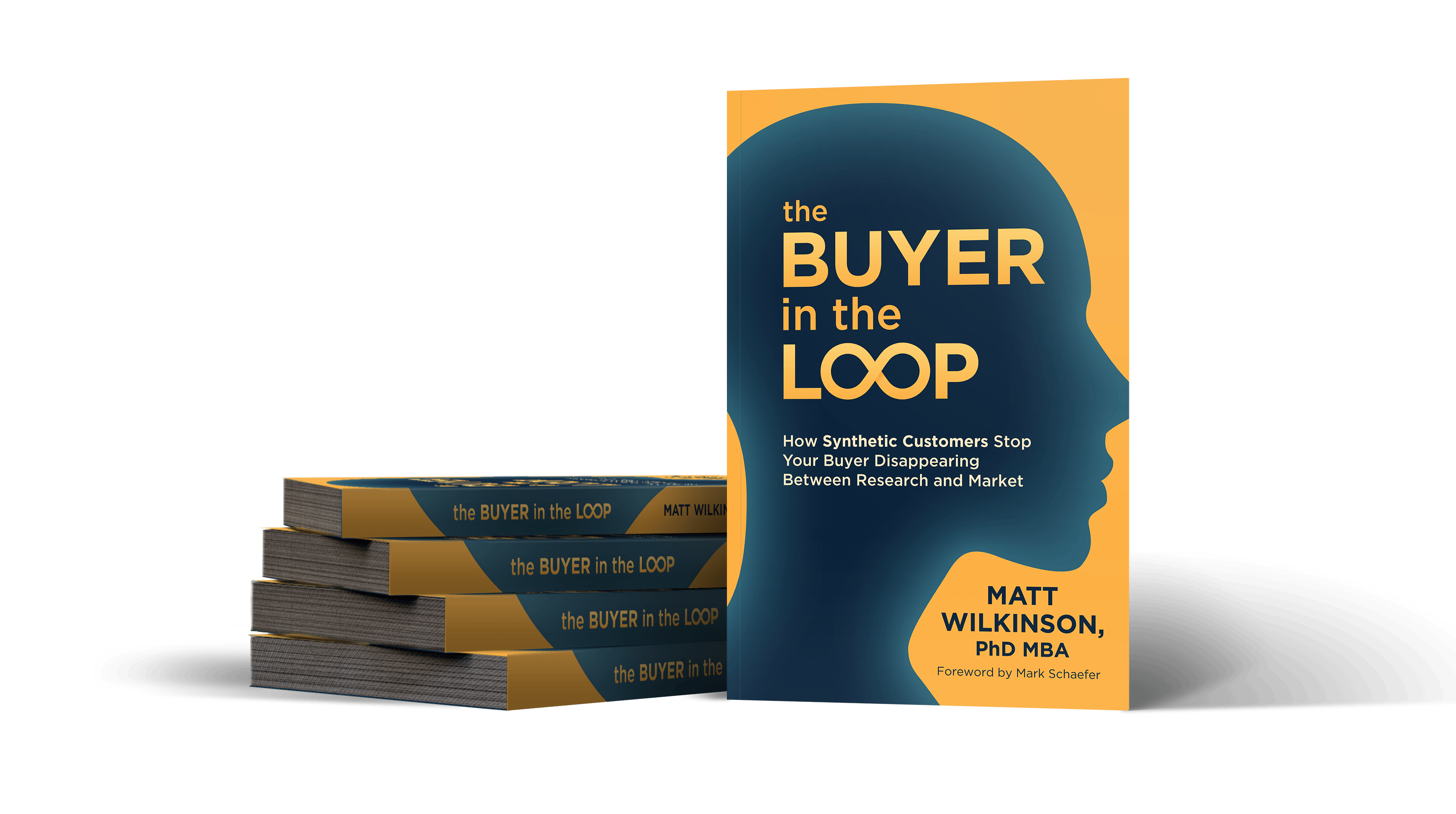
In The Buyer in the Loop I call this organisational gravity: the force that "pulls every message away from buyer truth and toward internal consensus". Friction used to slow it down. Briefs took weeks, drafts went round the houses, and somewhere in those cycles a salesperson occasionally asked whether a customer would ever say this.
AI removes that friction. A silo can now brief, draft, approve and publish inside its own walls in an afternoon. Cheaper production means more messages, and each one sits closer to the room it was written in.
Alice's experience at Alfred shows the other side. As a start-up, Alfred has no legacy process to weave AI into, so "AI becomes quite simply our first port of call". Starting without legacy processes gives Alfred more freedom to design the work around AI. Most marketing leaders inherited decades of org chart. For them, bolting AI onto each function multiplies the problem.
Perhaps judgement is the real gap
Here is the strongest case against my argument. Maybe silos are a distraction and the real failure is judgement.
I made that point myself on the panel: "If you're not in a position to judge the output properly, then you probably shouldn't be trusting it."
Alice went further. AI "can become dangerous when you're using AI to plug a gap in your own skills and capabilities and knowledge, because you lose that sense of judgement to know whether or not AI has done a good job."
The audience poll showed the disappointment, though not its cause. Asked where AI had least met expectations, 39 percent of those who voted chose content creation, the largest single answer. Content was supposed to be where AI shone. If weak judgement is behind it, connecting every system would only pipe mediocre content through one channel at higher speed.
I take that seriously, and the silo argument still holds. Judgement is siloed too. Product judges output against the roadmap. Sales judges it against last quarter's lost deals. Marketing judges it against the brand guidelines. Each expert is right inside their own picture of the buyer, which is how three confident experts end up approving three different stories.
Antony's answer was context. "The era of 'Vending Machine AI' is over," he wrote after the panel. "Mature enterprise systems pull in first-party data, brand guidelines, and proprietary knowledge to protect what makes your brand distinct." The richest proprietary knowledge any company holds is what its buyers actually say. Expert judgement needs that shared reference, or it turns into opinion with a job title.
Start with shared buyer evidence
So where does a marketing leader begin in the next 90 days? The panel converged on a single workflow.
Jonna's advice was to "look at one growth system, one workflow, prove it, and then expand", starting where work is "slow or still highly manual, or very fragmented". Antony told leaders to "stop messing around with the could-dos" and go after the must-dos that start with a why. Alice warned against measuring the tool at all. Set targets and measure results "agnostic of the process".
Jonna's prescription, in that same post, is a marketing organisation that learns, where "intelligence flows continuously across planning, creation, activation and optimisation". I agree with the plumbing. My concern is what flows through it. Signals are buyer data, and every function still reads that data through its own picture of the customer. Connect the pipes and gravity acts on the interpretation instead. A learning loop fed by campaign outcomes also learns from what the silos already chose to ship. The buyer has to be present in the loop as well as measured by it.
Put those together and the first move is clear. Choose one workflow that crosses a silo boundary. The path from customer insight to campaign decision is a strong candidate, because that is where the buyer most often goes missing. Then ground it in shared buyer evidence that every function works from, with the buying committee's different roles and conflicting needs left visible.
That was my answer to Russell's final question. Use the insight and proprietary information already inside the business to build AI twins: synthetic versions of your customers, grounded in real buyer evidence, that product, marketing and sales can question from their different perspectives. A buying committee holds more than one view, so the twins should hold several: the user, the budget holder and procurement each want something different, and some of those needs conflict. Keep the conflict visible. A panel of twins that always agrees has swapped internal consensus for synthetic consensus. Synthetic customers are for directional thinking, so test any consequential conclusion against real buyer conversations and real buying behaviour before you commit to it. When every silo tests its thinking against the same evidence, the speed AI gives each team pulls the teams toward one story.
Then measure what comes out the other side, as Antony put it:
"Measuring the speed or efficiency of an AI system is just measuring an input."
A 90-day test can be concrete. Pick one decision that spans product, marketing and sales, such as which customer problem a launch leads with. Record what changed when the three teams worked from the same buyer evidence: the claims that were dropped and the objections that surfaced before launch. Then track one outcome downstream, such as the number of qualified opportunities that progress to the next stage. The decision record will be ready within 90 days. The commercial outcome will usually take longer, often more than one sales cycle, and the board should hear that at the start.
Quicker can become better
Russell summed up the discussion on differentiation with a line worth keeping:
"We can use AI to raise the floor, but it does need people and strategy and human insight in order to truly raise the bar."
Back to his opening question, then. Is AI making marketing more effective, or simply quicker? Inside silos, it makes you quicker. Give the silos the same buyer evidence to answer to, and quicker starts turning into better.
If you want to see where the buyer is going missing in your organisation, book a 30-minute strategy call. You will leave with a one-page summary you can defend internally.
The Buyer in the Loop is about keeping the buyer present in every commercial decision, so the speed AI gives each team pulls them toward one story.