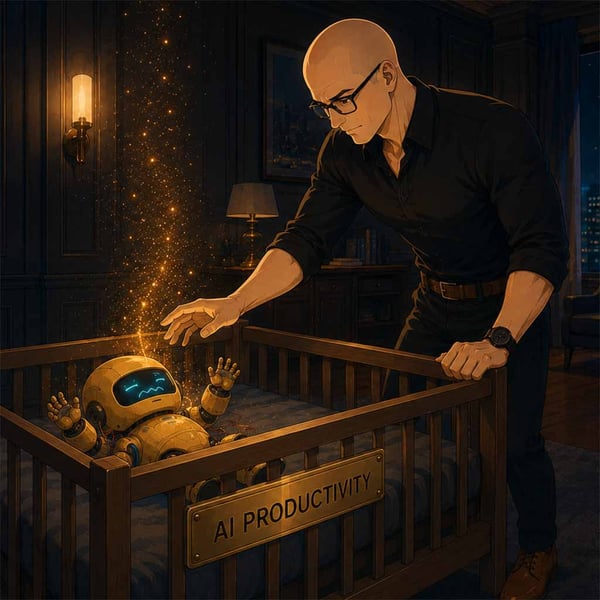

AI's infrastructure is already built, so the seventh wave now stalls on people, and that is what freezes buying groups.
The pipes for AI are already in the ground. Everything slowing the seventh wave down now sits inside your organisation and inside your buying group, and none of it is a technology problem.
Who this is for: life science marketers, product leaders and commercial teams being asked what AI actually changes about their go-to-market.
Matt Wilkinson and Jasmine Bar-Kochva work through Matt's blog post, Marketing's Seventh Wave Has a Buyer Problem, mapping seven waves of marketing from mass production in the 1880s to generative and agentic AI in 2023. They cover why the installation phase for this wave is so much shorter than the ones before it, what is really blocking adoption inside businesses, and why personas built by internal consensus stopped being fit for purpose. The conversation ends on change fatigue and the emotional context that decides whether a deal closes.
What you will learn
- Why innovation cycles keep shortening, and why marketing cycles do not map cleanly onto economic ones
- Why the installation phase of the AI wave is compressed, and what that means for how fast your customers move
- The two adoption problems businesses confuse: human adoption and organisational adoption
- Why cognitive surrender is a bigger commercial risk than AI slop or job displacement
- How AI turns personas from sanitised internal documents into grounded lenses on the whole buying group
- Why more than 30 percent of deals are lost to the status quo, and what emotional safety has to do with it
- What to do first: understand how the seventh wave is changing your customer's condition
Chapters
- [00:20] Welcome and what we are covering
- [00:41] The seven waves of marketing, from production to AI
- [02:37] Where the seventh wave idea came from
- [04:07] Adoption curves and the race to a million users
- [04:52] Why the consumer infrastructure was already there
- [05:56] Carlota Perez, installation phases, and why this one is shorter
- [08:05] So what is actually blocking AI adoption
- [08:32] Human adoption versus organisational adoption
- [09:16] Fear, unknown risk and the permanent learning curve
- [11:01] Pivotal Links, the CRM report, and reclaiming the manual hours
- [12:10] Cognitive surrender, the risk nobody budgets for
- [13:00] Confident wrong answers, calculators and spreadsheets
- [15:02] Personas and the seventh wave
- [15:34] From sanitised documents to grounded lenses
- [18:08] Emotion, safety and losing to the status quo
- [20:13] Human agency and the advice section
- [20:42] Pay attention to the customer condition
- [21:59] Change fatigue and rethinking change management
- [22:27] Close
Keywords: life science marketing, AI in marketing, buyer personas, synthetic personas, marketing waves, Carlota Perez, technology adoption, buying group, status quo bias, change fatigue, answer engine optimisation, B2B life sciences
Transcript
The full conversation between Jasmine and Matt, lightly cleaned for readability. Wording is as spoken. Two corrections have been applied where the recording misheard a name: the two-phase installation and deployment framing is Carlota Perez, and the note taker referenced is Claude.
Welcome and what we are covering
Speaker: Jasmine [00:20]
Hello, Matt.
Speaker: Matt [00:21]
Hey Jasmine, how you doing?
Speaker: Jasmine [00:23]
Awesome, awesome. I am super excited about our chat today because it's on part of a topic I know something about and part of a topic I just recently learned about, and I always like that learning opportunity. So should we get into it?
Speaker: Matt [00:40]
Yeah, let's do it.
The seven waves of marketing, from production to AI
Speaker: Jasmine [00:41]
In your recent blog post called Marketing's Seventh Wave Has a Buyer Problem, I learned about these six economic waves, which, I guess, thinking about it, I'd known about the waves themselves. I just didn't know about the principle behind them.
And I definitely didn't know the overlay of marketing to that principle. So you have this fantastic graphic in the blog that labels these seven waves of marketing, being production, sales, brand, direct, digital, social, and of course, AI.
And you walk through each of these waves and describe the era that they're in. So, for example, production, the era was the 1880s to the 1920s. You say the catalyst was mass manufacturing, the dominant practice was build it and demand will follow, and the primary channel in that case was print signage. And then if I go to the other extreme of the wave. For AI, we're living in that era right now, started around 2023. The catalyst is generative and agentic AI. The dominant practice is AI-assisted creation, answer engine optimisation, or AEO, and synthetic research. And the channel is AI answer engine. So with all of that, I'm really curious to hear, how did you land in connecting these dots between this economic concept of six waves and buyer personas?
Where the seventh wave idea came from
Speaker: Matt [02:37]
Yeah, how does my brain ever work? I mean, that's a great question.
Speaker: Jasmine [02:39]
Ha ha.
Speaker: Matt [02:40]
And I think I probably need a comfortable sofa and a psychologist to really dig into that one. But the story was I was just browsing on Medium and I came across this article by a gentleman called Jerry, and I'm gonna butcher his surname and I apologise in advance.
I think it's Grzegorzek. So I apologise because I'm guessing it's Eastern European of origin. Anyway, wrote this piece on the history of innovation cycles, and it had a couple of things that really struck me. One was that these cycles tend to shorten in time. And two, they didn't really map to what I knew about marketing.
And so as I'd sort of sat there and I'd been looking at these long economic cycles, you know, they started off at sort of 60 years and they were getting closer and closer. And as technology progresses, these cycles seem to get tighter. I just sort of thought, well, what happens if we look at marketing in a similar way over a similar time span? And what struck me was that there's probably a disconnect between what we see in marketing and the marketing cycles, and therefore the changes to consumer versus maybe the changes to industry. And I think I probably put that down to the fact that there's a lot of infrastructure to the move, a lot of factories to build, things that don't take as long to change. Whereas actually customers seem to move really, really quickly. Yeah, customers change quickly. And the layer of the way that we've engaged with customers has changed really quickly. And so that got me going down a bit of a rabbit hole for a while, just thinking about how are things changing.
Adoption curves and the race to a million users
Speaker: Jasmine [04:07]
You know, as you're describing this, it also struck me that what might also be changing is the adoption curve. And the shape of that curve may change and the slope of that curve may change, especially with AI. Is that something you thought about when you were writing this blog?
Speaker: Matt [04:29]
Well, yes, I've given a number of talks and I think the first talks I ever gave about AI were looking at the time it took to get various organisations to a million users as an example. And it would take months for Facebook to get there. Instagram was much quicker, Netflix took a long time, comparatively. ChatGPT took three days.
Speaker: Jasmine [04:50]
Wowee.
Why the consumer infrastructure was already there
Speaker: Matt [04:52]
Now some of these changes are because the infrastructure is already in place. So for people to have access to AI, yes, there's a lot of infrastructure in the back end, but the consumer piece, people already had phones, laptops, they already had an internet connection. So the piping for the AI was already there. All they had to do was to download an app from an app store, which was already there. So a lot of these things were changing the way that we're interacting with information, which is having huge changes to the way that we generate and interact with the world. But actually, the core infrastructure hasn't changed. Yes, the chips are advancing at pace because of the demand, we're still building huge facilities to house lots and lots of silicon that we pump electricity through, that we have to cool down. And then pump the resulting data out to wherever it's being asked for. So fundamentally there's not that big a difference between a database server room and an AI data centre.
Yes, the chips are different, the workloads are different, the power consumption's different, but fundamentally it's bricks and mortar with a load of silicon and cooling inside, and big power demand.
Carlota Perez, installation phases, and why this one is shorter
Speaker: Jasmine [05:56]
So the other concept that you bring out in your blog are these two phases that Carlota Perez describes for each of the cycles, whether it's economic cycles in her case or marketing cycles in our case.
She talks, for example, about the installation phase and these long installation phases, which maybe applied for the early 1800s and early 1900s, but now isn't quite as relevant.
Speaker: Matt [06:34]
Yeah, so I think that when you look at that installation phase, a lot of that is already there. So we're not having to do the big fundamental piping challenges. If we look at the challenge to get mass manufacturing, we had to build, the industrial revolution, we had to figure out how to get coal out of the ground. We had to build the infrastructure to get energy and materials to the right places. So there's a lot of infrastructure that went into place. As we look at the changes that have really happened, particularly from a marketing perspective over recent times, not a lot has changed really over the last 25 years in terms of the fundamental infrastructure. Yes, we've gone from copper pipes to optical fibre. So we've changed a lot of the way that data moves. But those are things that have been progressing all the time. Yes, we know we're hitting energy constraints, but again, we have different parts of the grid and different countries handle energy demands differently, but fundamentally any of the places where AI is being used, they have access to energy, they have access to that plumbing to receive the service. It already exists. We just have to upgrade it.
That installation phase is shorter.
And it's maybe more on the supplier side than on the customer side. And maybe that's always been the truth. But when mass manufacture started, people started to think about the way that we went from a local craftsman manufacturing shirts and selling them in their own shops locally, through to all of a sudden things being moved around the country. So the very nature of distribution had to change.
So what is actually blocking AI adoption
Speaker: Jasmine [08:05]
Okay, so it's not an infrastructure issue that's the blocker. It's not an awareness issue. If you're not aware that AI is around, that's a different issue that's outside the scope of this conversation. So, what is the blocker from having more widespread adoption of AI in marketing and within our life science tool sector?
Human adoption versus organisational adoption
Speaker: Matt [08:32]
So I think we have to separate out the human adoption from the organisational adoption and what those two mean. I think most people now seem to have downloaded ChatGPT or Claude, or they have AI on their devices. Or if not, when they go to Google, they're interacting with the generative answers that are being provided there.
So most people are interacting with AI, and generative AI in one way, shape or form. I think what's different is that in businesses, you've got a number of different things that are holding back adoption. I think the first is that there's been this narrative that AI is going to replace jobs. There's been documented evidence that people are sabotaging AI adoption programmes because they don't want to train their robot replacements. Yeah. Rightly so, I think.
Speaker: Jasmine [09:16]
Mm.
Fear, unknown risk and the permanent learning curve
Speaker: Matt [09:16]
So I think that that's a challenge. And then I think on the other side of this, you have organisations not really knowing where to apply it. There's this technology. It's new. We haven't learnt it yet. So we have a learning curve to understand what's possible with AI, which is changing all the time. We don't know the risks and there's been some pretty big risks associated with using AI and not managing it appropriately.
You've got to move an organisation. You're looking at fundamentally reshaping the idea of how certain tasks get done. I'll take a simple example. If we were to look at the Pivotal Links conference in June.
I went there and I used the HubSpot CRM scanner tool on my phone to scan the business cards in and I put a few notes together while I was there. Now AI can't replace that, but I also had my Claude note taker. So I recorded notes from some of the conversations when I was given permission. Obviously, permission is important, kids. And I then uploaded those alongside the CRM stuff. So I did a bit of work to update the CRM.
But then with access to the MCP server or a service key into HubSpot, I could very, very quickly generate my activity report. In fact, I generated that activity report sitting on my couch while I was eating dinner using my phone. And I was able to share that with yourself and Charlotte to say, hey, this is what I got up to over those two days.
That would have taken several hours to go through and do manually. And I think you pinged me, asked me a question, and I go, I'm gonna create a report because it's all there and it's gonna be a better response than I'm ever gonna be able to give.
Other than the fact that the AI and the CRM data couldn't say what a great event Pivotal Links really is. And Tim, thank you. The sponsorship money hopefully is in the mail.
Speaker: Jasmine [10:59]
Ha ha ha.
Reclaiming the manual hours, and AI-assisted fact checking
Speaker: Matt [11:01]
But joking aside, we need to start thinking they're tasks that we can replace and spend our time doing higher value work.
Other things like creating content. There's this question about what we should be creating using AI or not. But fact-checking, everybody talks about AI hallucinations, and people in the life sciences are rightly concerned about hallucination. At the same time, you can do a phenomenal job of using AI to review a document against a source of data and find what's been actually written. Compare it to documents or the reference list and actually create a table that says, here's this claim on page one, links to this claim here, does it match up with this. And you can go through claim by claim on every single page and create a checkbox for the humans that look at the claim in this sentence and this is where I go to look it up and verify it.
And does it match? And you can even get the AIs to argue over whether you're overstating, understating. There's so much we can do that would have been very, very manual, not necessarily that value adding. I mean, reputation absolutely critical, trust absolutely critical. So they're valuable jobs, but they don't really add any value to the end piece other than making sure it's correct.
Cognitive surrender, the risk nobody budgets for
Speaker: Jasmine [12:10]
Yeah, so I don't think that AI taking jobs away worries me in the short term or the long term. I don't think that AI slop, you know, the em-dash arguments and other AI tell phraseology. That doesn't worry me as much as the immense risk of cognitive surrender.
Meaning the false lull that you allow yourself to succumb to because you think that everything that AI says is true. You know, the old saying, if it's on the internet, it must be true. And the way that AI says it is so convincing that it lulls you into complete cognitive surrender.
Confident wrong answers, calculators and spreadsheets
Speaker: Matt [13:00]
That I'd agree with. And I think it's something we have to be very conscious of. I think it's also that, AI, as you said, they're very confident even when they're wrong. And that is a big risk. The number of times, however, I call out my AI and I challenge it and he goes, yeah, you're right, I was wrong. And then it's agreeing with me that it was wrong. And I'm like, hang on a second, which of these versions of the truth do I really need to listen to? So I think that there is a definite risk there. But I think it's also like the risks of social media. I think it's how do we teach people to use these tools? And I don't have all the answers there.
Some time ago in schools, they used to teach people to count using an abacus. And people had to do long multiplication and division and complicated maths using a piece of paper. And then all of a sudden, we had to still learn those skills, but only so that we could type numbers into a calculator correctly. And of course, the calculator was talked about as a big evil that would destroy our ability to do maths.
And then spreadsheets came along and that was gonna destroy accountancy.
All of those transitions created upheaval, they changed jobs, they changed the very nature of jobs. But they didn't get rid of them. In fact, they created the ability to do more oversight and to do more. My concern, I think, alongside cognitive surrender, injury is likely to happen during the transition phase. I
Speaker: Jasmine [14:13]
Mm-hmm.
Speaker: Matt [14:13]
think we'll come out the other side and learn better. But with AI, what's going to be important is really teaching people about how to operate in an AI world. And we don't know how to do that yet because we're still building it.
Speaker: Jasmine [14:26]
Mm-hmm.
Speaker: Matt [14:27]
And it's moving so quickly that even if a course taught you the very, very latest stuff today, by tomorrow a new model might come out or a new capability might come out, and it might be a little bit out of date.
So this ability to keep up with everything is impossible, has been for a long time. So I think we have to then step back into fundamentals and look at what are we trying to achieve? What is the business strategy? And what usage of the tools that we now have available is appropriate for us to be using. And I think if we approach the tools in that way, we're in a better place.
Personas and the seventh wave
Speaker: Jasmine [15:02]
So I think that's a natural transition into the fundamentals of personas. Something that I think every marketer has been involved with. Yes, I will raise my hand yet again. You and I have developed personas for me, and I have shoved them in a drawer.
Speaker: Matt [15:21]
So you're seeing a little bit of Alice in there.
Speaker: Jasmine [15:23]
Yeah, right.
So how do you think this seventh wave of AI marries with personas?
From sanitised documents to grounded lenses
Speaker: Matt [15:34]
Well, I think it's just one of the many things that the seventh wave is unlocking. And for me, what persona documents historically are, is a page, maybe two, three, four pages of kind of sanitised opinion about what our customers are.
The typical workshop, you get people into groups and they describe their customer and maybe they go to a LinkedIn profile and they write some stuff down and they come away with a nice looking portrait of who the customer is and some sanitised questions that they might want to know about at different buying stages. Maybe it's three questions at each stage. But it's a very sort of internal, consensus driven process, historically.
What I think AI gives us is the ability to take customer insight, it gives us data from the CRM systems. It's brilliant at trawling through that data and looking for trends and thematically analysing and grouping things in ways that as humans we might overlook. We might say, no, these are all researchers or whatever. There's actually five different types of researcher in this group.
And so what we have to be able to do is use that information as different lenses through which we look at the customer condition. I think if we treat this as, there is never one absolute truth in marketing, but there are lots of lenses through which we can interrogate the truth and perceive it through.
Beauty is in the eye of the beholder and it might be a beautiful web page or whatever, but that might only be for one specific customer type. If you imagine, you might be really, really good at marketing to the champion in your buying group, the scientist, but you might have no messaging at all for the lab manager or the purchasing person or whoever else it is. So if we can start to map what's important to each of those customer groups, because they're all part of the buying group, we can all of a sudden start to get so much better at looking at how do we make sure that we're doing better at answering the key questions that each of them are going to ask. Is it going to be perfect? No. But if we look at the Pareto principle, if we can get 80 percent of the way there.
Well, isn't that so much better to be able to reduce the fear that people have of purchasing these days? I think I saw something that more than 30 percent of sales now don't proceed. And it's not because you've lost to a competitor, you've lost to status quo because the decision-making unit can't make a decision. They're scared to move forward. I say scared, but they're undecided as to how to move forward. And so therefore they don't. The pain of staying in the condition they are currently in is safer than making the switch. And I think that's something that by understanding each of their individual conditions better, we can help make marketing and sales solve those problems better.
Emotion, safety and losing to the status quo
Speaker: Jasmine [18:08]
Yeah, as you and I have talked about before, the logic and the ego sides of decision making are not something that we've struggled with in marketing in the life sciences sector. It's the emotional side. It's this what's safer side that we really haven't pulled on strongly enough. And I think that having a debating partner like grounded synthetics is a useful way of developing those messages, whether you're in marketing or testing principles if you're upstream in product management.
Speaker: Matt [18:49]
I think that's absolutely right. These are useful tools. I would never suggest that they should replace the customer. In fact, I would strongly argue that it actually increases the need for more customer insight, for us to be better at documenting the condition of the customer, spending more time with customers, understanding what's going on there so we can deliver better products, better services, better messaging.
But it also means that we have to be really careful because the speed of change is increasing, we have to then look between each of these points in time, where if something is true today, is it still true tomorrow? So we have to look at that drift. And I think that's a really important thing. Now, you know, science doesn't necessarily move at quite that speed, things do change quickly. They're changing faster than a lot of us really appreciate. And a lot of companies are getting caught out. They're thinking already that we've got to do something about being discovered on AI. Well, yes. But there are probably other things as well that you really need to be thinking about as to how is AI changing your customers? How can we respond? How should we be rethinking our entire service design around how we serve the customer? There are going to be places where AI is going to be expected and places where we absolutely should be using AI to get to the human as quickly as possible. And I think that reimagining what good looks like is one of the beauties of where we're currently at. And one of the big challenges that people have.
Human agency and the advice section
Speaker: Jasmine [20:13]
It comes down to what you and many others have also said. You can use AI and synthetic buyers for direction, but it really is important that humans still retain the agency of decision. So with that, we're turning into the advice section of our podcast. What advice would you give our listeners relating to this super important seventh wave?
Pay attention to the customer condition
Speaker: Matt [20:42]
I would say the first thing is you've got to pay attention. When I say paying attention to it, I'd be looking at two things. One, from a strategic perspective, what's important for you and your department and your team in order to deliver on your goals. But I think even more important, how is this seventh wave impacting your customer? Because it will be.
It'll be changing what's important to them. It'll be changing how they're measured, the things that they can and can't do. And so I think it's really, really important to be spending more time understanding the customer condition and how it's changing and how it's impacting them. It's been widely documented that because of all of this change, people in organisations are suffering from massive change fatigue. You can't just launch a change initiative and expect it to happen anymore. So we have to be really conscious that if people are going to go through a change, we have to be there to hold their hand, to make it feel safe. And actually not to make it feel like a change, but maybe feel like it's more like a journey.
And it's not like a big journey up a big mountain to the promised land, but it's a little saunter along the beach. I think we have to really look at understanding the emotional context of how our customers are expressing themselves because at the end of the day, those emotions are gonna be what kills any commercial deal.
Change fatigue and rethinking change management
Speaker: Jasmine [21:59]
Yeah, I think it really behoves organisations to rethink change management and how change management needs to be implemented from a structural perspective as well as a very human emotional perspective.
Well, thank you again for enlightening us and helping us with a mind shift as well. This was a great discussion as always. Thanks, Matt.
Speaker: Matt [22:27]
Thank you, Jasmine.
Speaker: Jasmine [22:28]
And thanks to everybody for listening to another episode of A Splice of Life Science Marketing. Bye for now.
Speaker: Matt [22:34]
See you. Bye bye.
Q&A
My board wants an AI strategy. Matt says the constraint is human. Where do I actually start next week?
Start with one deal you lost to no decision in the last quarter. Pull the CRM notes, the email thread and the proposal, and have one person map who was in the buying group and which of them you never wrote a single line for. That takes half a day and costs nothing. It gives your board a named gap instead of a technology shopping list, and it makes the human constraint visible in revenue terms.
We have personas already. Do I need to throw them out and rebuild with AI?
Keep them and stress-test them. Take your existing persona documents, load them alongside 20 real CRM records, closed-lost reasons and support tickets, and ask where the document and the data disagree. One person, one afternoon. Most teams find the persona describes a champion they already win, and says nothing about the lab manager or procurement contact who actually blocks the purchase. That gap is your cheapest messaging win this quarter.
How do I use synthetic personas without falling into cognitive surrender?
Treat every synthetic output as a hypothesis with a name attached. Write the claim down, then book one real customer call to check it. Set a rule that no synthetic finding reaches a campaign brief until a human has either confirmed it with a customer or logged it as untested. The discipline costs you one calendar slot per claim. It keeps the speed and removes the false confidence that Jasmine warns about.
What is the single cheapest use of AI in a regulated life science marketing team?
Claim-to-source verification. Take one piece of technical collateral, feed it with its reference list, and generate a table linking every claim to the page and line that supports it. Have your reviewer check the table instead of re-reading the document. One person, no new budget, and it converts hours of manual cross-referencing into a check. It also builds internal trust in AI by starting where accuracy improves.
Our buyers keep stalling. How does understanding the customer condition actually unstick a deal?
Stalling is usually emotional safety, so make staying put feel like the risk. Interview three customers who did buy and ask what they were afraid of before signing. Turn those three fears into three explicit answers on your product page and in your sales follow-up. One person, three calls, one page of edits. You are reducing the fear of moving rather than adding another feature argument nobody asked for.