
Your competitors can buy the same AI, perform the same analysis, and use the same frameworks. What your customers tell you is yours alone.
Ten billion dollars. That is what the Big Four and the top strategy houses have committed to AI since 2023.
Here is what it bought: the same four workstreams, running on the same three models, arrived at within about seven months of each other.
So the category redefinition you asked your AI to help with, the one sharp enough to defend to your board, could also be being used by your key competitor soon. Nobody copied anybody, you both paid for the same artificial intelligence.
Everyone can buy the analysis
Any analysis built primarily from public material is increasingly available to everyone in your category, at similar speed and similar cost, from firms running similar processes.
That leaves the most defensible variance in one place. The evidence your competitors cannot reach: what your customers actually think, say, fear, reject and buy.
Intelligence is cheap. Truth and trust are scarce.
Ten brand names, four workstreams
Start with the infrastructure.
Deloitte took Claude to more than 470,000 of its people in late 2025. Accenture named OpenAI a primary AI partner, signed Anthropic eight days later with co-developed solutions aimed at regulated industries including life sciences, and by April was rolling Microsoft 365 Copilot out to roughly 743,000 staff. PwC certified 30,000 US professionals on Claude in May, KPMG put Claude in front of 276,000 employees five days later. Three of the Big Four now run on Claude. EY went Microsoft.
Then the method. Niche consultancy Consulting Huber benchmarked ten firms side by side: BCG's 10-20-70 rule, McKinsey's Rewired capabilities, Deloitte's Trustworthy AI dimensions, KPMG's Trusted AI pillars, Accenture's AI Refinery, EY.ai, PwC's Responsible AI toolkit, Bain's OpenAI alliance, Capgemini's Resonance, IBM's Consulting Advantage. Strip the naming conventions and almost every one packages the same four workstreams:
- Assess maturity,
- Prioritise a use-case portfolio,
- Deploy on a governed platform,
- Upskill and stand up a centre of excellence.
Four workstreams. Ten brand names. Ten billion dollars to arrive at essentially the same destination.
Convergence starts at the input
Positioning is the output of a process. You read a market, decide what the company should claim, and write it down. For twenty years differentiation came from the difference in the inputs gathered, the organisational lens they were viewed through, and human creativity.
Different firms held different data. Different partners had watched different things fail.
Now compress the inputs. eMarketer flagged the consequence in a single line, noting that as the big consultancies adopt the same agentic playbook, the risk of AI-driven sameness grows.
The market analysis converges first. Then the segmentation, the category framing, the messaging, the launch narrative. A sea of sameness forms without a single person choosing it.
Six people around a table
Watch it happen at the level of one sentence.
A customer said something specific in an interview. It went into the messaging as a line with an edge on it, the kind that makes part of the market uncomfortable and the right part of it lean in. Then it goes round the table. Legal wants a qualifier. Regulatory wants a hedge. Somebody senior wants the company heritage mention. Six edits later you have a line nobody could disagree with, which is also why nobody will remember it.
That force has a name. Organisational gravity pulls a message back toward the room it was written in, because the people holding the most approval authority usually sit furthest from the buyer.
Something has changed about the room. It now holds the same analytical layer as your competitor's room, trained on the same public material, shaped by the same four workstreams. Gravity used to pull your message toward internal consensus. That consensus is now being pulled toward the category average, and the category average has never been better documented.
Customer truth is intellectual property
Customers became the marketers long ago, as Mark Schaefer argued in Marketing Rebellion, and companies lost much of the control they once held over their own story. The truth of a brand increasingly sits with the people who use it.
In a converged market that observation gets harder edges. Customer truth stops being research input and starts behaving like intellectual property.
Consider what a competitor cannot buy at any price. The objection that killed your last three deals, phrased the way the buyer phrased it. The sentence in an interview nobody wrote into the report. The reason a technical evaluator chose someone else when your specification was better. None of it is in the training data, in the framework, or on the market.
Other things still create variance. Creativity, judgement, culture and sheer execution all survive, and anyone telling you otherwise is selling something. Proprietary customer evidence is different in one respect: it is defensible by construction. Nobody else can assemble it, and you already own it.
Owning it changes nothing
Most commercial teams already hold this material, in a voice-of-customer deck from fourteen months ago and a folder of call recordings nobody opens. Possession on its own produces no advantage.
It has to be present where positioning gets decided. The brief review on a Tuesday. The draft at eleven at night. The meeting where somebody wants the heritage sentence and you need something to push back with. Those are the moments where variance gets kept or thrown away, and no research report has ever attended one.
Which makes the question mechanical. How do you get the evidence into the room?
Grounding runs on a gradient
A synthetic customer is one answer, and there is a version of it that fails completely.
An ungrounded synthetic customer is a language model asked to roleplay a buyer type from average internet data. It sounds plausible. It agrees with you. Your competitor can build the identical thing in twenty minutes, because you both supplied the same input, which is to say almost nothing.
One tier up sits grounding on public signal: real profiles of real buyers in your segment, the language they use in the open, your value proposition underneath. Cheap, quick, and a serious improvement on roleplay. It is also visible to everyone else, because your competitor reads the same profiles.
The tier nobody can copy runs on evidence you already own. Interview transcripts, win-loss calls, support tickets, the CRM fields your reps fill in after a deal dies. A synthetic customer built using your internal knowledge of your human customers can push back based on the data you have already collected.
Two teams on the same frontier model with different evidence underneath produce different work. That is the whole mechanism, and the consulting convergence shows it running in reverse.
The obvious objection
The strongest case against all of this is that you are proposing to fight AI-driven sameness with AI. Same models, same regression toward the average, one layer down the stack. Worse, a synthetic customer is exactly the artefact organisational gravity absorbs most easily. Build it, consult it after the message has cleared approval, and it becomes decoration that makes the drift feel evidence-based.
Both are fair, and the second is the real risk. A synthetic customer consulted after the decision is theatre.
The answer sits in the input rather than the model. Same model, different proprietary evidence, different output. That is the mechanism the consulting convergence illustrates in reverse: similar models, similar public material and similar processes produce increasingly similar work.
One discipline keeps it honest. Synthetic for directional, human for decisional. Stop running primary research and your grounding goes stale, at which point you rejoin the category average by a more expensive route.
Plausibility is cheap too
There is one more scarcity here. Trust.
Intelligence can generate a plausible claim. Customer evidence can tell you whether the claim is true. Neither one guarantees that a buyer will believe you.
That gap widens every quarter, because AI has made competent language close to infinite. Fluent, structured, confident copy now costs almost nothing to produce, which means fluency has stopped working as a signal of care. Buyers in this market were professional sceptics before any of this started. They have already adjusted.
What earns belief is grounding. Customer experience. Evidence. Consistency between what you say in a campaign and what a rep says in the room. Visible human conviction behind the claim. All of it is slow to build and impossible to buy.
Intelligence is abundant. Truth is proprietary. Trust still has to be earned.
Back to the board
The deliverable was good, and it will keep being good. The workstreams are competent and the models are strong. Good and identical is a fine outcome for a governance programme, and an expensive way to disappear into your own category.
A generic AI output was never going to differentiate you, because every input that produced it was available to the firm across town for the same fee. You cannot buy an advantage in intelligence any more. Everybody can buy that.
What is left is the truth only your customers can give you, and whether you have the courage to keep it in the room.
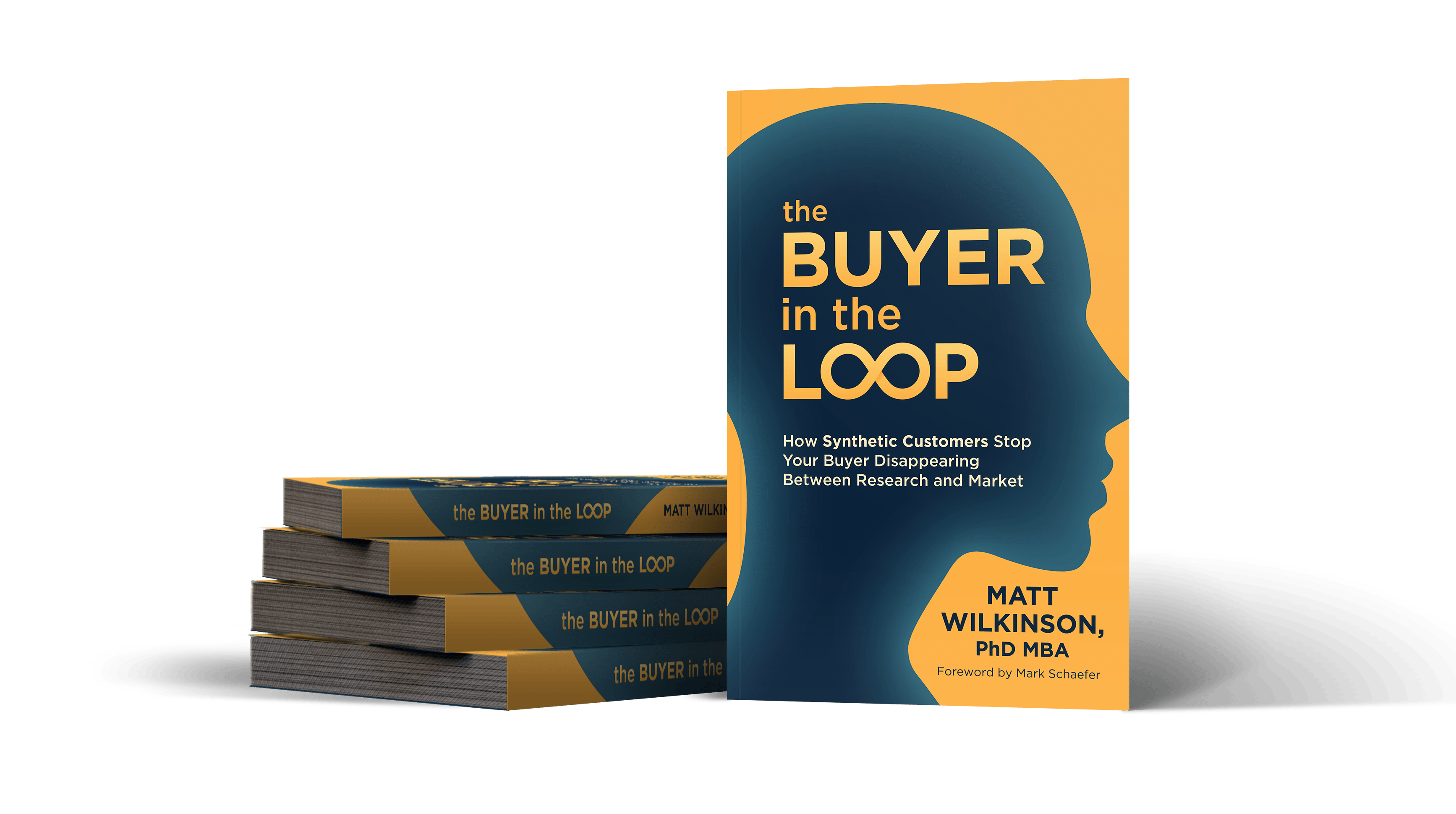
The Buyer in the Loop explores this in depth: how buyers disappear between the brief and the market, and how grounded synthetic customers keep their evidence in the room. Get your copy.