
I have followed Brooke B. Sellas since her run alongside Mark Schaefer on The Marketing Companion, and I have been reading her blogs ever since. So when Valentina Escobar-Gonzalez of Beyond Engagement introduced us and Brooke agreed to come on the podcast, I was, I admit, a little starstruck.
What I took from the conversation goes well beyond social media tactics. It changed how I think about listening programmes, because the real problem is not whether organisations are collecting customer conversation. It is what happens to that evidence once the organisation gets hold of it.
If you aren’t doing this already, imagine you are funding a listening programme. Someone on your team pulls a monthly summary. Sentiment is broadly positive, mentions are up slightly, two competitors got named. You scan it, note nothing surprising, and move on to the launch review. The report has done its job: it has reassured you that nothing has gone wrong.
That may be the least valuable thing your listening programme produces.
Your report confirms what you believed
Brooke put a name to the failure mode in our recent conversation on the Splice of Life Science Marketing podcast. She called it social listening light: teams run the reports, then gravitate toward the praise and quietly move the complaints to one side. The output is a document nobody argues with, which is exactly what makes it useless. Praise is easy to overvalue because it rarely forces a decision. More often, it tells you which of your existing beliefs you can currently provide proof for.
You already know this pattern from your own experience. Months of interviews produce a positioning brief, the brief passes through internal review cycles, and what emerges reads like something your leadership team could have written without leaving the building.
That is organisational gravity. And it operates on listening data exactly as it operates on a positioning deck: every summarisation step pulls the buyer’s language toward the room.
The listening programme may be collecting the buyer’s words, but the machine processing them is still the organisation.
Brooke’s correction is to start with the negative, because that is where the clearest catalysts for change tend to live.
- Does a conversation carry buying intent?
- Does it talk about customer friction?
This is the heart of the CARE Method (Conversation, Acquisition, Retention, and Engagement) she has been running with clients for fifteen years. Read it as a research design decision rather than a customer service workflow, and its value changes shape.
Negative-first has to be a rule in the analysis, not merely a preference. Leave it open to interpretation and your analysts will drift toward whatever they believe you want to see, which is the same instinct that diluted your last positioning brief.
Get the tagging right and the data starts doing more useful work.
Your competitor’s complaints are your brief
The bucket most teams underuse is the third in Brooke’s BIC framework: Brand, Industry, Competitor. This most obviously means listening to what people say about your competitors alongside what they say about your brand and category.
She described running this for a credit union and finding that a single product feature accounted for the overwhelming majority of negative conversation about the brand. They rebuilt it, went further than the competitors had, and watched the complaint volume collapse.
Now invert it. Point the same listening at your competitors and you are reading the objections their customers raise in public and never raise with you.
Those objections are a differentiation brief written in buyer language, traceable to a thread you can put in front of a sceptical CEO.
You are no longer arguing that buyers care about turnaround time. You are showing the sentences in which they said so about somebody else’s product.
The questions nobody sends you
Your content calendar is probably built from a keyword tool and a planning meeting. Both produce topics. Neither produces phrasing.
Listening gives you the questions buyers put to each other, in the words they actually use, usually asked that way because they would rather not ask a vendor. Which competitor’s kit fails on what. Whether the assay justifies the switching cost. What the training burden looks like in month three, once the applications scientist has stopped visiting.
Answer those, in their phrasing, and two things follow. The buyer recognises the question as theirs, which is most of the work in getting your content read at all. And the answer becomes the sort of specific, sourced material that AI search systems can discover and cite when somebody puts the same question to a model instead of a forum.
The cheaper evidence is already inside
The strongest argument against all of this is that public chatter in life science is thin, and you have better evidence sitting unused in your own building. Win/loss debriefs, recorded sales calls, technical support tickets. Often higher signal, and already being generated as part of the business.
That argument is largely right, and you should act on it first. Here is why it does not settle the question. Every one of those sources passes through someone with a stake in the outcome:
- The rep who lost the deal explains the loss.
- The support agent writes the ticket and wants to believe they helped find a resolution.
Public conversation has biases of its own. The value is that they are different biases from the ones inside your building. Nobody on your sales team authored the post, explained away the loss, or decided how the complaint should be summarised.
Run both. Treat the public stream as a control against which your internal accounts get checked.
Keep the source with the insight
Public conversation in a specialist technical market accumulates slowly, and thirty days of thin data will read as noise to anyone looking for a reason to cut the budget.
Keep the source with the insight. When medical, legal and regulatory review asks where a claim came from, an assertion you cannot trace is difficult to use. Provenance per insight is the difference between an evidence base and an opinion with a logo on it.
Then bring one thing to leadership. One friction point you found in public, the fix you made, and what happened next. A sentiment dashboard will not do the same job, because a single attributable cause and effect gives finance something to underwrite.
Organisational gravity gets the evidence too
Some teams take this a step further and build a buyer model from the data, a grounded synthetic customer they can use as a lens through which to view a draft.
If you go there, one rule governs everything: the data you feed it is the buyer you get. Feed it a sample filtered for praise and you have engineered agreement into the model.
I have argued before that a buyer model built on average internet data is worthless, because your competitor can easily build the same one. That position holds. What makes a model useful is specificity and provenance: a tagged corpus of what buyers in your category actually wrote, traceable to the source, used alongside rather than instead of primary interviews.
Notice what the three uses have in common: competitor objections, buyer questions, a grounded buyer model.
Each fails in the same place.
The evidence gets softened on its way through review because the people holding the most approval authority often sit furthest from the buyer.
Better listening does not fix that. It only gives you something to fight with.
The buyer your team hears
The monthly summary will keep arriving, and organisational gravity will keep pulling what buyers actually said toward what the organisation already believes.
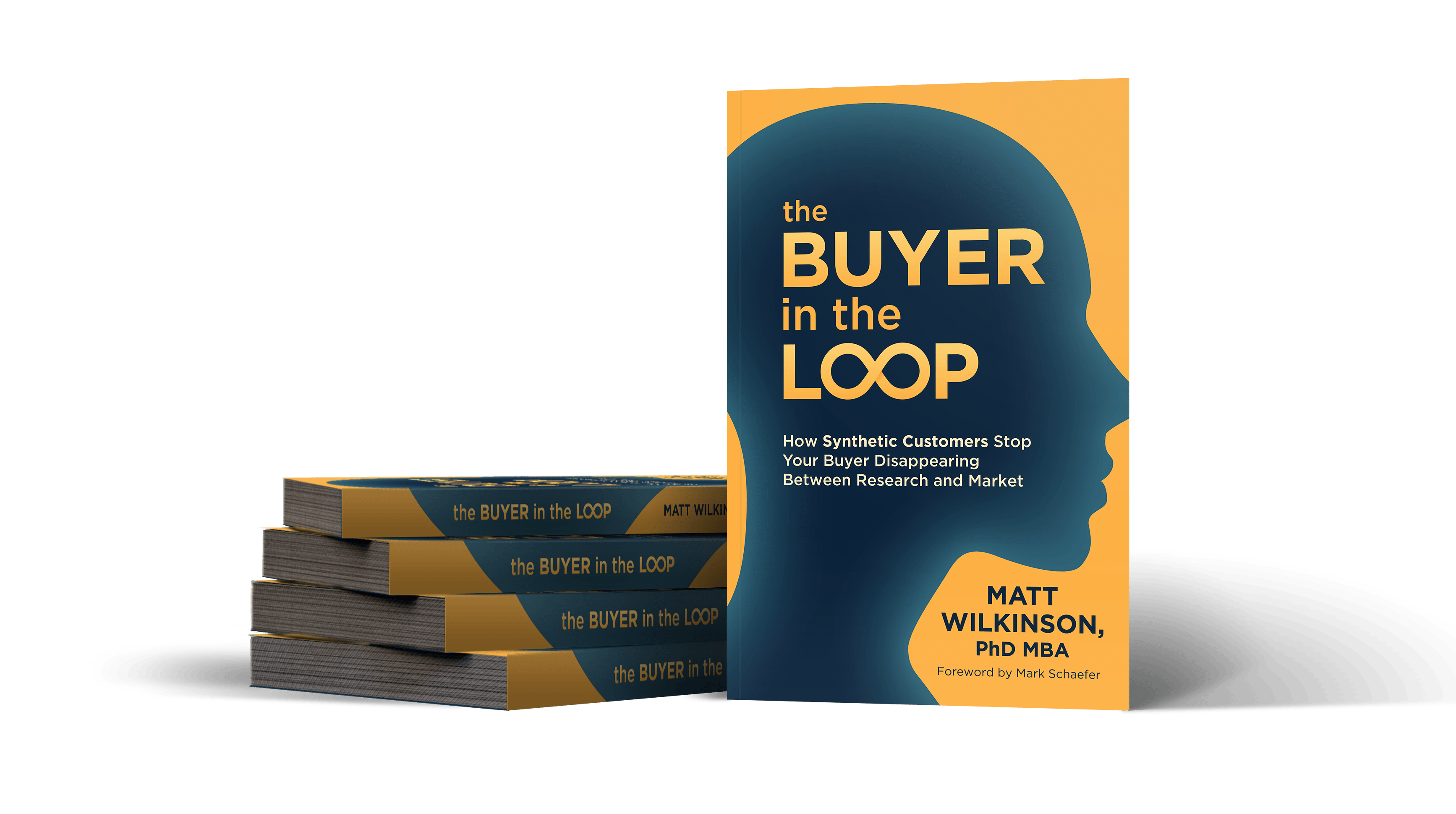
That is the problem behind The Buyer in the Loop: most commercial teams are rich in buyer data and poor in buyer presence. Listening gives you more evidence. The harder problem is keeping the buyer present while that evidence travels through the organisation.
Your listening streams are already collecting the sentences.
The only question left is whether anyone in your organisation is permitted to act on them.