
The final gate review panel gave the launch plan an emphatic approval. Every function lead signed off and was excited. Fast forward to eleven months later, and the pipeline review meeting opens with a slide explaining that the market was not ready for such an outstanding innovation.
Nobody in that room believes it. The data was sound and the product answered a real unmet, and very painful customer need. The reality is the messaging, benefits and feature list just didn't resonate with the customer.
The famous statistic is wrong
The widely quoted statistic is that 80 to 95 per cent of new products fail. When Castellion and Markham went looking for the study behind it in the Journal of Product Innovation Management, they found nothing underneath. Their paper describes the claim as an urban legend. The 3,000-ideas-to-one ratio from Stevens and Burley, wheeled out to support it, counts raw ideas, most of which were never meant to reach a market at all.
The defensible number is smaller and far more uncomfortable. Across 19 peer-reviewed studies covering more than a thousand business units in over ten industries, roughly 40 per cent of launched products fail commercially, in a range of 30 to 49 per cent. Healthcare and medical products sit at the better end of that range, near 35 per cent.
Read the sentence again with the word "launched" doing its work. These products cleared every gate. They were chosen, funded, resourced and taken to market. Attrition in the idea funnel explains none of this. Two in five of the ones you picked still fail.
Failure rate is a process variable
The benchmarking underneath that 40 per cent figure splits companies into the best performers and the rest. The best fail at 24 per cent. The rest fail at 46 per cent. Same sectors, same buyers, same market conditions, nearly double the failure rate.
Which means the number is something an organisation sets rather than something it suffers.
The separator is not effort or budget. It is who the product was defined for, and how precisely that was done. The customer often never gets pinned down, so the ordering scientist, the lab head and the budget holder all get addressed as one person. Workflow friction gets underestimated. Evidence gets generated to satisfy reviewers rather than to move a purchase decision. None of these are scientific failures. All of them are commercial, and all of them are settled long before anyone sets a launch date.
You already ran the research
Here is what makes the 40 per cent figure worse still. Most teams that fail did the customer work. The interviews happened. The transcripts are in a folder on a shared drive. Somebody wrote a good synthesis deck in year one of a four-year programme.
Then the brief moved through approvals, and each cycle pulled the message a little closer to the room it was written in and a little further from the buyer it was written for. That is organisational gravity doing exactly what it does. The people with the most approval authority are usually the furthest from the buyer, so the copy gets adjusted for their comfort rather than for buyer relevance. No single edit is wrong. The accumulation is fatal.
The gap is rarely a data gap. It is a translation gap between research that exists and research that is present in the room when a decision gets made.
What the evidence actually supports
This is where synthetic customer simulations have started to earn serious attention, and where most of the writing about them stops being careful.
The strongest published work comes from a Stanford-led team. Researchers built simulated participants from two-hour interviews with 1,052 people, then tested them against the participants' own survey answers. Participants built from interviews reproduced responses at 83 per cent of the consistency the humans themselves managed two weeks later. From structured surveys, 82 per cent. From both sources combined, 86 per cent. The same architecture carried less bias across racial and ideological groups than versions given only a demographic description.
Grounding is the variable that moves the result.
Now the counterweight. Nik Samoylov, founder of Conjointly, ran one demographic profile through a model several times with slightly different prompt wording. Mean household income came back anywhere between USD 111,348 and USD 272,014 depending on the phrasing. Where a synthetic customer has nothing solid underneath it, you are not measuring a buyer. You are measuring your own prompt.
Which is why the discipline is a sequence. Synthetic for directional. Human for decisional. Use a grounded synthetic customer to pressure-test thinking at the speed of a question, then validate with real buyers before you commit budget, clear a gate or brief a field force.
Where it belongs in the gate
The applications with the best support are the structured ones. Concept screening and ranking. Message and claim pressure-testing before the brief goes to creative. Objection rehearsal, run against the objections that actually killed your last five deals. Segment hypotheses to sharpen before you pay for primary research.
A useful starting exercise: take those five lost deals, name the objection that killed each one, and put the same objections to your grounded synthetic customer. Where it answers in language your buyers have never used, you have found the grounding gap. Better to find it before the brief is approved than after the launch report reaches the board.
One limit belongs in the same breath as the applications. A grounded synthetic customer has no place in claims substantiation or promotional review. That evidence comes from humans and instruments, and any deliverable heading into a regulated process should disclose which parts of it were synthetic.
The profession is circling this, correctly
The strongest case against everything above is being made by people who know research better than most vendors do.
The Market Research Society published a Delphi report citing Stanford work that found hallucination rates between 69 and 88 per cent on specific legal queries, and documenting a group flattening effect where models homogenise the experiences and identities of diverse groups, erasing exactly the subgroup detail a commercial team needs. Conjointly went further and called synthetic respondents the homoeopathy of market research.
Every one of those criticisms lands on an ungrounded synthetic customer: a general-purpose language model asked to imagine a buyer type from average internet data. They are right about those, and the honest response is to agree.
The argument holds anyway, because the criticism targets substitution and the method here is sequencing. A grounded synthetic customer built from your interview transcripts, your win-loss calls and your survey data answers from evidence you commissioned. It extends the reach of research you have already paid for into the hundred small decisions that never justify a new study. It does not close the loop by itself, and any vendor telling you otherwise is selling you something that will fail the professional review that is coming.
Back to the gate
Return to that gate review. Every function signed, and each one was describing a slightly different buyer, which is why the sign-off felt so smooth.
The 24 per cent firms and the 46 per cent firms are not separated by better science. They are separated by whether a buyer was present when the decision got made, or represented by three people's memory of a deck. That is a structural problem, and structural problems respond to design rather than to effort.
Two in five launched products fail. Your gates will keep saying yes. The question is who is in the room when they do.
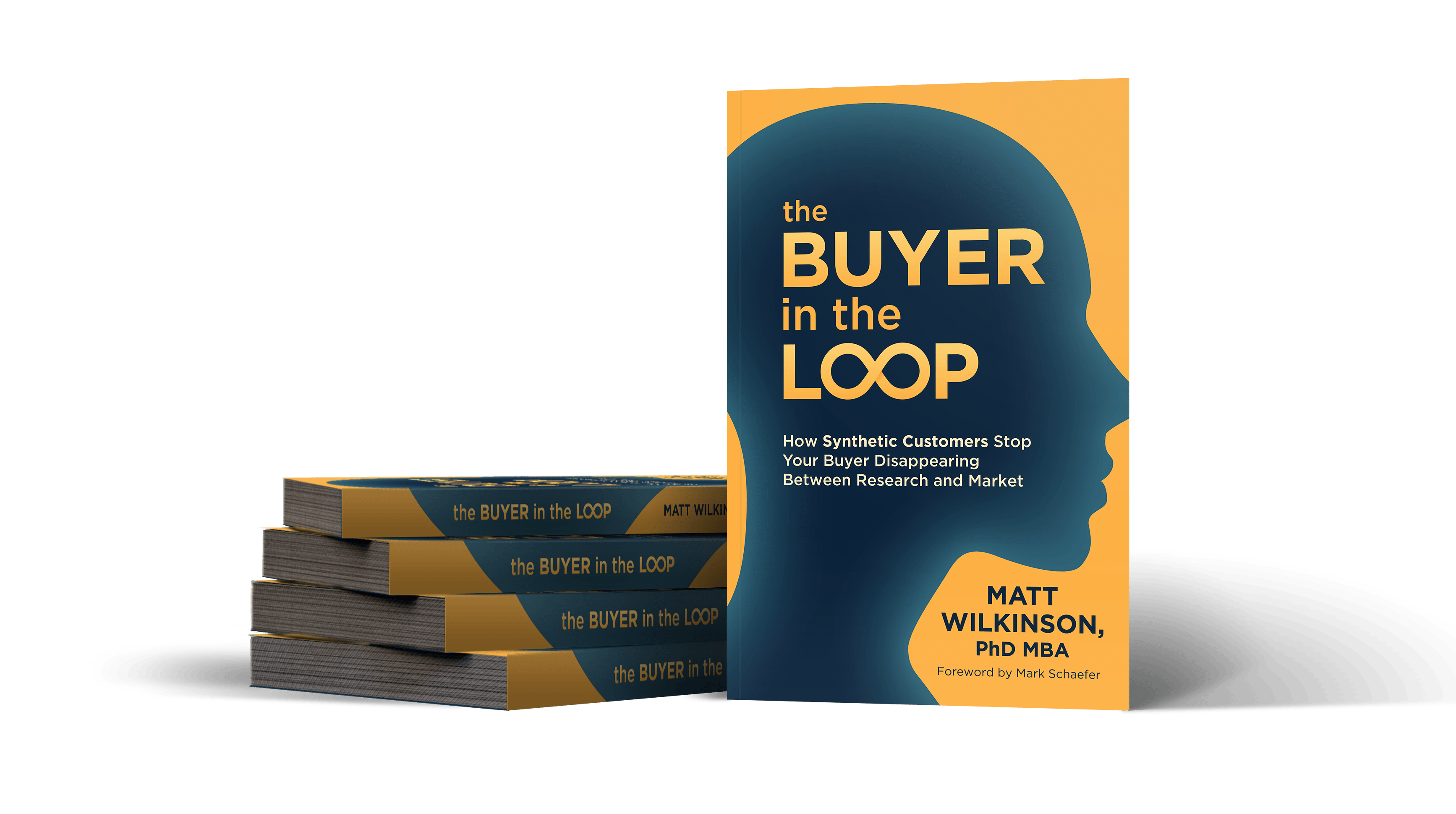
The Buyer in the Loop is out now. It is about the force that pulls every commercial message away from the buyer, and what it takes to escape it.