

Two procurement managers sit on your account list this quarter. One signs off purchases at an academic medical centre. The other runs supplier consolidation at a mid-cap biotech. Your CRM tags them both as "procurement." Your content library has a section called "for procurement professionals." Your sales team walks into both calls with the same deck.
Neither call goes anywhere.
You assume the deck needs work, but the deck is fine. The problem sits with an assumption you didn't realise you had made. You have flattened two genuinely different buying contexts into a single persona label, and your whole commercial motion is now calibrated for a buyer who does not exist.
This is what happens when segments, ideal customer profiles (ICPs), and personas get treated as a hierarchy when they are actually three independent axes.
Why the hierarchy fails
Most B2B segmentation training presents the three concepts as a tree. Segments contain ICPs. ICPs contain personas. It feels orderly. It has three levels, which sounds rigorous.
It does not hold up.
Segments, ICPs, and personas are three independent axes. Each varies without reference to the others, and the buying context that drives a real purchase decision sits at the intersection of all three. That intersection is a cell in a three-dimensional matrix. A hierarchy view cannot see that cell.
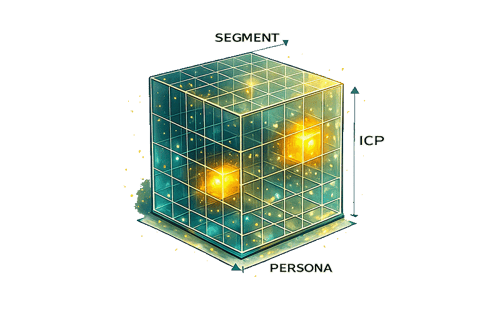
The hierarchy view produces predictable failures. Marketing builds content for "the pharma buyer" or "the procurement persona" as if either were a single addressable audience. Sales gets handed enablement assets that work in academia but die in biotech, or land with a bench scientist and fall apart in front of a procurement lead. The flattening happens upstream. Everyone downstream pays for it.
The three axes
Segment is the market context the buyer operates in. Academia, pharma, biotech, government, clinical, applied. Segments vary by procurement environment, regulatory pressure, funding model, and time horizon. A pharma buyer and an academic buyer face fundamentally different conditions before any persona or organisation specifics come into play.
ICP is the organisation archetype. Inside academia: tier-one research university, academic medical centre, government lab. Inside pharma: large pharma R and D, mid-cap biotech, early-stage biotech, CRO. ICPs vary by annual spend, governance model, sourcing maturity, regulatory exposure. ICPs are sales filters. They answer which organisations are worth pursuing.
Persona is the individual buyer inside the organisation. Researcher, lab manager, procurement professional, scientific operations leader. Personas vary by role anxiety, decision authority, and the evidence diet they trust. Personas are content and enablement filters. They answer what an individual needs in front of them to advocate for you internally.
Each axis varies independently. Each cell in the resulting cube is its own addressable buying context with its own decision logic.
Two procurement managers, two jobs
Back to the opening. The academic procurement manager is solving for 2 CFR 200 compliance, faculty-driven specification choices, and Fisher rebate structures. Their day involves reconciling federally-funded grant rules with what faculty want to buy. They have less authority over specification than most people assume. They cannot switch a reagent if a PI has written the original product into a protocol.
The biotech procurement manager is solving for Master Supply Agreements, supplier consolidation, lot traceability requirements, and CFO-level defensibility under audit. Their day involves consolidating spend, tightening supplier risk, and producing the paper trail their compliance function will demand when BIOSECURE provisions hit. They have significant specification authority, often more than their colleagues realise.
Same persona axis. Different segment. Different ICP. Different decision logic. Different content needs. Different sales conversation.
If your library only has one piece of "procurement content," it is doing one of two things: failing both buyers, or accidentally working for one and confusing the other. If your sales team carries a single procurement objection-handling playbook, half their calls are running a script the buyer would never agree to.
Which axes earn the work
The matrix is a diagnostic tool, not a content production target. The temptation, once you accept the three-axis view, is to fill every cell. Three axes with five values each gives you 125 cells. You will not produce 125 things. You should not try.
The discipline is to ask, axis by axis: does varying this dimension materially change the buyer's decision criteria? If yes, the axis is live and your content has to vary along it. If no, the axis collapses.
In life science reagent procurement, BIOSECURE provisions, lot traceability, and audit requirements matter to pharma in a way they do not to most academic labs.
A bench scientist reads different evidence than a procurement professional, and they read it in different places.
But the ICP within each segment collapses. The buying behaviour of a tier-one R1 and a tier-two R1 is more similar than different. A mid-cap biotech and a well-funded early-stage biotech often behave like a single archetype.
The result is rarely a 5x5x5 matrix. It is closer to 3x3x3. Sometimes smaller. The collapse is where most segmentation work should concentrate, because it tells you where to invest content and sales effort, and where you are over-engineering.
What the matrix avoids
The matrix is not an excuse to spec out a content factory. Most cells share enough decision logic with a neighbouring cell that one well-scoped piece can do the work of three. The reader is right to suspect that segmentation frameworks have produced more whiteboards than revenue over the years.
The matrix earns its keep because it forces the collapse question. Without it, marketers default to one of two failures: treating an axis as a single audience because they only see one dimension, or producing bespoke content for every micro-segment because they have no framework to decide which dimensions to collapse. The discipline sits between those two failure modes.
Run this on your library
Four questions. Answer them honestly about your current content and sales enablement.
First, can you name a buyer context, a specific segment-ICP-persona cell, that your current content does not address well, and explain why? If you cannot name one, you have not looked closely enough.
Second, if you write a piece for a single axis (say, "for procurement professionals"), does it work across all your segments? If yes, your segments are probably not driving real decision differences and one of your axes is dead. If no, you have a multi-axis problem you are currently treating as a single-axis problem.
Third, where in your library do you have pieces that try to serve too many cells at once? These dilute. They are the assets that everyone in sales says are "fine" but nobody actually sends to a buyer. Audit them.
Fourth, where do you have pieces that serve a single cell when they should serve a collapse of three or four neighbouring cells? These are over-engineered. They burned production budget that could have gone elsewhere.
Both failure modes are common in mature content libraries. Both are invisible without the matrix. Run the questions on your top ten assets. You will find at least one of each.
Why this matters now
AI-assisted content production has made it cheap to fill in cells. You can spin up 60 variants of an asset for 60 cells in a fraction of the time it used to take to write one. This is where production economics flip.
The temptation is to fill the matrix because you can. The discipline is to fill the cells that genuinely earn the investment and collapse the rest. Production has become cheap. The judgement about which cells to produce for has become the entire job.
Your buyer segmentation was two-dimensional because you did not have a third axis to organise it around. You have one now. Two procurement managers sit on your account list this quarter. The matrix gives marketing and sales a way to act on the difference, instead of pretending it isn't there.