
On 12 November, shares in NVIDIA, until recently the world’s most valuable listed company, fell as much as 14.3% after Jensen Huang resigned as chief executive, rattling AI stocks around the world. NVIDIA closed 4.3% lower that day, and CFO Colette Kress took over as interim CEO. By 17 November, CNN estimated that NVIDIA had lost $751bn in market value since Huang’s earlier disclosure.
On the 17 November earnings call, board Chair Harvey Jones told investors the board did not intend to reinstate Huang. On 23 November, NVIDIA announced his return. Reuters reported that NVIDIA shares rose about 33% in early trading, amid a broader tech rally.
This was no routine succession. The board had opened an independent investigation after reports about Huang’s conduct and concerns about national security. Reuters reported that President Donald Trump pressed for his return. Three House committees announced that Huang is due to give a transcribed interview on 1 December.
Eleven days between announcements. Long enough to ask what happens when the person most closely associated with a company’s promises stops making them.
When five years are on the line
Imagine you’re leading a drug discovery programme built around a supplier’s technology. You’ve committed people and budget for years. Then the chief executive who helped launch the partnership leaves. Who can tell you what’s still on the roadmap, and who has the authority to keep it there?
NVIDIA’s GPUs sit underneath the work of your partners and customers. NVIDIA and Illumina announced plans to offer DRAGEN secondary analysis on NVIDIA computing. Eli Lilly and NVIDIA plan to invest up to $1bn jointly over five years in a co-innovation lab. NVIDIA has also described its work with Thermo Fisher on autonomous lab infrastructure. At January’s J.P. Morgan Healthcare Conference, Huang sat down with Lilly chief executive Dave Ricks to discuss the lab. He was a visible face of that commitment.
When GEN asked NVIDIA’s life science partners about the turmoil on 15 November, most declined to comment. 10x Genomics chief executive Serge Saxonov answered.
“It’s not just one person who made it so.”
Serge Saxonov, CEO, 10x Genomics
Your own customers have made the same kind of commitment to you.
Trust sat with one man
Huang’s exit showed how closely NVIDIA’s public story was tied to its founder. The share-price swings caught investors’ attention, but the broader market was moving too. Neither the headlines nor the trading tell us whether customers relied on the personal relationship with Huang. That’s a separate question, and if you are looking at your own organisation it’s a question marketing can help answer by finding out who customers already turn to when a decision matters.
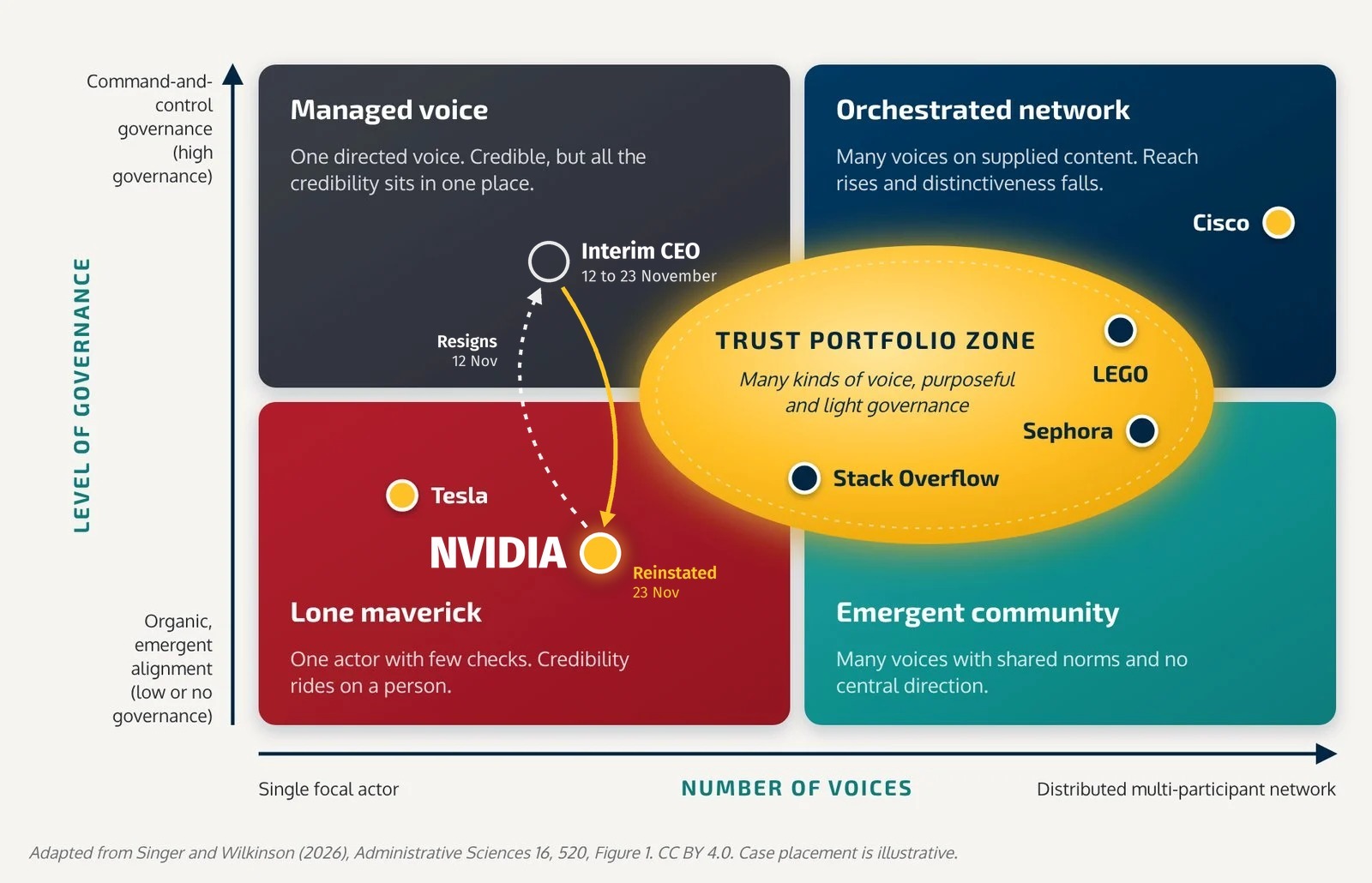
In the paper Dr Mara Singer and I published in Administrative Sciences we define a trust portfolio as the configuration of credible human voices around a brand. Those voices include employees, technical experts, customers, independent creators and community members, and each is believed for different reasons and on different questions. A portfolio spreads trust. A single voice concentrates it.
The graphic maps two things: how many voices carry trust and how tightly the company directs them. At one end, a single prominent voice carries the load. In a trust portfolio, different people have earned trust on different questions. Adding more spokespeople won’t help much if they all give the same answer. For investors, NVIDIA looked like a lone maverick: one voice carried most of the weight.
Huang was a prominent public voice. Kress, NVIDIA’s long-serving finance chief, could explain the company’s plans to investors. The more useful question for a life science partner is who has earned the right to speak about its specific programme.
Buyers ask two kinds of questions
Evidence answers the first kind. Does BioNeMo do what the benchmarks say? Will our pipeline run on CUDA? Those are questions you can put to a technical expert and test for yourself. NVIDIA still had people who could answer them: while Huang was out, its VP of Hyperscale and HPC, Ian Buck, introduced Nemotron for Science at SC26.
The second kind needs someone accountable for the answer. Who sponsors our programme now? If the roadmap changes, who has the authority to stand behind our five-year commitments?
On the earnings call, Kress reaffirmed NVIDIA’s multi-year roadmap and customer commitments. A life science partner would still want to know who could make decisions about its own programme.
In our trust portfolio paper we call this role-question fit. Buck could explain the tools. Kress could speak to the company’s roadmap. For a question about a particular partnership, the person people believe is the one who can make the commitment and be held to it.
Investors and customers carry different risks
If investors put that much weight on Huang’s return, why spread trust around?
An investor can sell in a morning. A pharma team that has built a programme around a supplier’s tools and engineers can’t unwind that decision so quickly. Customers need to know who will take responsibility for the partnership if an internal sponsor leaves.
Before your CEO asks
Take these four questions into your next leadership meeting:
- Which customer questions does only one person in our company answer today?
- Who else could answer each one, and do our customers already know their name?
- Which answers can we back up with evidence, and which commitments need a named person to stand behind them?
- Which voices outside our company do customers already believe about us, and on which questions?
If your company also builds on an AI supplier, ask them the mirror questions: who is our named executive sponsor, and which roadmap commitments are in the contract?
NVIDIA got its founder back after 11 days. If the person who usually makes your most important promises left tomorrow, whose word would your customers take?
Explore the trust portfolio framework
Free to read. Read Trust Portfolios in Online Brand Communities, the peer-reviewed paper Dr Mara Singer and I published in Administrative Sciences.
I’ve also written about how to tell whether your trust portfolio is too concentrated. Dr Mara Singer and I discussed the framework with Dr Jasmine Gruia-Gray on A Splice of Life Science Marketing.
Find the questions first
Every exercise in this piece starts with knowing which questions your customers will ask before they commit. Grounded synthetic customers, built from real buyer evidence, can surface those questions early and help you pressure-test who in your company can answer them. Answering them still takes a person your customers believe. Synthetic for directional, human for decisional. That balance is the subject of The Buyer in the Loop.